


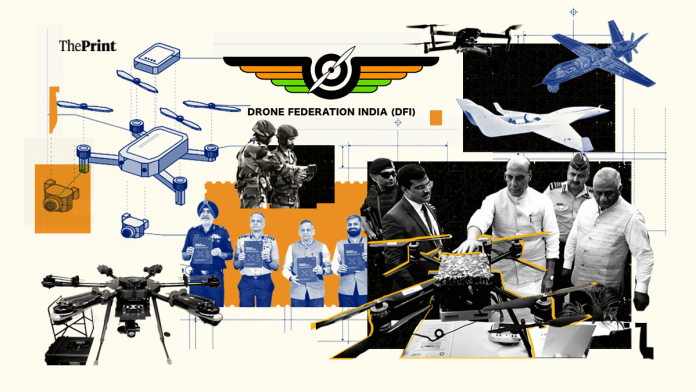
New Delhi: As many as 689 tenders floated on the Government e-Marketplace (GeM) by the military, security forces and others over nearly six years were found to specify Chinese drones and drone components, 355 of them this year alone, the Drone Federation India (DFI) has told defence officials.
The Army alone accounted for 580 (84 percent) of the tenders over the full period and 328 (92 percent) of those put up in 2026.
The Border Security Force (BSF) follows with 12 tenders (1.7 percent) over the full period. The Armed Forces Tribunal, the Controller General of Defence Accounts and the Centre for Development of Advanced Computing (C-DAC) have issued seven each (1 percent each).
The Jammu and Kashmir Police, the Directorate of Public Relations and the Directorate General of Defence Estates have five each (0.7 percent each). The remaining 61 tenders (8.9 percent) come from 44 other organisations.
Notably, GeM tenders specifying Chinese drones or drone parts nearly doubled from 190 in 2025 to 355 in 2026 up to 19 November, according to the DFI’s findings.
The DFI’s representation, dated 20 November, to the officials is based on its findings on tenders published between 10 March 2021 and 19 November 2026. The DFI says it had received reports of Army units procuring Chinese drone components, as well as knocked-down kits made up of Chinese components.
The DFI then studied publicly available bid documents on GeM and found that bids for Army procurement specify products of Chinese-linked brands, including EMAX, RunCam, SpeedyBee, RadioMaster, T-Motor, GEPRC and HGLRC. The items include motors, flight controllers, electronic speed controller (ESC) stacks, receivers, cameras and video transmission equipment, it adds.
“These are not peripheral accessories. They govern a drone’s flight, control and data transmission,” the DFI has cautioned.
The DFI is a non-government, not-for-profit industry body representing the domestic drone and counter-drone systems industry.
ThePrint reached out to the Army by email for comment. This report will be updated as and when a response is received.
“Most of the Army’s drone-related tenders from the past year or two are for drone parts, since it has recently begun assembling its own drones,” an industry source told ThePrint.
While acknowledging the Army’s role in enabling the government’s push to indigenise drones and drone components, including through initiatives such as the AASHVAST laboratory, the DFI found that 104 of the 328 flagged Army tenders from this year were raised after the laboratory was inaugurated 14 August.
An Army cybersecurity and firmware validation facility, the AASHVAST laboratory screens drones for Chinese-origin components, concealed code and remote-access mechanisms before being cleared for use.
According to the DFI’s findings, GeM tenders specifying Chinese drones or drone parts were few in the early years: six in 2021 (from 10 March), 36 in 2022, 60 in 2023 and 42 in 2024.
The sharp rise came after that. They grew 352 percent to 190 in 2025 and a further 87 percent to 355 in 2026, up to 19 November. The Army’s tenders followed the same pattern, rising from two in 2021 to 31 in 2024, then growing 419 percent to 161 in 2025 and 104 percent to 328 in 2026.
The DFI’s submission, which also seeks a meeting with officials, says the use of Chinese drones or components raises “serious security and industry concerns”.
When a bid specifically names such components, it argues, these risks enter at the tender stage itself, and it lists three risks.
First, components that units procure for their own internal use may escape further security screening, leaving units exposed to cyber vulnerabilities in flight control, communication and data. Second, with China’s export licensing of drone motors, ESCs, autopilots and radios in force from 18 November, supplies could be disrupted when they are most needed.
Third, if the user does not buy Indian components itself, the domestic component industry will not grow, and Indian manufacturers’ investments in indigenous design and secure supply chains will be undermined.
Noting that the domestic drone components ecosystem is still in its early phase, the DFI said, “It can mature only with assured demand from Indian users, and the armed forces are its most important user.”
The DFI has suggested that the authorities issue an advisory to all military formations, units and establishments to exclude Chinese components from drones and drone parts procured for internal use, including through GeM.
It has also called for reasonable preference to be given to Indian components, particularly critical parts such as flight controllers, receivers and data links, video transmitters, global navigation satellite system modules, cameras, motors, ESCs, and batteries.
Another suggestion is that a country-of-origin declaration, along with traceability at the component level, be made mandatory in all future bids related to drones, so that security is built into the specification and not left to checks after procurement.
Offering to help identify Indian alternatives at short notice, the DFI suggested that its Bharat Drone Stack Platform could be used to find Indian sources for these components. Launched in August 2025, the Bharat Drone Stack initiative lists more than 200 Indian component makers and aims to bridge the gap between them and drone integrators.
According to the DFI, the initiative targets 90 percent indigenisation in drone components by 2030, a Rs 15,000-crore domestic component market, a 75 percent cut in imports, as well as generating more than 5,000 new jobs and roping in over 500 Indian suppliers.
(Edited by Tony Rai)
Also Read: India’s defence atmanirbharta needs a dose of realism—and a lot more drones