





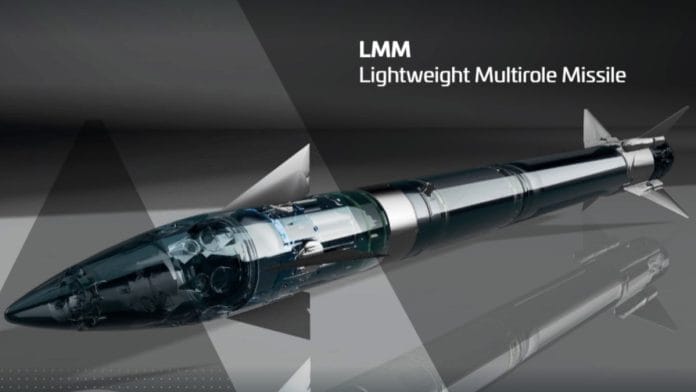

New Delhi: India and the United Kingdom are close to signing an Inter-Governmental Agreement (IGA) for the procurement of British Lightweight Multirole Missiles (LMMs) for the Indian Army’s tactical units.
While the two countries had, in October last year, announced the signing of an MoU for a £350 million ($468 million) government-to-government deal for the missile—also known as the Martlet, named after a mythical bird that never roosts—British officials said the numbers have gone up significantly since then. The announcement had come during Prime Minister Narendra Modi’s visit to the UK last year.
As the name suggests, the missile, manufactured by Thales UK, can be fired by an infantry soldier, or integrated with an armoured vehicle, helicopter and naval ships.
The British Army has integrated the missile with its helicopter units and some naval platforms. It is designed for an urban environment, and Thales manufactures it at its Northern Ireland facility.
For the Army, it can take out threats ranging from light armoured, wheeled and tracked vehicles, to aerial platforms within a distance of 6 km.
LMM, which is based on laser beam guidance, is available on shoulder launch, tripod and vehicle configuration. Weighing a mere 13 kg, the missile has a velocity of 1.5 Mach, and has been in service with British military since 2019. It has also been deployed by Ukrainian forces in the ongoing war against Russia.
The Martlet is relatively small and inexpensive, compared to many conventional air-defence interceptors, which makes it attractive for dealing with proliferation of Shahed-type one-way attack drones and other UAVs, where using expensive long-range missiles against every target creates an unfavourable cost equation.
The UK itself has increasingly shifted its Martlet procurement towards the counter-Unmanned Aerial Systems (C-UAS) mission. In June this year, it placed another £36 million order for LMMs, specifically highlighting their use against aerial threats.
British officials did not get into specific numbers, but said that the Indian order will run into several hundreds—the number having gone up significantly, compared to October.
They added that an IGA is expected to be signed soon, and with that India will become the second largest customer of the missile after Ukraine.
In 2025, the UK had announced a £1.6 billion deal of more than 5,000 LMMs for Ukraine. Ukraine’s Defence Ministry had subsequently said the arrangement would provide 5,350 LMMs, along with RapidRanger launchers over five years.
Another 1,000 missiles were added in this year, taking the publicly announced UK commitment beyond the 6,000-mark.
The UK and India had, in February 2025, agreed to expand collaboration on next-generation weapons with Thales and Bharat Dynamics Limited (BDL) signing a contract to deliver Laser Beam Riding MANPADs (LBRM), with an initial supply of High Velocity Missiles (STARStreak) and launchers delivered last year.
(Edited by Mannat Chugh)
Also Read: Modi govt opens up conventional missile production to private players. Astra & Pralay up for grabs