







New Delhi: Hyderabad-based Zen Technologies Monday unveiled India’s first modular, AI-powered counter-drone system, marking a significant milestone in the country’s push for defence self-reliance.
In a release, the company said the system is fully indigenously designed and developed, which helps create sovereign intellectual property in critical battlefield technologies. It has a dedicated R&D and production facility in Hyderabad to address the evolving threat landscape.
The company claims the system offers a wider frequency range to disrupt diverse drone communication channels, detects targets up to 15 km away, and can track more than 100 drones simultaneously.
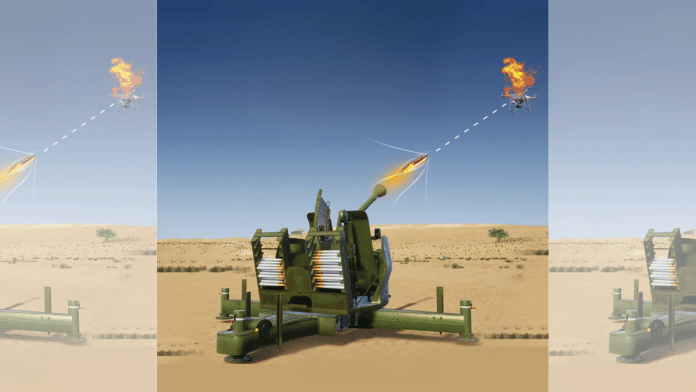
The system features a layered architecture to neutralise incoming drones, comprising RF (radio frequency) jamming, air defence guns, kamikaze interceptors and other counter-drone measures. It also has an indigenously developed radar with a 20 km range, along with a data fusion and command centre for precise threat classification, tracking and response.
Ashok Atluri, chairman and managing director of Zen Technologies, said at the launch: “Operation Sindoor exposed a hard truth: drone warfare is redefining the battlefield, and nations that fail to adapt will remain vulnerable. While the world is focused on building drones, the real advantage will belong to those that can make them irrelevant. At Zen Technologies, we have built exactly that advantage.”
“As a leading anti-drone solutions provider, Zen Technologies is uniquely positioned to design, develop and deliver world-class systems at scale, and we will continue to invest aggressively in shaping the future of anti-drone warfare technology,” he added.
The platform can be deployed in three key configurations: vehicle-mounted, for rapid deployment on dynamic battlefields; man-portable, for neutralisation during patrols and counter-insurgency operations; and stationary, for the protection of critical infrastructure and continuous 24/7 defence coverage.
Recent conflicts in West Asia and Eastern Europe have shown how low-cost first-person view (FPV) drone systems are emerging as force multipliers, capable of bypassing traditional air defence systems.
(Edited by Shashank Kishan)
Also Read: The Op Sindoor lessons—not just how to fight wars, but also how not to