





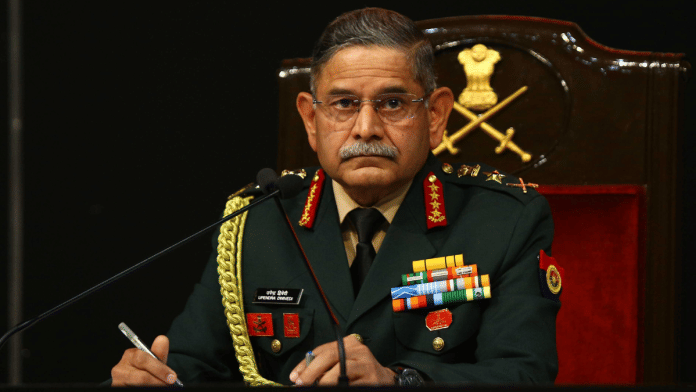



New Delhi: Dialling down tensions at the Line of Actual Control (LAC) in Eastern Ladakh, India and China have carried out “troop readjustment” as part of the plans to keep the border stable, and gradually increase the trust factor, Army Chief General Upendra Dwivedi said Tuesday.
He underlined that the situation along the northern front remains stable, but needs constant vigil.
“Apex-level interactions, renewed contact, and confidence-building measures are contributing to the gradual normalisation of the situation. This has also enabled grazing, hydrotherapy camps, and other activities along the northern borders,” he said at his annual press conference in the national capital.
The Army Chief added, “With our continued strategic orientation on this front, our deployment along the LAC remains balanced and robust. Concurrently, capability development and infrastructure enhancement are progressing through a whole-of-government approach.”
He underlined that the LAC needs constant vigil, but both sides are “slowly trying to increase the trust factor”.
Also Read: China detains and harasses an Indian citizen. New Delhi must do more than issue a démarche
The disengagement
In October 2024, India and China had agreed to disengage from the last of the remaining friction points—Depsang and Demchok—and resume patrolling under a renewed arrangement.
Since then, the Special Representatives of India and China—National Security Advisor Ajit Doval and China’s Foreign Minister Wang Yi—have met twice and agreed to work towards demarcating the boundary.
Doval is expected to travel to China soon for his next round of talks.
“You know what kind of understanding we reached on October 21, 2024. Before that, the two top leaders (Prime Minister Narendra Modi and Chinese President Xi Jinping) met in Kazan. After that, they met in Tianjin, and in between, we had our SR-level meetings. Similarly, we have had our WMCC (Working Mechanism for Consultation and Coordination) meetings, and in addition to all this, our defence minister has met with their defence minister twice.
“Our foreign minister has met with their foreign minister twice. As a result, what is happening is that there is a kind of sense of urgency and a sense of acceptance from both sides to keep the borders as calm and quiet as possible,” the Army chief said.
Explaining further, he said that multiple levels of talks are taking place on a daily basis, depending on the need to ensure that any minor issue or misunderstanding does not snowball into something new.
Replying to a separate question on reallocation of troops, the Army chief said that deployment is based on the TSR factor: Time, Space and Resources.
“So we always work on that, and based on that this readjustment has been carried out to make sure that we should be able to timely apply the forces as per the operational requirement,” he said.
‘No troop reduction’
Asked if India and China have pulled back some of the troops from Eastern Ladakh as part of the normalisation process, sources in the defence and security establishment told ThePrint that nothing of this sort has happened.
“No, there has not been any troop reduction by either side. What the chief alluded was to the fact that certain adjustments have been done to the deployment pattern,” a source explained.
Asked if this meant that the troops of the two nations are not deployed in close proximity at forward locations, the sources explained that “it will not be right to write so”.
They explained that both sides remain operationally deployed but at different distances.
“Eastern Ladakh is all about terrain and infrastructure. China would obviously want both sides to, let us say, pull back by 200 kilometres because they have plains on their side and better infrastructure which will enable them to come back to the same location very fast. If we have to move back the same distance, we would be out of Ladakh,” a source explained.
The sources said that the same number of troops remain deployed as before but at certain distances from earlier, and with the capability to reach back the original point at the same speed as the Chinese.
The sources also said that the both sides have carried out disengagement but the process of de-escalation is still under discussion and has not been agreed upon.
De-escalation will involve pulling back troops to pre-May 2020 status.
(Edited by Ajeet Tiwari)
Also Read: India warns citizens to ‘exercise due discretion’ while travelling to or through China