







Nobody tells you that preparing for your board exams might not be enough. Not because you didn’t study hard enough, or because the paper was difficult, but because the system you were preparing for wasn’t ready for you.
I am a Grade 12 CBSE student in Kuwait. Next year, I will sit my board examinations. That sentence used to feel straightforward. It no longer does.
This year, CBSE cancelled Class 12 board examinations across Gulf countries due to the regional conflict. Results were calculated instead from internal school assessments: pre-boards, quarterly exams, and half-yearly papers. Assessments never designed to be a student’s final word.
Nobody is saying CBSE was wrong to make that call. There was no good option. But someone still paid the price for that impossibility, and it was the students, many of whom would have performed significantly better in the actual board exam and had no way to show that. Their futures were shaped not by their ability, but by circumstances entirely outside their control.
I watched this happen to students I know. And I am next in line.
So I study differently now. Every school test carries a weight it didn’t used to; not because I’m ambitious, but because I genuinely don’t know what might happen between now and next February. That is not a healthy relationship with learning. But that is the reality of being a CBSE student right now, preparing for boards while uncertainty sits in the background.
And yet, even for students whose exams were conducted, students in India who actually appeared for their boards, the system found another way to fail them. Except this time, it wasn’t circumstance. This time it was a decision.
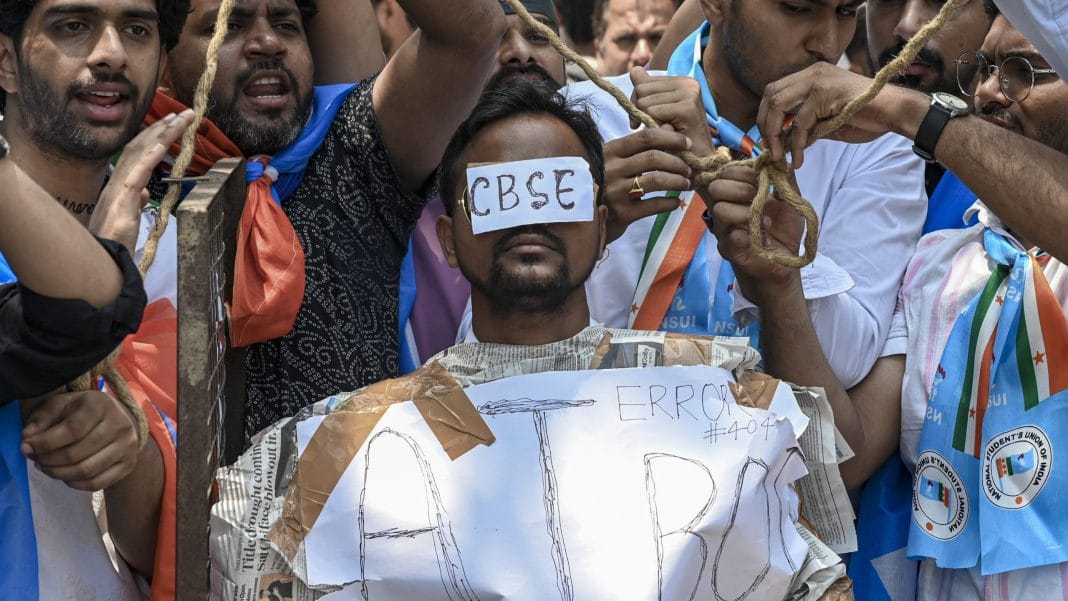
CBSE introduced On-Screen Marking (OSM) for Class 12 evaluations at the national scale this year for the first time. The contract was awarded to the lowest bidder just 66 days before a full nationwide rollout. Teachers who participated in pre-rollout exercises said the system needed at least another year of preparation. Those warnings were ignored.
When the results were declared, students received answer sheets that weren’t theirs. Scans were blurred. Pages went missing. Students who had scored above the 95th percentile in competitive examinations received unexpectedly low marks in their board subjects. The revaluation portal was hacked. And then schools reportedly asked principals to record videos defending OSM on social media, with students alleging they were pressured to participate while still processing the distress of their own results.
A parliamentary panel has since summoned CBSE officials to answer for what happened.
Two groups of students. Two completely different failures. One was an act of circumstance nobody could prevent. The other was rushed, warned against, and rolled out anyway. But the students who bore the consequences of both had absolutely no say in either.
This is what it actually feels like to be a student right now—preparing as hard as you possibly can for something that keeps shifting beneath you, and then being treated as the source of risk in a system whose actual failures happen far above you. Students are frisked at exam centres, pockets checked, treated as a threat, while answer sheets get mixed up in a portal that was never properly tested.
Our generation is not struggling because we are weaker than those before us. We are being asked to carry more instability, disruption, technological failures in systems we depend on, and the ordinary pressure of building a future; all simultaneously, all quietly.
I say this not just as someone sitting inside this system, but as someone who has seen what it looks like at the very bottom. Through Trellis, my platform for education and humanitarian work through which I have collaborated with NGOs and worked as a Rotary Interactor, I have spent time in classrooms in Assam and Bangalore, where the problem isn’t a glitching portal; it’s that there is no qualified teacher to walk through the door at all.
The government has genuinely tried; schemes and infrastructure have made a difference. But schemes do not teach children. And where that gap remains, civil society steps in to make what the government has built actually work on the ground.
Different circumstances. Same question underneath all of it.
Who is this system actually built to serve? And when it fails, as it keeps failing—who is always the one left holding it?
Riddhima Bora is a Class 12 student of Fahaheel Al Watanieh Indian Private School, Al Ahmadi, Kuwait. Views are personal.
Also Read: Between perpetuity & randomisation, UPSC has become fertile ground for coaching factories