



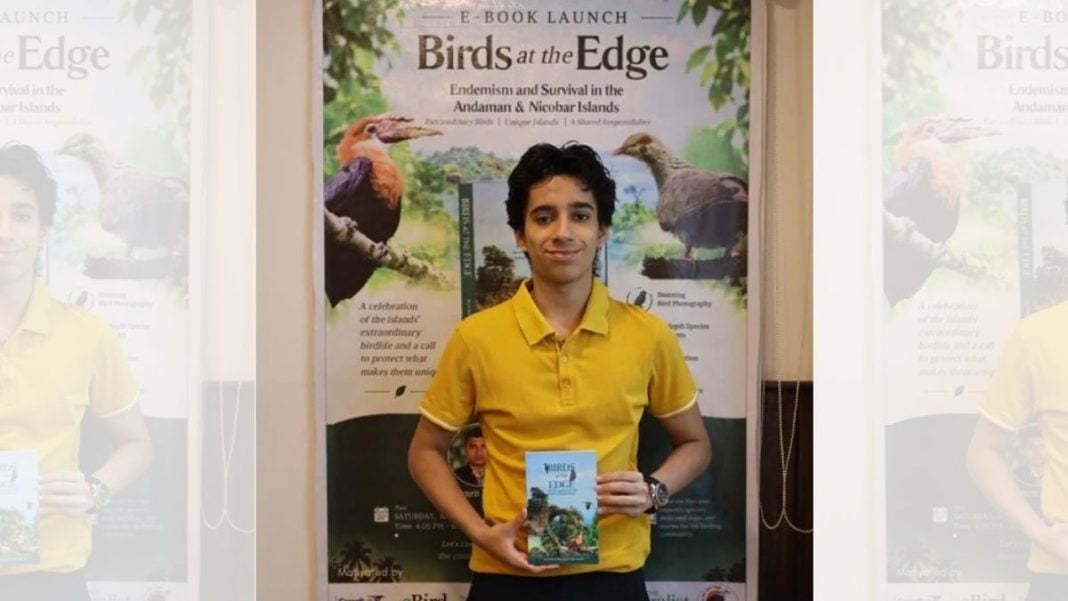


Co-authored by Amrit Raha and Fateh Jahaan Singh Dhaliwal, Birds at the Edge: Endemism and Survival in the Andaman & Nicobar Islands is a heartfelt celebration of the extraordinary avian diversity found within one of India’s most ecologically vital island archipelagos. The book weaves together rigorous scientific documentation with a passionate plea for conservation, inviting readers to explore the vibrant world of the country’s undisputed capital of endemic birds.
The heart of this book lies in the extensive, hands-on field explorations undertaken by its authors across both the bustling, inhabited hubs and the remote, untouched islands of the archipelago. Together, they have meticulously documented numerous endemic and rare vagrant species.
Their dedication is reflected in their remarkable personal achievements: Amrit, a forensic photographer by profession with the Andaman & Nicobar Police, has recorded 581 lifers, while Delhi-based Fateh has logged 247 lifers. Their paths crossed on the islands, where Amrit’s deep local expertise as a naturalist and Regional Coordinator for Bird Count India perfectly complemented Fateh’s growing momentum in citizen science. Fateh’s birding journey, fuelled by tools from the Cornell Lab of Ornithology and enriched by journeys from the wetlands of Kaziranga to the dense island forests, found a guiding hand in Amrit’s practical field mentorship.
Beyond simply identifying species, the book serves as a launchpad for fresh ornithological discoveries and conservation strategies. It includes comprehensive, beautifully illustrated species profiles, vivid field notes, and essential scientific references. Notably, it shines a spotlight on poorly understood island birds and raises intriguing scientific questions, such as preliminary observations regarding the provisionally named “Great Nicobar Crake”—a mystery still awaiting definitive research.
Furthermore, the narrative extends below the canopy to advocate for an integrated approach to eco-tourism. Through community engagement and volunteer partnerships, Fateh explores how responsible nature-based tourism can drive coral reef conservation, urban bird ecology, and marine habitat restoration.
Ultimately, this book is designed to bridge the gap between complex science and the public, appealing equally to seasoned researchers, student naturalists, and everyday wildlife enthusiasts. It operates on a profoundly simple truth: we cannot protect what we do not understand, and we cannot understand what we do not observe.
By sharing their personal field experiences and insights, Amrit and Fateh aim to inspire a new generation of observers to pick up their binoculars, document their findings, and actively safeguard the irreplaceable evolutionary heritage of the Andaman & Nicobar Islands.
Widely known as the “capital of endemic Avifauna in India”, the Andaman & Nicobar Islands host species found nowhere else on Earth. The book captures this magic through:
- Detailed species profiles: In-depth, beautifully illustrated guides focusing heavily on the islands’ endemic avian residents.
- Field notes & insights: Immersive stories from the trail, backed by scientific references and data-driven citizen science.
- Ornithological mysteries: Highlights on poorly documented species, including preliminary field observations of the provisionally named Great Nicobar Crake—a mysterious bird awaiting further scientific validation.
A call to action for the next generation
Tailored for birdwatchers, photographers, students, researchers, and anyone who finds wonder in the natural world, this e-book is designed to make island ornithology accessible to everyone.
Also Read: From sacred river to local sewer: The story of the Vrishabhavathi