



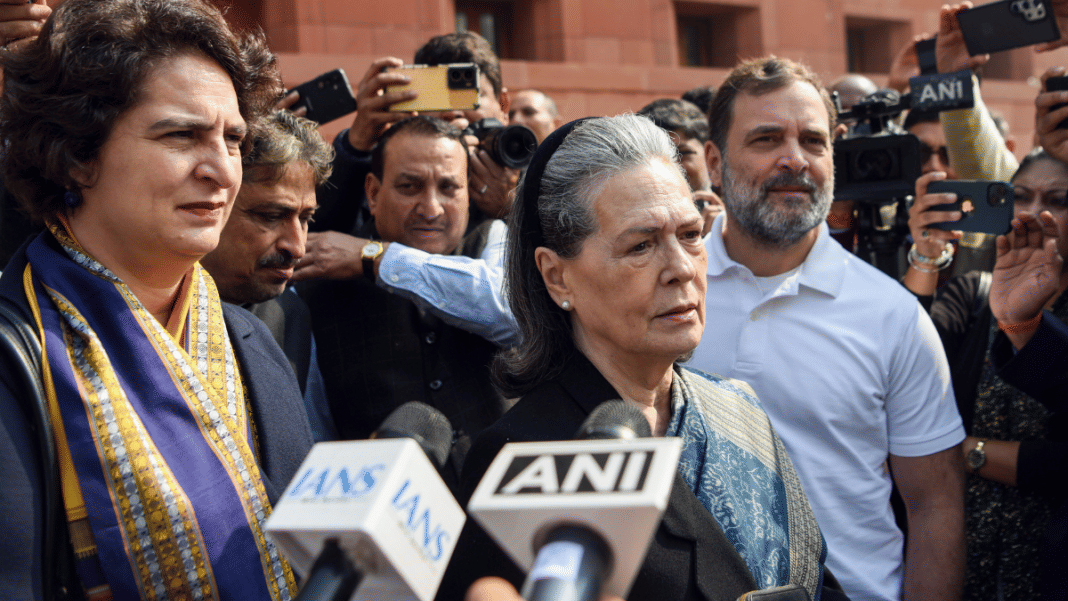


The Indian National Congress frequently presents itself as a defender of democratic institutions and constitutional values. Yet, its internal organisation raises a question that deserves closer scrutiny: Can a political party credibly champion democratic culture nationally, while retaining a highly centralised structure internally?
The Congress has long depended on a powerful central leadership, with the Gandhi family occupying a defining position in its political identity. What makes this arrangement particularly interesting is the relationship between that central authority and the party’s senior regional leaders—individuals who have spent decades building political networks, mobilising supporters and exercising influence within their respective states.
The issue is not simply whether the party is dynastic. It is whether a structure built around dynastic authority creates an asymmetry, in which senior leaders enjoy considerable public influence, but remain unusually deferential to the central leadership. Public interactions, forms of address and the language used within the party offer a useful starting point for examining this relationship.
Three dimensions are particularly revealing: the language of political hierarchy, the public treatment of senior leaders, and the sociological mechanisms through which deference becomes normalised.
The language of casual elitism
In Indian political culture, age, experience and organisational seniority often command considerable respect. Political parties may adopt informal communication styles, but the meaning of informality changes when it operates within an unequal distribution of power.
A reported interaction involving Sonia Gandhi and Congress spokesperson Pawan Khera illustrates this tension. Outside Parliament, Gandhi reportedly referred to Khera as the “safed baal wala”—the white-haired one. The remark attracted attention because it appeared to identify a senior party spokesperson through a physical characteristic rather than by name or position.
The significance of such an interaction depends on its context. A casual remark can reflect humour or familiarity without necessarily constituting an insult. Nevertheless, it raises a broader question: does informal familiarity within the Congress operate as a relationship between political equals, or is it shaped by the authority of the person speaking and the institutional position of the person being addressed?
This distinction matters because political organisations do not distribute informal power evenly. A remark that would be unremarkable between equals may carry a different meaning, when one individual occupies the party’s highest informal authority and the other depends on that leadership for organisational advancement.
The issue, therefore, is not whether senior leaders should always be addressed formally. Rather, it is whether respect and familiarity operate reciprocally within the organisation.
A similar question arises when Rahul Gandhi addresses experienced regional leaders by their first names. Informality is not inherently undemocratic, and it can encourage a sense of closeness within a political organisation. But if informal treatment flows predominantly from the top while deference flows predominantly from below, the result may be less egalitarian than it appears.
The central question is whether the Congress has developed a genuinely horizontal political culture or merely an informal style of communication within a fundamentally hierarchical structure.
Political optics & the limits of regional autonomy
The Congress is not sustained by its central leadership alone. Its regional leaders are essential to its electoral presence, organisational machinery and ability to compete in state elections. Many have accumulated influence through years of political work, personal networks and relationships with local constituencies.
This creates an apparent contradiction. If regional leaders possess substantial political resources, why does the central leadership continue to exercise such considerable authority over the party?
The answer may lie in the difference between possessing political influence and possessing institutional independence.
A regional leader can command supporters, influence electoral outcomes and occupy a powerful position within a state without having equivalent control over the national party’s organisational decisions. The central leadership can retain considerable influence through its role in national messaging, candidate selection, appointments and the management of competing factions.
Such an arrangement creates mutual dependence, but not necessarily equal bargaining power. Regional leaders contribute electoral strength and local legitimacy; the central leadership provides a national identity and a mechanism for coordinating the party’s competing interests.
This relationship also shapes how disagreements and controversial public interactions are handled. A regional leader may decide that maintaining access to the central leadership is more valuable than publicly challenging an incident that could be interpreted as disrespectful.
However, such a decision cannot automatically be classified as submission. It may reflect political calculation, a desire to prevent internal conflict or a genuine personal relationship. The important question is whether leaders can disagree openly with the central leadership without jeopardising their institutional position.
A political party’s internal democracy is not measured by the absence of disagreements. It is measured by whether disagreement is possible without disproportionate consequences.
The Congress’s challenge, therefore, is not merely to demonstrate that its regional leaders possess influence. It is to ensure that this influence translates into meaningful participation in the decisions that govern the organisation.
The feudal distancing of hierarchy
Political hierarchy is communicated not only through formal positions and organisational decisions but also through language. The words used to address a leader can express affection, familiarity, respect or institutional distance.
Across Indian politics, prominent leaders have acquired distinctive honorifics. Mamata Banerjee is widely known as didi, Mayawati as behenji, and the late J. Jayalalithaa as amma. Such forms of address can establish a symbolic relationship between a leader and their supporters, presenting political authority through the language of family, community or cultural familiarity.
The Congress presents a different linguistic question in its treatment of Sonia Gandhi. Congress spokespersons, including Supriya Shrinate and Pawan Khera, have publicly addressed her as “Madame” in social-media posts and political communications.
The significance of this practice lies not in the word itself, which can be an ordinary expression of respect, but in the possibility that its repeated use reflects a particularly formal relationship between the party’s spokespersons and its central leadership.
Unlike kinship-based honorifics, “Madame” can convey a more formal institutional distance. When used consistently for one central figure, it may reinforce the impression that the person being addressed occupies a position distinct from that of other senior colleagues.
Yet, the distinction must be examined carefully. The use of an honorific does not, by itself, establish subordination, nor does it prove that the speaker intends to create distance. Its political significance depends on how the term is used, whether the practice is distinctive to the individual concerned, and how it fits within the party’s broader organisational culture.
If the use of “Madame” is indeed disproportionately associated with Sonia Gandhi, as the cited public communications suggest, it raises a legitimate question about the symbolic status of the Gandhi family within the Congress.
Are its members treated primarily as senior political colleagues, or does the language surrounding them place them in a category of authority separate from the party’s other leaders?
This is where the concept of a corporate-feudal hybrid becomes relevant. The Congress operates as a modern political organisation, with spokespersons, committees, state units and formal offices. At the same time, its political identity and leadership structure have long been associated with a family whose influence extends beyond any single organisational position.
The combination is not unique to the Congress, nor is it inherently proof of authoritarianism. But it creates a tension between formal organisational roles and informal sources of authority.
When a party’s internal language repeatedly distinguishes its central family from other senior figures, it can symbolically reinforce that distinction—even when those other figures possess considerable experience and political influence of their own.
The question is not whether Sonia Gandhi deserves respect. She is a veteran political leader who has occupied a central position in Indian politics for decades. The question is whether respect within the party is reciprocal and institutional, or whether it reinforces a hierarchy in which proximity to the central family carries a significance that formal seniority alone cannot provide.
The dynastic anchor
The Congress’ centralised leadership cannot be understood solely as a product of personal loyalty or the weakness of its regional leaders. It also reflects the practical difficulties of managing a large, factionalised political organisation.
The Gandhi family has served as a common point of reference for leaders whose interests, ambitions and regional priorities do not always align. A central authority can help contain factional disputes, coordinate national strategy and preserve a recognisable political identity. For leaders operating within such a structure, maintaining a relationship with the high command may be a rational political choice.
But organisational unity and internal democracy are not the same thing.
A leadership structure may prevent factions from fragmenting a party while simultaneously discouraging open disagreement. It may provide continuity while limiting the independence of regional leaders. It may maintain a common political identity while making access to the central leadership disproportionately important for institutional advancement.
These tensions are particularly significant for a party that presents democratic values as central to its political identity.
The decisive question is not whether senior Congress leaders use formal or informal language, nor whether every public interaction should be interpreted as an act of disrespect. It is whether the party’s internal arrangements allow its experienced leaders to exercise genuine authority, question decisions and participate meaningfully in determining its future.
A party cannot establish internal democracy merely by maintaining committees, appointing office-bearers or holding organisational meetings. It must also create conditions in which authority is accountable and disagreement is legitimate.
For the Congress, the dynastic anchor may remain a source of cohesion. But if that cohesion depends excessively on personal loyalty to a central family, it risks becoming an obstacle to institutional renewal.
Ultimately, the test of internal democracy is not how respectfully leaders speak about their organisation’s central figures. It is whether those leaders possess the freedom and institutional standing to disagree with them.
That is the paradox of deference: a political organisation may rely on powerful leaders to sustain its collective strength while simultaneously maintaining a hierarchy that limits their independence.
Harsh Kumar Singh is a student of Langat Singh College, Muzaffarpur, Bihar. Views are personal.
Also read: Strait of Hormuz: How a crisis unfolding thousands of kilometres away came to India’s doorstep