



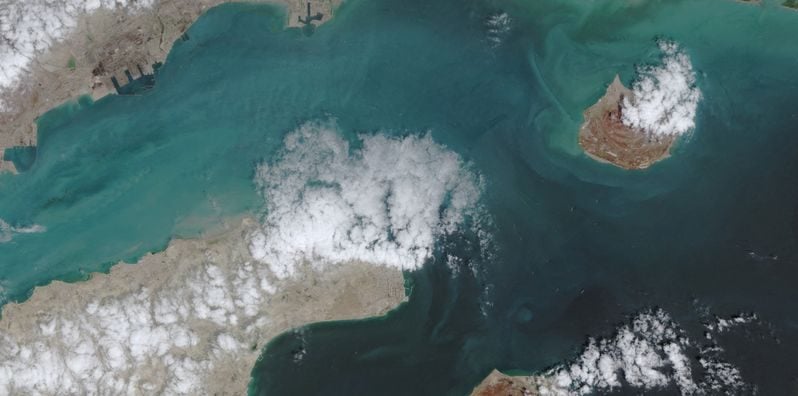


A tiny stretch of water between Iran and Oman seems like an unlikely place to begin a conversation about India. Yet, the Strait of Hormuz plays a central role in a persisting global crisis—from global oil markets to Indian households.
A critical maritime and geopolitical crisis erupted following US and Israeli military strikes on Iran on 28 February. Iran responded by closing the vital oil and gas transit chokepoint, slashing pre-war traffic by roughly 80 percent and triggering a severe global energy crunch.
Daily ship transits dropped from roughly 130-140 vessels down to a tiny fraction, spiking war-risk insurance premiums and pushing Brent crude oil prices past about $90 a barrel.
The strait is 33 kilometres wide at its narrowest point, yet functions as the world’s most critical maritime energy choke point. Bounded by Iran to the north and Oman and the United Arab Emirates (UAE) to the south, it handles roughly one-quarter of global seaborne oil trade and 20% of liquefied natural gas (LNG).
The recent conflict over this resource-rich waterway has rippled through oil trade, gas shortages and global economies.
For India, this ripple is rather significant, as being one of the world’s major energy importers, uninterrupted flow of oil and gas is crucial to its economy. When the Strait closed, the Indian crude basket rose from about $70 to above $120/barrel within four weeks. With the current naval blockade by the US and recurrent strikes in the strait, oil prices remain elevated. LPG prices also rose sharply this year, while shipping insurance costs increased several-fold.
Crude oil and petroleum
Yet, India was not without options. India successfully diverted its energy supply from the Middle East crisis, routing roughly 70 percent of its crude oil imports outside the Strait of Hormuz. The number of crude source countries expanded from 27 to 41, with newer suppliers like Libya, Gabon, Equatorial Guinea, and Guyana added, and volumes from the United States and Russia increased.
India also maintains strategic petroleum reserves that provide a buffer when global supplies are disrupted, giving approximately three weeks of cover, with the expansion of storage in Chandikhol, Odisha and Padur, Tamil Nadu, extending the stall time further. India’s ethanol blending has reached 20 percent, providing another way of reducing dependence on imported crude.
LPG—the factor that hit home
The clearest example of the crisis reaching ordinary Indians was LPG. Around 80-85 percent of India’s household LPG supply had been arriving through Gulf routes.
Yet instead of allowing the disruption to translate directly into empty cylinders, an LPG control order was issued within eight days, refineries were rapidly reconfigured, and domestic production increased from 35,000 to 54,000 tonnes per day.
Keeping energy moving
The impact was not limited to oil and LPG.
Disha, an Indian LNG carrier carrying 62,370 metric tonnes of LNG, safely transited the Strait of Hormuz after the announcement of a preliminary ceasefire, becoming the first Indian LNG tanker to cross the conflict-hit waterway since the war began.
The government was forced to tinker with excise duties on petrol and diesel during the crisis. Protecting consumers came with a high fiscal cost.
The State Bank of India estimated that the excise reduction alone could cost the government nearly Rs 1.1 lakh crore in foregone revenue over the fiscal year.
As growing threats from both US and Iran fuel fears of intensification of the conflict again, Iran has now said the US must lift its naval blockade and honour the Memorandum of Understanding previously signed.
What the crisis shows
The Strait of Hormuz crisis demonstrates that no country can completely insulate itself from a geopolitical crisis in an interconnected world. What it can do is prepare for one.
For India, diversification, strategic reserves and domestic capacity did not make the crisis disappear—but they gave the country room to respond.
As a 15-year-old, geopolitics may seem like a word reserved for diplomats and United Nations Officials. But perhaps, this is the misconception one needs to challenge.
Because International Relations isn’t just about treaties and speeches. It is the world we live in and the decisions that will eventually shape the world we inherit.
Remaining informed about Global Affairs may not conform to the standards of today’s youth but to be aware about global affairs just may be “low-key cool”.
Nandani Kumar is a student at Presidium Indirapuram, Ghaziabad. Views are personal.
Also Read: Why Strait of Hormuz is critical oil chokepoint & how Iran is weaponising it | Cut The Clutter