


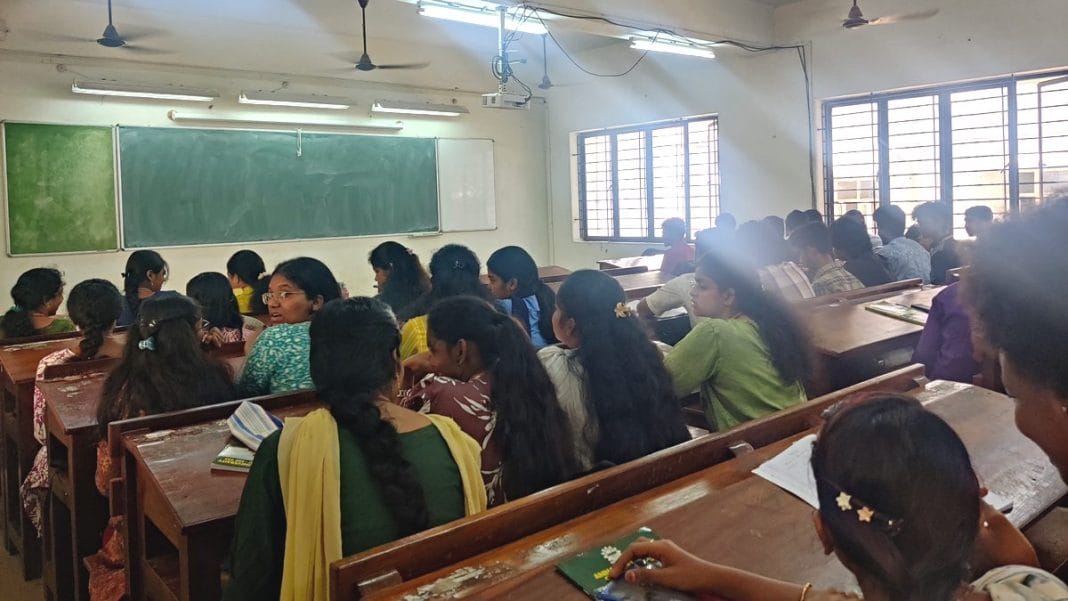
India’s higher education sector is facing a problem that seems to go against logic.
Universities have too many empty teaching roles, teachers are becoming overworked, while thousands of educated young people are left searching for meaningful jobs.
How can we face a shortage of teachers, while also having unemployed highly educated individuals?
This raises questions on who is responsible for this issue and how it should be resolved.
Empty roles & overworked staff
In 2025, the Parliamentary Standing Committee found that from the 18,940 sanctioned positions, 5,410 (29 percent) were empty in central universities. This issue became more of a problem when looking at the higher roles such as professors and associate professors. Fifty-six of the professor roles and 38 percent of associate professor roles were empty.
However, the Ministry of Education found that the percentage of staff roles in central universities had lowered to 25.44 percent in 2025. Despite this, there are still a large number of staff roles empty.
With fewer teachers, there is more pressure on the current staff. Professors are responsible for supervising research projects, practical exams, administration, organisation of academic activities and reporting. This can cause issues with teaching quality and research output.
Unemployment of qualified graduates
Despite the lack of staff in universities, qualified graduates are struggling to find jobs. The International Labour Organisation (ILO) and Institute for Human Development found that in 2022, 28.7 percent of young people with graduate-level education or above were unemployed. This compares to only 3.2 percent of young people with less than primary education being unemployed. While this does not show how many teaching hopefuls are unemployed, it shows how difficult it is to turn an education into a job.
Young scholars are spending years getting their postgraduate qualifications, passing the eligibility tests and getting their doctorates. There is no guarantee of getting a job in academia. It is ironic that despite needing teachers, there are still empty roles.
Growth of higher education
India has seen lots of growth in Higher Education. In 2021-22 there were around 4.33 crore students enrolled in Higher Education, compared to 3.42 crore in 2014-15. There were also around 15.98 lakh teachers. However, this causes more pressure on teaching institutions if there are not enough staff being recruited.
In the 2026-27 education budget analysis, PRS Legislative Research found that there were 24 pupils per teacher in Higher Education in 2021-22. This varies greatly between different states. Bihar had 64 pupils per teacher, Jharkhand had 54, and Uttar Pradesh had 35. This can create issues with personal attention and mentoring.
Are we measuring education?
Modern universities place a lot of emphasis on rankings, accreditations, building infrastructure and paperwork. However, this does not mean that there will be meaningful teaching. While a university may have state-of-the-art labs, digital classrooms and impressive buildings, if there are not enough teachers to guide the students.
This can cause problems in many fields such as agriculture, medicine and engineering where lab work, practical work and constant supervision are needed. Education should not be seen as completing a syllabus and getting good exam results.
The true measure of an institution is how much they can help encourage curiosity, critical thinking, practical skills and research.
Recruitment should be a priority
The government have made some progress with recruitment. Between September 2022 and 23 May this year, 18,757 staff positions have been filled across central Higher Education institutions using Mission Mode recruitment.
However, this should be a regular process for institutions. Universities should be transparent with their vacancies, have a clear recruitment schedule and quick recruitment processes. Teachers should not be overworked. While contract staff can help with immediate issues, over-reliance on temporary staff can cause issues with continuity in education and research.
India wants to become a global knowledge economy. However, this can only be achieved if there is consistent investment in teachers, researchers and institutions. It is ironic that we have qualified individuals looking for opportunities, universities with empty roles and students waiting for quality education.
We need to create a system that values the qualifications of graduates. We need to ensure educational institutions have enough people to run effectively. A nation cannot claim to value education if it is leaving teaching roles empty, overworking teachers and leaving qualified individuals underused.
The future of higher education in India is dependent on how much we value the people giving out the degrees.
Anushka Chourasia is a student of Indira Gandhi Krishi Vishwavidyalaya, Raipur, Chhattisgarh. Views are personal.
Also Read: Relevance of Dr Ambedkar in 21st-Century Indian society