


The real success of Make in India shouldn’t just be measured in terms of how many products get assembled in India. It should be measured in terms of how much of the knowledge, the technology and the innovation is actually being generated in India.
India has gone a long way in building itself up as a global manufacturing hub via Make in India and the Production Linked Incentive (PLI) scheme. The intent of both these initiatives are to get foreign companies to set up manufacturing facilities in India, to create jobs and to increase our own manufacturing output. The question that then arises is this: are we in fact becoming a manufacturing nation or are we in the process of becoming a research and development (R&D) driven economy?
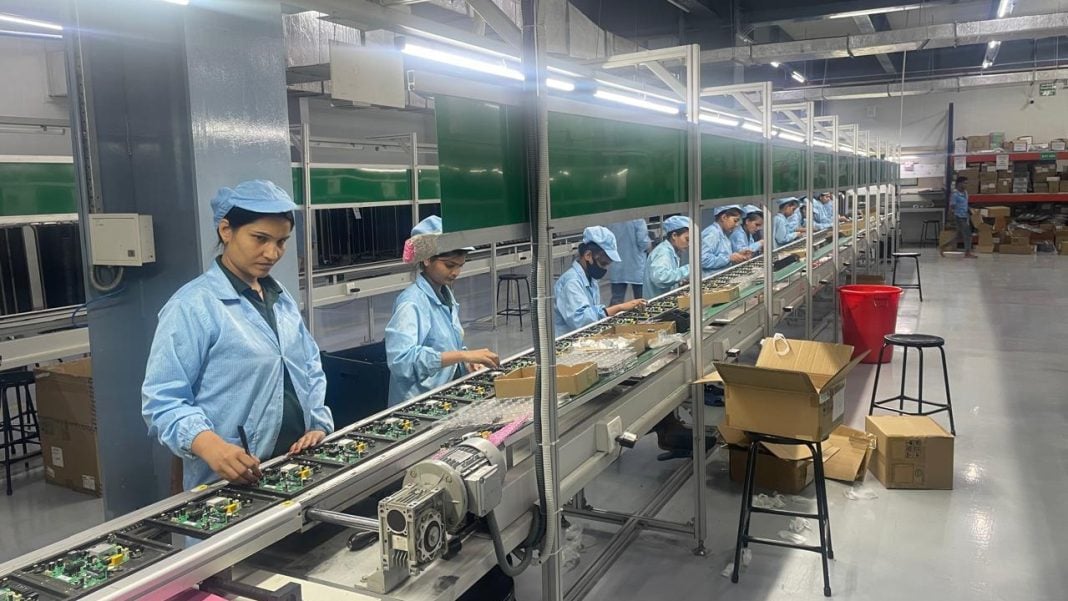
Manufacturing in India is vital, but manufacturing by itself won’t make a country technologically independent. Today, we see a huge number of multinational companies setting up manufacturing or assembly units in India. They take the technology, the components and the designs from all over the world, assemble the product in India and either sell it in India or export it.
It’s a model which creates jobs, boosts exports and links India to the global supply chain. But the issue which arises is of course how much of the actual technology and intellectual property is being developed in India.
As per the Government of India’s Economic Survey 2025-26, India has become the world’s second largest mobile phone maker with over 300 manufacturing units. That said, the growth in production doesn’t necessarily mean that all the technology and components are being made in India.
The issue isn’t foreign investment at all. Foreign investment is absolutely vital for growth. The real issue is our over reliance on imported technology, components and R&D. We need to make the distinction between Made in India and Designed and Developed in India.
Another big issue is the environmental cost of industrial growth, specifically e-waste. The Environment Ministry puts the amount of e-waste generated in India at 12.54 lakh metric tonnes for 2023-24 which has increased to 13.98 lakh metric tonnes for 2024-25. The reason for this is clearly the increased consumption of electronics, the propensity to replace products frequently and the very short lifespan of products. Industrial growth therefore must also be looking at sustainable product design, repair and recycling.
The Achilles heel of our industrial development is the chasm between education, research and industry. Year on year we have thousands of graduates from the IITs, the NITs, the central universities and all the other higher educational institutions. The problem is that very often, the students who are quite capable and have the requisite talent don’t have access to adequate research facilities, funding and industry exposure here in India. So they end up going abroad for their research.
As per the Department of Science and Technology’s R&D Statistics 2025-26, India’s Gross Expenditure on R&D was at approximately 0.84 percent of GDP in 2023-24. That clearly indicates that we need to do more in terms of investment in R&D and innovation.
To deal with this, the government should have a robust policy in place to encourage the large private industries to set up their own R&D and incubation centres in India. The companies which are getting the government incentives and subsidies should be encouraged to put money into R&D, innovation and technology development right here in India.
Industries need to work with the universities, provide research opportunities for students, set up incubation centres and provide funding and technical infrastructure to young innovators. That will go a long way to turn academic knowledge into industrial applications. The government also needs to do more to support initiatives such as the Anusandhan National Research Foundation and the Research, Development and Innovation Fund.
India doesn’t need to turn its back on foreign investment or international co-operation. What it does need is for the growth of its own industry to go hand-in-hand with the development of its own research capability, its own skilled human resources and its own indigenous technology.
The real meaning of Atmanirbhar Bharat is not simply about making things in India, it’s about developing the knowledge, the scientific ability and the technological capacity to make them ourselves.
If India is to be a developed nation by 2047, it has to go beyond being a manufacturing nation and become a global hub of research, innovation and scientific thinking.
Make in India is a very important first step. The next big step has to be: Research in India, Innovate in India and Develop for the World.
Sunil Kumar is a student of Central University of Rajasthan, Ajmer. Views are personal.