



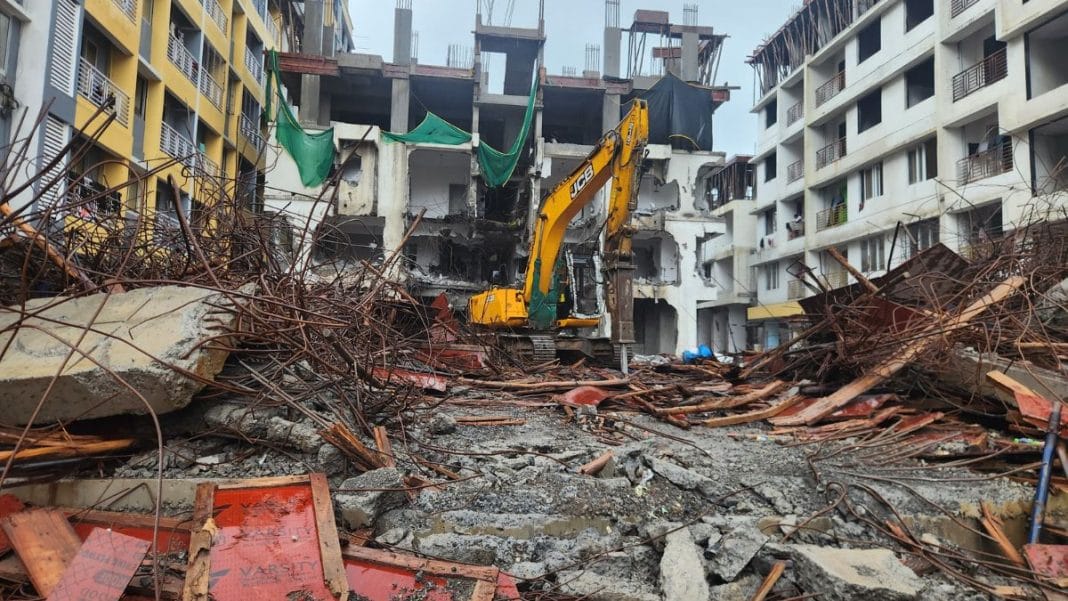


From 12 October, Mumbai will fine construction sites and debris trucks that do not register with its new digital monitoring system. The vehicles that carry construction and demolition (C&D) waste without an active GPS-based tracking device will be fined Rs 25,000.
The construction sites also need to register and failure to do so with the Brihanmumbai Municipal Corporation’s (BMC) newly launched Debris Control and Tracking System (MDCTS) will face the same fine.
The system is built to track debris from the site where it is generated until an authorised unloading or recycling facility. The argument behind monitoring vehicle movements is that the BMC hopes to identify trucks that move away from approved routes and dump waste illegally. The timing is significant as Mumbai’s air quality has deteriorated after the monsoon, and there is significant evidence that the dust from construction activity adds to the city’s pollution burden.
The move is appreciated, but this comes at a time when BMC lacks capacity to treat even one-seventh of this construction and demolition waste, and this adds another layer of problem that tracking alone cannot solve. Mumbai generates more than 8,000 tonnes of construction and demolition waste every day, while its two treatment facilities at Dahisar and Shilphata can process only around 1,200 tonnes.
This means that the city produces almost seven times as much debris as its existing facilities can handle. This gap is enormous.
This is where Mumbai’s new system faces its test. While we can track where a truck is going using a GPS device, where will it unload if the BMC has not provided a place for the truck to unload? This is also the question we need to ask.
The Debris Control and Tracking System (MDCTS) were launched on 24 August. It covers builders, developers, government agencies, contractors, transporters and citizens carrying out repairs or renovations. They have to register themselves on the portal, and the builders must state how much waste a project is expected to generate and where it will be disposed of. Transporters must use vehicles fitted with a Vehicle Tracking and Monitoring System.
The response for the registration till October 9 shows that getting people to use the system might not be easy also of is there a confusion among developers or builders regarding the portal. By 9 October, BMC had only received 220 registrations. These included 109 builders and developers 44 transporters, 19 BMC contractors, 17 external buyers of debris and soil 15 corporate entities and four government agencies. Not a single individual citizen had signed up.
These numbers make us wonder how well the system has been shared with the public. They also make us question if the registration process is simple enough for waste generators. The question is that even if registration becomes mandatory and all comply, how will BMC handle the remaining 6,000 tonnes of waste.
Gurugram gives us an example to follow. Its municipal corporation connects proof of construction waste disposal to the process of getting occupancy and completion certificates. Builders must state how much debris they expect from a project. They must take it to the Basai facility or other approved collection points and get a receipt. Officials check the receipt and inspect the site before they approve the certificate.
This system works because it ties waste disposal to something getting a legal certificate. It also makes sure the waste is handled in a way. Mumbai could consider an approach to make sure the system is used by everyone.
Gurugram has also set targets to increase the use of construction material. For buildings, the city wants 5 percent of materials in 2026-27 and 25 percent from 2030-31. For roads, they are planning 15 percent from 2030-31. The two cities are approaching the problem differently. Mumbai focuses on tracking the movement of debris while Gurugram links disposal to building approvals. Neither approach can work alone. Waste must be transported, and then processed and recycled material must find buyers.
While crushed concrete, bricks and other construction waste can be reused in road sub-bases and other construction works if quality standards are met, the question is whether recycling will grow simply because municipalities track waste. It also needs processing facilities, demand for recycled aggregates and builders willing or required to use them.
For Mumbai the immediate question is what happens to waste that existing facilities cannot process. How much debris reaches Dahisar and Shilphata each day? How much is turned into material? How much is taken to authorised sites and how much remains unaccounted for? The BMC must publish data on dumping complaints, vehicles tracked and penalties imposed once enforcement begins.
Without these figures, it will be hard to tell whether the new system reduces dumping or only improves monitoring of part of the city’s waste stream. The city must know where its debris goes and also needs enough places to take it facilities to process it and a market, for the material that comes out and finally tracking can make the movement of waste visible but it alone cannot make waste disappear.
Abhay Tomar is a student at Ashoka University, Sonipat. Views are personal.