





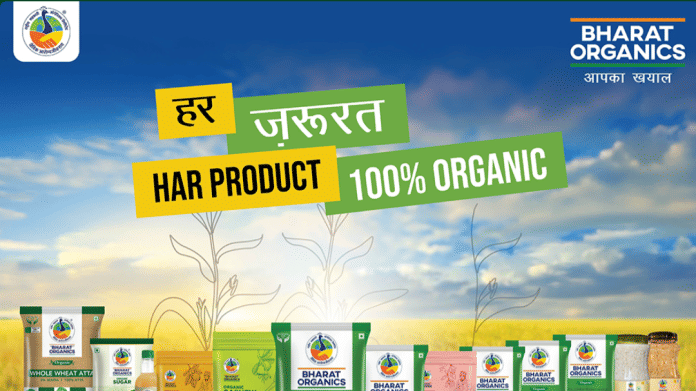



New Delhi: The Ministry of Cooperation has stepped deeper into the digital commerce space with the launch of a direct-to-consumer (D2C) website and mobile application for Bharat Organics, a consumer-facing brand of the National Cooperative Organic Limited (NCOL), signalling its growing push to expand the cooperative model into sectors traditionally dominated by private players.
Launched in March, the digital platform has already started gaining traction, recording over 25,000 visitors as the government-backed initiative looks to establish itself as a national organic brand. So far, the NCOL has introduced 27 products under the Bharat Organics label, covering staples such as pulses, rice, flours, dry fruits, and sweeteners.
Bharat Organics marks another step by the government to diversify cooperative-led ventures into different sectors, following the launch of Bharat Taxi.
“Cooperatives have very good economic models; they are the best way of redistributing wealth that a business generates,” Vipul Mittal, Managing Director of National Cooperative Organics Limited, told ThePrint, underlining the economic logic behind the initiative. “Once the government realized that organics provide an opportunity to generate an additional income for the farmers, they formed a cooperative dedicated to organics.”
Before the D2C platform went live, Bharat Organics products were available at select Safal stores across Delhi-NCR and Bengaluru since 2024, and later expanded to quick commerce platforms like Zepto, Blinkit, and Swiggy, among others.
“We started our D2C platform, so that in case a customer doesn’t find Bharat Organics products in the vicinity or on a chosen platform, customers have an option to directly reach out to us and we deliver the products to them,” Mittal said.
The brand clocked around Rs 21 crore in revenue in FY 2026—largely from Delhi-NCR and Bengaluru, before the launch of the D2C platform.
Set up in 2023 under the Multi-State Cooperative Societies Act, NCOL functions as an umbrella body handling procurement, certification, testing, branding, and marketing of organic produce.
It is backed by five cooperative societies: the National Dairy Development Board, Gujarat Cooperative Milk Marketing Federation (Amul), National Agriculture Cooperative Marketing Federation of India, National Consumer Cooperative Federation, and National Cooperative Development Corporation.
Process certification & supply chain gaps
At the heart of Bharat Organics lies a complex supply chain challenge: ensuring authenticity while building scale. Mittal said the organic sector is constrained not by demand but by certification and transition timelines. “Organic is a process certification, not a product certification… it takes about two to three years to certify a piece of land.”
While NCOL has onboarded over 14,000 cooperative members across more than 22 states, only a small number are currently producing certified organic goods. “We have to build the market and at the same time enrol our members into the organic journey,” Mittal added, describing it as a “chicken and egg” situation.
In the interim, NCOL is sourcing from existing certified producers while working to transition its own network. The organisation operates across multiple geographies, including the Northeast, where many farmers follow “default organic” practices but lack formal certification. “There are lot of organic stuff out there, but it may not have an organic certification,” Mittal said.
To address credibility concerns, NCOL has added a second layer of testing beyond certification. “We test each and every batch for 245 plus pesticides, and the report is available through a QR code on packaging for the consumer,” he said.
The company is also trying to bridge the gap between certified farmers and market access. “We find that many times certified organic farmers are not able to get market access… so we have asked them to come and register with us,” Mittal said.
Pricing and differentiation
A key pillar of Bharat Organics’ strategy is pricing. Unlike many private organic brands that operate in a premium niche market, NCOL is attempting to make organic products more accessible.
“Today we are pricing ourselves about 10 to 15 percent higher than conventional products [non-organic products],” Mittal said. However, compared to other organic brands, the gap is narrower. “Other organic products are pricing themselves anywhere from 50 to 100 percent higher,” he added.
The cooperative model allows NCOL to operate on a “higher volume, lower margin” approach. “We are not keeping too much margin, but we want to generate larger volumes,” Mittal said.
He also flagged concerns around excessive premiumisation. “If you put a premium on something beyond a point, the incentive to play mischief is higher,” he said.
Beyond pricing, the company is emphasising product integrity and authenticity. Staples such as pulses are sold in unpolished form, and every batch undergoes extensive pesticide testing. “If we are calling it organic, we are ensuring that what you are getting is chemical-free and process certified,” Mittal said.
Future expansion plans and pipeline
Having established an early presence in Delhi-NCR and Bengaluru, Bharat Organics is now gearing up for expansion. The D2C platform, supported by a warehouse in Ghaziabad, enables deliveries across more than 25,000 pin codes, with early orders coming in from states like Odisha and West Bengal.
Vipul Mittal said the D2C platform aims to build more brand visibility than to drive immediate revenue. “D2C is more about creating the buzz and the reputation of the brand; it may not be a very sizable contributor to business right now,” he noted.
The company is planning a wider geographical rollout in FY 2027. “This year we are planning to go pan-India,” Mittal said, adding that the focus will initially be on metros and Tier-1 cities before moving into smaller towns.
NCOL is also looking to expand its product basket beyond 27 products. Items such as ghee, poha and makhana are in the pipeline, along with a push towards traditional and regional varieties, including millets and native rice. “There are a lot of traditional products out there… we want to expand into regional and native varieties,” Mittal said.
At the same time, the cooperative is working on strengthening its farmer base. The strategy, Mittal explained, is two-fold – expanding demand while bringing more farmers into certified organic production. “This twin-prong approach will carry us through the next financial year,” he said.
(Edited by Varnika Dhawan)
Also Read: India must take advantage of Iran crisis, shift gears from fuel to organic waste management