





Thank you dear subscribers, we are overwhelmed with your response.
Your Turn is a unique section from ThePrint featuring points of view from its subscribers. If you are a subscriber, have a point of view, please send it to us. If not, do subscribe here: https://theprint.in/subscribe/
For nearly fifteen years, India and Bangladesh represented one of South Asia’s rare diplomatic success stories. Security cooperation deepened, insurgent sanctuaries disappeared, connectivity improved and New Delhi achieved unprecedented influence in Dhaka.
The achievement was neither accidental nor trivial. Under Sheikh Hasina, Bangladesh aligned unusually closely with Indian security concerns. Anti-India insurgent groups operating out of Bangladeshi territory were dismantled. Transit links expanded. Economic integration accelerated. Even as China spread infrastructure projects across South Asia, Dhaka largely avoided drifting into overt strategic hostility toward New Delhi.
Which is why the current atmosphere along India’s eastern frontier feels so oddly self-defeating.
The Rhetoric Shift
The deterioration has not occurred through war, diplomatic rupture or economic confrontation. Instead, it has emerged through something far more contemporary: the gradual merging of neighbourhood policy with domestic electoral politics in West Bengal and Assam.
The language itself has changed noticeably. “Infiltrators”, “demographic change”, “detect and deport”, “impenetrable borders” and “accelerated fencing” now dominate political discourse across large parts of eastern India. Much of this rhetoric makes electoral sense. Border anxiety has long remained politically potent in Assam, while Bengal’s increasingly polarised politics has created incentives for competitive displays of securitisation.
But neighbours, unfortunately, also listen.
Bangladesh’s political establishment is beginning to interpret these developments not as isolated domestic debates, but as signals of a broader strategic mood. Restrictions around Eid slaughter, scrutiny of madrasas, debates over clerical subsidies and the increasingly muscular vocabulary of border management together create a cumulative political atmosphere that Dhaka cannot entirely ignore.
The difficulty with politically useful rhetoric is that neighbouring countries occasionally take it literally.
Strategic Implications
This matters because Bangladesh is not merely another neighbour. It sits at the heart of India’s eastern strategic architecture. Stability in Bangladesh directly affects the Siliguri Corridor, connectivity to the Northeast, Bay of Bengal security, migration management and the wider balance of influence between India and China in eastern South Asia.
Great powers generally prefer not to convert strategically important neighbours into nervous geopolitical hedgers. South Asia, however, has always possessed a talent for innovation.
The Teesta Test Case
The Teesta River dispute illustrates the problem elegantly. What was once viewed as an unfortunate complication of Indian federalism is increasingly seen in Dhaka as evidence that India’s domestic political compulsions can override long-term regional commitments. For Bangladesh, Teesta is no longer merely a water-sharing disagreement. It has become a test of Indian strategic reliability itself.
That perception carries consequences.
China has already shown interest in deeper involvement around Teesta-linked infrastructure and water management projects. Beijing could scarcely have designed a more efficient opening for influence than an India that gradually allows Bangladesh to feel strategically mistrusted.
The irony is difficult to miss. India spent years reducing Bangladesh’s dependence on anti-India nationalism, only to risk slowly reviving it through the compulsions of state-level electoral politics.
None of this implies that India lacks legitimate concerns regarding illegal migration or border security. Every sovereign state has the right to regulate borders, detect undocumented entrants and protect demographic stability where necessary. The issue is not whether India should secure its frontier. The issue is whether border management is quietly evolving into a larger political vocabulary through which an entire neighbouring society increasingly feels viewed with suspicion.
And diplomatic atmospheres are often shaped less by formal policy than by accumulated political signalling.
Political Theatre and Strategic Weight
This is where the situation becomes geopolitically delicate. Bangladesh’s current political transition already carries uncertainties following the weakening of the Hasina-era consensus. Nationalist sentiment inside Bangladesh has become more assertive. Sections of the Bangladeshi political class increasingly advocate a more “balanced” foreign policy between India and China. Public sensitivity toward Indian rhetoric has visibly sharpened.
Under such conditions, symbolism acquires strategic weight.
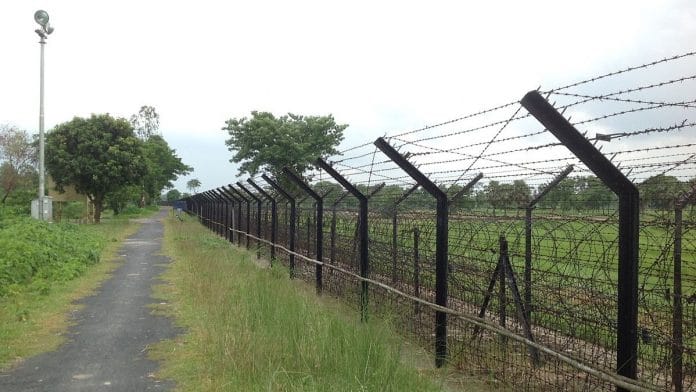
Barbed-wire fencing may appear domestically reassuring in India while simultaneously reinforcing perceptions of strategic mistrust across the border. Electoral language crafted for rallies in Assam or Bengal can easily harden into diplomatic memory inside Dhaka. Political theatre rarely remains geographically contained for very long.
India once feared strategic encirclement by hostile powers. It may eventually discover that neighbours need not become hostile to become distant.
The larger irony is that New Delhi’s Bangladesh policy had once been cited as proof that India could successfully manage its immediate neighbourhood through persuasion, economic integration and security cooperation rather than coercion alone. Yet today, some of that carefully constructed goodwill risks being diluted not by Beijing or Islamabad directly, but by the increasingly porous boundary between domestic mobilisation and regional diplomacy.
Electoral narratives have short shelf lives. Geopolitical consequences generally do not.
The Path Forward
India can certainly secure borders, negotiate firmly and protect national interests. But successful regional powers also understand where domestic political signalling must end and strategic restraint must begin. The challenge lies not in abandoning legitimate security concerns, but in ensuring that the language of border management does not inadvertently become the vocabulary of strategic alienation.
Because borders can indeed be fenced.
Political atmospheres are considerably harder to contain.
Submitted by: Aloka Sengupta, Bengaluru-based healthcare professional and commentator on international affairs and geopolitics.
These pieces are being published as they have been received – they have not been edited/fact-checked by ThePrint.