





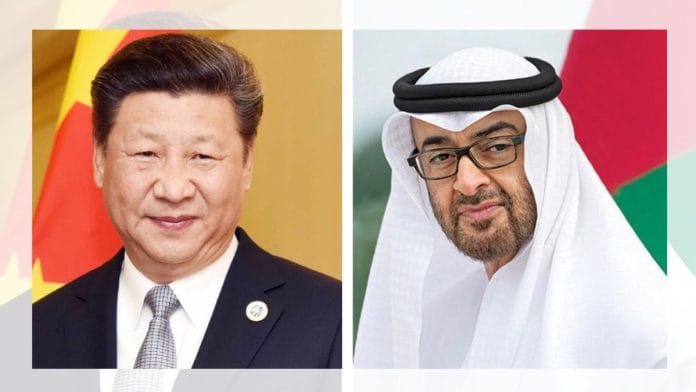



New Delhi: Chinese President Xi Jinping met the UAE Crown Prince of Abu Dhabi Mohammed bin Zayed Al Nahyan (MBZ) Tuesday and outlined a four-point proposal for peace in West Asia. The proposal provided a “common, comprehensive, cooperative and sustainable” security framework for the Gulf and the wider region.
The leaders met in Beijing for a high-level meeting where Xi said both countries “must strengthen coordination in light of the choice between peace and war, and unity and confrontation”. He added, “A stronger and more comprehensive strategic partnership between China and the Arab world must be built.”
The crown prince arrived in Beijing Monday, as part of Abu Dhabi’s efforts to strengthen bilateral relations and enhance cooperation with Beijing.
China has become one of the UAE’s largest economic partners, with non-oil bilateral trade reaching approximately $111 billion in 2025.
China’s outreach to the UAE amid the escalating Gulf war is significant. The UAE has been a target of Iran in the West Asia war, initiated by the US-Israel, with Tehran labelling their targets as legitimate due to alleged US use of the sites.
According to the UAE’s ambassador to the US, Yousef Al Otaiba, Iran has launched over 2,180 missiles and drones at the Emirates. That’s more than those launched at the remaining five Gulf Cooperation Council (GCC) countries—Oman, Bahrain, Saudi Arabia, Qatar, and Kuwait—combined.
Iran and the UAE’s dislike for each other was further evident in remarks by envoy Otaiba and former Iranian Foreign Minister Mohammad Javad Zarif.
“Iranians don’t like us. Not only because we are so near, but because we are so different,” Otaiba wrote in an article for The Wall Street Journal on 25 March this year.
Meanwhile, Zarif purportedly exchanged some messages on Telegram, which got leaked, where he, reportedly, said that the UAE was as much an enemy of Iran as Israel.
Xi’s 4-point plan for regional stability
During the meeting, Xi laid out a framework for what he described as a “common, comprehensive, cooperative and sustainable” security architecture for the Gulf and the broader West Asia.
The four key principles in his proposal are peaceful coexistence among neighbouring states, encouraging Gulf countries to improve relations and reduce tensions; respect for sovereignty and territorial integrity; non-interference in internal affairs; commitment to international law, supporting a global system anchored in institutions such as the United Nations; and balancing development and security for promoting economic growth alongside regional stability.
Xi stressed that Gulf nations are “close neighbours that cannot move away”.
“The Gulf states in the Middle East are close neighbours that cannot move away,” the statement shared on social media platform X by Mao Ning, Spokesperson of the Chinese Foreign Department, stated. “It’s important to support the Gulf states in improving their ties, work to build a common, comprehensive, cooperative, and sustainable security architecture of the Middle East and the Gulf region, and consolidate the foundation for peaceful co-existence.”
The discussions between Xi and MBZ included talks with senior Emirati officials, including Khaled bin Mohammed bin Zayed Al Nahyan, focusing on expanding collaboration in advanced technology, environmental sustainability, and scientific research.
(Edited by Madhurita Goswami)
Also Read: Delhi & Beijing search for new normal & why India can be the ‘juggernaut’ of women’s cricket