





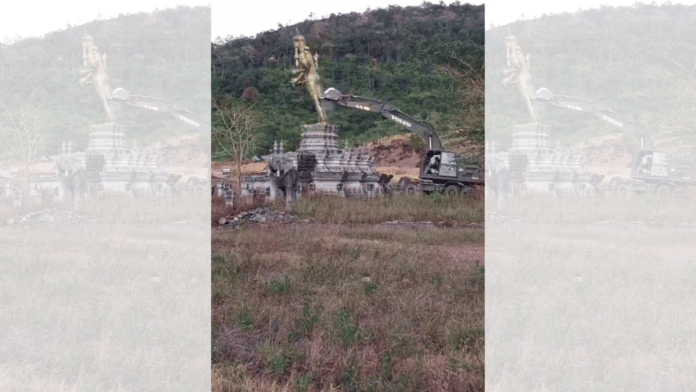



New Delhi: New Delhi’s reaction to the demolition of a statue of Hindu deity Vishnu in Cambodia’s Preah Vihear province has been unambiguous, marking a significant intervention by the Indian government into the current Thai-Cambodia border dispute which has claimed over 96 lives since July.
MEA Spokesperson Randhir Jaiswal condemned the incident on X: “We have seen reports on the demolition of a statue of a Hindu religious deity, built in recent times, and located in an area affected by the ongoing Thai-Cambodia border dispute.”
“Hindu and Buddhist deities are deeply revered and worshipped by people across the region, as part of our shared civilisational heritage.”
“Notwithstanding territorial claims, such disrespectful acts hurt the sentiments of followers around the world, and should not take place.”
“We once again urge the two sides to return to dialogue and diplomacy, to resume peace and avoid any further loss of lives, and damage to property and heritage.”
The incident, which occurred in the disputed An Ses area of Cambodia’s Preah Vihear province, came to public attention on 22 December when a video of the Thai military allegedly demolishing a Lord Vishnu statue using a backhoe loader went viral.
Cambodia has condemned the Thai army for demolishing a Hindu Vishnu statue in a disputed border area after more than two weeks of fighting between Cambodia and Thailand.
According to Cambodian officials in Preah Vihear, the statue was built in 2014 and stood several hundred… pic.twitter.com/Epqzy6vzBk
— Jacob in Cambodia 🇺🇸 🇰🇭 (@jacobincambodia) December 24, 2025
The statue was constructed in 2014 on the An Ses pass in the strategic Dangrek mountain range, a tactical location near the contested border.
Despite its recent origin, the statue had quickly become a spiritual anchor for local Cambodian troops and villagers, who regarded it as a guardian watching over the volatile frontier.
Its placement reflected a tradition in the region where Hindu deities are invoked for protection and stability in times of conflict.
Cambodian spokesman Kim Chanpanha stated, “We condemn the destruction of ancient temples and statues that are worshipped by Buddhist and Hindu followers. The statue was inside our territory in the An Ses area.”
The incident came against a backdrop of renewed hostilities that have shattered the fragile US-brokered ceasefire since July, with clashes escalating through Thai F-16 airstrikes and Cambodian rocket fire.
The An Ses area, where the statue stood roughly 400 meters from the border, lies in close proximity to the Preah Vihear temple—a UNESCO World Heritage site awarded to Cambodia by the ICJ in 1962.
However, the area is a perennial flashpoint, stoking nationalist fervour on both sides. Now, the longstanding territorial dispute over differing map interpretations has acquired a religious layer with the destruction of what was a symbol of shared Hindu-Buddhist heritage across Southeast Asia and India, complicating chances of a de-escalation.
Thailand and Cambodia’s General Border Committee (GBC) secretariats, led by Thailand’s Gen. Nuttapong Praokaew and Cambodia’s Maj-Gen. Nhem Boraden, are currently meeting in Chanthaburi province to draft ceasefire terms reviving the July US-brokered truce, amid ongoing artillery exchanges.
Both sides reaffirmed commitment to bilateral mechanisms, the 2000 Memorandum of Understanding, and ASEAN oversight, while preparing for full GBC talks (defence ministers) on 27 December.
Cambodia had initially pushed for a neutral venue in Kuala Lumpur, but it was rejected by Thailand in favour of Chanthaburi for security reasons.
Persistent disagreements include Thailand’s allegations of violations of the ceasefire deal by Cambodian: Deploying anti-personnel mines (breaching Ottawa Treaty), and using temples (Ta Kwai, Khana and Vihear temples and sites) as military bases.
(Edited by Viny Mishra)
Also read: Modi’s Bangkok visit: India-Thailand friendship is heading for a strategic upgrade