





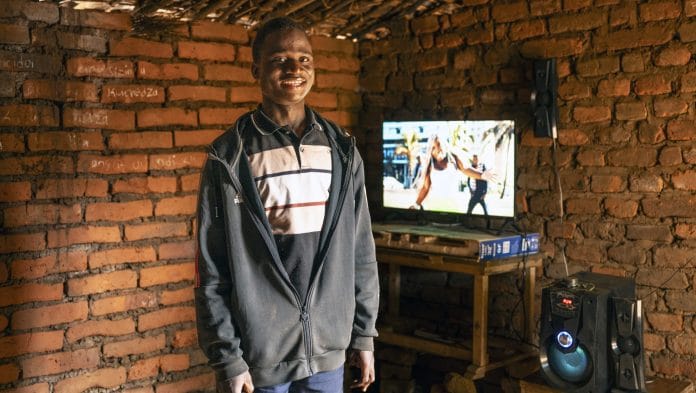

Yonas Fote smiles as he proudly shows off his cinema. In an earth-floored room with low wooden benches, he uses a television and sound system to show Nigerian movies dubbed into the local language to his friends. He charges them the equivalent of 12 cents each.
It might sound like a teenage side hustle, but 19-year-old Fote’s makeshift movie theater in the bustling village of Kamala in southern Malawi is part of an experiment designed to showcase what the future of aid might look like: Give people cash and see what they do with it.
Fote is among the beneficiaries of what calls itself the world’s biggest unconditional large, direct cash transfer trial, a $198 million program run by the not-for-profit GiveDirectly. As many as 230,000 adults in two districts of Malawi are each receiving about 1.2 million kwacha, or almost $700, and they can do whatever they want with it.
Near Fote’s cinema in the country’s Chiradzulu district, tailor William Mwacho is busy making dresses. He bought a 500,000-kwacha electric sewing machine to meet a surge in orders.
“It works fast and it makes the clothes look beautiful,” said Mwacho, speaking in Chichewa, the dominant language in Malawi. “I haven’t calculated, but one thing I know for sure is that I make a lot of money.”
By developed world standards, $700 is the price of an entry level iPhone. In Malawi, the world’s poorest country not affected by conflict, it’s roughly the same as its per-capita economic output for a year. The aim is simple: that people will use it entrepreneurially to generate economic activity, lessening the need for aid in the future.
The majority of the project is funded by the co-founders of Australia’s $42 billion design startup Canva. And, for now, it seems to be working in Kamala.
A store owner displays the village’s first refrigerator from which he and his wife sell chilled water. Other villagers are stocking their shops with soap and salt. Cecilia Malidadi is cooking potato fries and cabbage to sell as a snack to her customers including two visiting priests.
Since the money arrived in February, there’s been a rush to plaster houses and install corrugated iron roofs instead of thatch. Others have bought goats and one recipient of the cash is building a rest house for passing travelers.
When the US is slashing assistance and other traditional donors are redirecting resources to defense and other priorities, charity groups and not-for-profits are trying to make their money go as far as possible. Cash transfers offer a low-cost way of distributing what’s available.
In Malawi, 47% of the population of about 21 million live under the government poverty rate of 1,563 kwacha a day. That’s 90 cents at the official exchange rate or half of that at the more commonly used black market rate.
“We wanted to choose a country that was peaceful, and obviously that did have a lot of extreme poverty,” said Melanie Perkins, Canva’s billionaire co-founder and chief executive officer. “This is the best money I’ve spent and it’s extraordinarily effective in achieving people’s basic human needs.”
Direct cash transfers have been the subject of academic debate and smaller studies for decades. The question has always been whether the money would be squandered and if it’s better to use it for programs that need trainers and equipment, such as chicken-rearing and chicken coops.
“There is the idea that you give a man a fish, you feed him for a day, teach a man to fish and you feed them for a long time,” said Nick Allardice, president and CEO of GiveDirectly. “Capital is far more often a constraint than know-how. We don’t need a whole village of people fishing. We need bakers, we need taxi drivers, we need mechanics.”
The contrast between Kamala and Sapali, a village in nearby Phalombe district, is stark. GiveDirectly staff in Sapali are just beginning to register recipients with the aim of sending through payments via mobile phone in a few weeks.
With the summer harvest over, villagers sit outside rudimentary structures whiling away the dry and dusty winter months of the southern hemisphere with little to do. People scratch a living. There’s no money for entertainment and few business activities.
Agnes Kaloza, who is 56 but looks old beyond her years, sits on a wooden stool outside her half-finished house. A smaller structure was destroyed by Cyclone Freddy in 2023. Her youngest son, Sidric, was rebuilding it for her, but he fell ill and died at the age of 26 last year.
Since then, she’s survived by selling bags used for storing corn and pigeon peas, which she buys from suppliers and then sells individually making about $50 profit a month.
“I am very, very excited,” Kaloza said. With her cash transfer, she plans to finish her house by plastering its interior and installing windows. She then wants to buy larger consignments of bags at a lower per-unit cost, making her trade more lucrative. “Our lives will all be changed.”
One of her neighbors, 24-year-old Friday Chiwaula, plans to pay to finish his medical studies and buy some chickens. Fifty-year-old Daniel Misomali will add a corrugated iron roof to his house to stop the water coming through the thatch and destroying food stores. If there’s any money left, he’ll buy pigs or cattle, he said.
Founded by graduate students from Harvard University and the Massachusetts Institute of Technology in 2008, GiveDirectly has run smaller trials and programs in a number of countries, starting with Kenya. Disbursements have ranged from giving money only to the poorest people in communities, to disaster relief and now community grants.
While GiveDirectly started work in Malawi in 2019, Canva joined two years later. It began with a small contribution before pledging $50 million and last year a further $100 million to fund the program for another three years. “Why we chose this was because it could go directly to the people that it was intended to help,” Perkins said in an interview from Sydney in June.
In Malawi, the distribution of cash starts with a meeting with community leaders often including the chief before a wider meeting, or Baraza, where the program is explained. At one event in a village about an hour-and-a-half’s drive from the commercial capital, Blantyre, villagers, divided into groups of men and women, sing and laugh at the presenter’s jokes.
While about 98% of eligible recipients get on board, there have been some complications. Projects have been hampered at times by beliefs that witchcraft is involved or it’s a political scheme to sway elections, said Grace Jackson, GiveDirectly’s country director in Malawi.
The next stage is for all eligible adults to be registered and a token payment is made within a few weeks. Once receipt is confirmed, the rest of the money follows with administrators checking at intervals on how the money is having an effect rather than advising on what it should be spent on.
Research shows that for every dollar distributed, $2.50 of economic activity is created over the next 30 months and prices only rise marginally, said Dennis Egger, an economics professor at Oxford University who has studied GiveDirectly’s programs. Other benefits include a fall in child mortality, as pregnant women can pay for transport to clinics and stop working in the weeks before childbirth.
Initially there was skepticism that the money would create dependency or it would be spent on temptations like alcohol, Egger said. “There’s hundreds of papers now that have shown that this is really not the case,” he said.
With 83% of every dollar donated going to recipients, according to Jackson, the project in Malawi is more efficient than charities saddled with staff, logistics, training and other costs. Chicago-based Charity Watch considers 75% or more to be “highly financially efficient.”
What’s more, traditional assistance programs have made little difference in Malawi. The nation received about $20 billion over the two decades until 2023, according to the World Bank. the government depends on donors to fund a large part of its budget and food aid arrives on an annual basis. Despite that, its poverty rate has stagnated.
Meria Tambala, a 38-year-old mother of five in a polygamous marriage in Kamala, is using her $700 payment to connect her house to the electricity grid. Then she will build a small room where she can cut hair to make money.
“Things have changed for the better,” Tambala said, sitting outside her house with her youngest child, a two-year-old called Chikondi, which means “love” in Chichewa. “The children are well looked after.”
Disclaimer: This report is auto generated from the Bloomberg news service. ThePrint holds no responsibility for its content.