



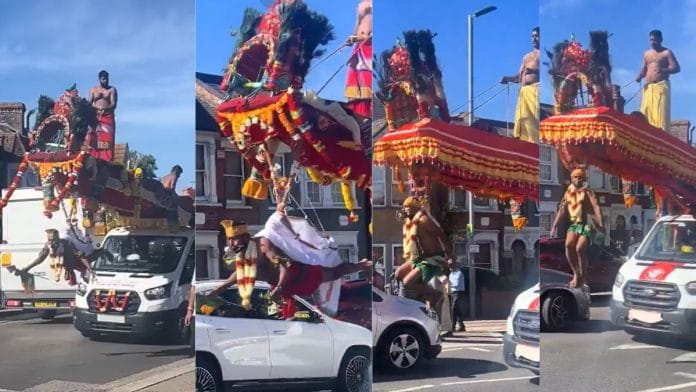

Chennai: A viral video of devotees performing a dramatic ritual known as the “flying Kavadi” on the streets of London has drawn global attention to a centuries-old Tamil temple tradition now thriving far beyond India’s borders.
The video shows devotees suspended mid-air from decorated chariot-like structures, giving the impression that they are flying.
Spectators estimated that more than 30,000 people attended the Kavadi Aattam ritual dance for the Ther Thiruvizha chariot festival, which led to the closure of many streets. The programme was organised by the Shri Kanaga Thurkkai Amman temple in West Ealing.
What is the Ther Thiruvizha chariot festival?
Ther Thiruvizha is one of the most eagerly awaited annual ceremonies at temples across Tamil Nadu.
During the centuries-old ritual, a smaller processional form of the presiding temple deity is placed on a massive, elaborately carved wooden chariot known as a ‘ther’. Devotees then pull the chariot through specially designed “ther streets” near the temple.
The act of taking the deity outside and the procession are seen as the deity leaving the sanctum to move among the people, receiving their prayers, offering darshan, and blessing the community.
The Thiruvizha is held in numerous Hindu temples across Tamil Nadu, particularly during annual temple festivals or Brahmotsavams.
A significant feature of many such processions and related festivals is the Kavadi Attam, or the “burden dance”, turning the roads into a vibrant stage of music, colour and fireworks.
The devotees carry a ‘kavadi’, a semicircular wooden or metal frame balanced on the shoulders and decorated with flowers, peacock feathers, cloth, and sacred symbols, while dancing rhythmically to the beat of traditional percussion instruments.
Not all processions are celebrated with the Kavadi Attam.
The festival is also accompanied by music from the traditional wind instrument, the nadaswaram, and drums, as well as ritual offerings and public participation.
Some of the famous chariot processions are those at the Meenakshi Amman Temple in Madurai and the Thyagaraja Temple in Thiruvarur, which is home to one of Asia’s largest temple chariots.
Other prominent examples are the Kapaleeswarar Temple in Mylapore, the Arunachaleswarar Temple in Tiruvannamalai and the Chidambaram Nataraja Temple. It is also popular among Tamil diaspora communities worldwide.
The story behind the ‘flying kavadi’
The practice of carrying the ‘kavadi’ is rooted in mythology. The legend goes that Lord Murugan’s devotee Idumban was asked by Sage Agastya to transport two sacred hills, Shivagiri and Shaktigiri, to southern India. Idumban set out, the hills slung over his shoulders on a kavadi, balanced on either side. Tired after the long journey, he rested near what is now Palani and put down his load. But when he tried to lift the hills again, they would not move. A young boy stood atop one of the hills and refused to step aside. A fierce confrontation followed between the boy and Idumban, where he was struck down.
At the pleadings of his wife and the sage, Lord Murugan resurrected Idumban. Realising the boy was none other than the deity himself, Idumban begged for forgiveness. Deeply moved by the Idumban’s steadfast duty and faith, Murugan declared that anyone who approached his shrine carrying a kavadi in the same spirit of devotion would receive his blessings.
The famous Palani Murugan Temple now stands at the spot. Idumban was thereafter appointed guardian at the foot of the hill, and the practice of bearing the kavadi as a sacred burden began. Idols of Idumban are placed outside Murugan temples as well.
Priests and devotees who participate in Ther Thiruvizha describe the more intense form known as Parakum Kavadi, or ‘flying Kavadi’, as a way of worship that signifies complete surrender. The ritual involves devotees being suspended from hooks attached to a decorated frame or vehicle so that they appear to be flying.
Many devotees explain that the posture evokes the peacock, Lord Murugan’s divine vehicle, soaring freely. However, the act of being suspended mid-air is also understood as an act of total vulnerability—a deliberate attempt to let go of the ordinary, physical world—with nothing left to hold on to except faith.
Devotees participating in a procession at an Amman temple in Chennai said that, over time, carrying the ‘kavadi’ has come to represent the willing acceptance of a spiritual burden, the fulfilment of vows, gratitude for blessings received, or a plea for divine help.
Some participants also carry milk pots on their heads or undergo temporary body piercings with vels, or thin metal rods.
Some temples also have a tradition of devotees walking on fire at a dedicated place inside the temple while carrying the pots or ‘kavadi’.
Though most closely associated with Murugan festivals such as Thaipusam, the Kavadi Attam frequently appears in processions honouring other deities.
The festival is celebrated for a range of deities, most commonly the temple’s principal god or goddess, including Hindu god Shiva in forms such as Thyagaraja, Kapaleeswarar or Nataraja, goddess Meenakshi, Parvati, Durga, Lord Vishnu, and Lord Murugan.
(Edited by Sugita Katyal)
Also Read: Ganga aarti on the Thames. Sold-out London event sparks joy & social media buzz