



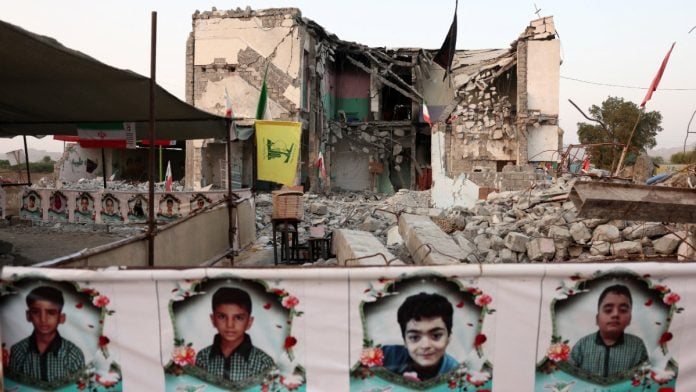
New Delhi: A Pentagon investigation has revealed that a combination of flawed intelligence, outdated satellite (SAT) imagery and an overdependence on artificial intelligence resulted in the US missile strike that killed 123 children at Shajarah Tayyebeh Elementary School in Iran’s Minab on 28 February.
According to a report by Bloomberg, officials directly involved in the Pentagon’s internal investigation have now said that the strike was caused by what they described as a ‘cascade of preventable failures’. They also identified an array of missed opportunities that could have prevented the tragedy.
The officials, speaking anonymously, revealed that the Trump administration ordered a massive aerial assault on Iran towards the end of February, during which more than 1,000 targets were struck within the first 24 hours. The order squeezed the time frame for finalising targets, sparking an urgency that, compounded with information gaps about the site, staffing cuts in civilian-protection personnel, and an overdependence on AI tech, prepared the ground for the deadly military targeting error.
Officials part of the internal investigation also emphasised the role of outdated intelligence.
Despite being identified as a military complex years earlier, abundant physical evidence on recent satellite imagery showed that the site had already undergone modifications dating back nearly a decade—construction of walls and entrances separating the school from the military base (2017), and colourfully painted walls adjacent to a football pitch, besides assembly rows and play markings etched on the ground (2018).
However, the Pentagon, which had characterised the site as a IRGC naval unit base years earlier, failed to upgrade its classification.
In June, The New York Times had also reported that officials overseeing the operation relied on satellite imagery that had not been updated in seven years and did not show a school at the site.
In a separate report in June, Bloomberg had revealed that a US intelligence analyst noticed the changes as early as 2019 and also fed his remarks electronically. But the system was not connected to the primary military intelligence database that aided targeting.
According to officials, artificial intelligence embedded in the Maven Smart System owned by Palantir Technologies Inc., contributed to the disaster since CENTCOM, which carried out the attack, consisted of personnel over-relying on and over-trusting the AI system.
As 28 February neared, US defence officials were allotted the task of identifying potential targets that would paralyse Iran’s military even before Tehran could respond. The naval division of IRGC was foremost on the list. The site at Minab, erroneously classified as an IRGC facility and fed into Maven, was made a primary target by the software.
All targets usually move through a multi-stage assessment process known in military circles as the ‘kill chain’. Earlier, the process involved intelligence analysts, imagery specialists, targeteers, lawyers, operational commanders and launch crews. However, this time around they were replaced or sidelined by Maven, which condensed several hours of work into a matter of minutes, according to those involved in the Pentagon’s internal review.
The report also points to US Defence Secretary Pete Hegseth’s purge of Pentagon’s civilian harm mitigation (CHM) units, which involved slashing headcount across various teams by an overwhelming 90 percent to fewer than 20 staff members. CENTCOM’s strength was, according to the report, reduced from 10 to 1.
A few CENTCOM workers, it added, expected Maven to flag outdated information or incoherencies, but that did not materialise.
(Edited by Amrtansh Arora)
Also Read: Iranian billboard shows Donald Trump lying in a coffin. ‘We Kill Trump’ reads a slogan