





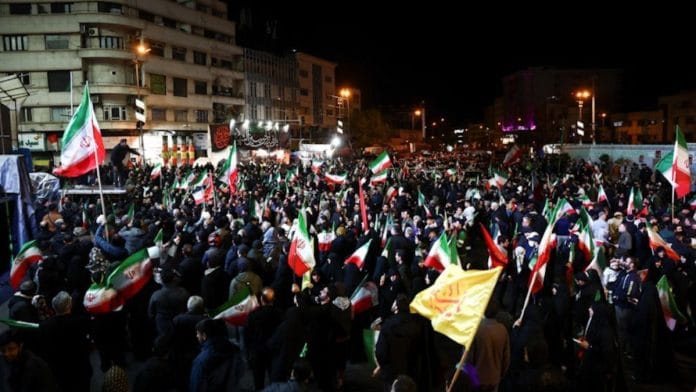



New Delhi: With just hours to go before President Donald Trump’s ‘civilisation-ending’ deadline ran out, the United States and Iran agreed to a two-week ceasefire in the six-week long West Asia conflict that has engulfed the entire region. This Pakistan-brokered move, starring Prime Minister Shehbaz Sharif and Field Marshal Asim Munir, will reopen the Strait of Hormuz “for two weeks”, and calm the roiled world oil market.
The dual announcements by Trump and Iran Foreign Minister Seyed Abbas Araghchi came about an hour after Pakistan’s Prime Minister Shehbaz Sharif, one of the leaders mediating an end to the conflict, put out a statement requesting Trump to extend the deadline to bomb Iran by two weeks while making a request to Tehran to reopen the Strait of Hormuz. Both conditions have since been accepted by both sides, in separate statements.
“Based on conversations with Prime Minister Shehbaz Sharif and Field Marshal Asim Munir, of Pakistan, and wherein they requested that I hold off the destructive force being sent tonight to Iran, and subject to the Islamic Republic of Iran agreeing to the COMPLETE, IMMEDIATE, and SAFE OPENING of the Strait of Hormuz, I agree to suspend the bombing and attack of Iran for a period of two weeks. This will be a double sided CEASEFIRE!,” Trump said in a statement on the social media platform Truth Social.
The US President added: “The reason for doing so is that we have already met and exceeded all Military objectives, and are very far along with a definitive Agreement concerning Longterm PEACE with Iran, and PEACE in the Middle East. We received a 10 point proposal from Iran, and believe it is a workable basis on which to negotiate.”
The diplomatic success has brought a pause in the conflict which was poised to reach higher with the expiry of the latest Trump deadline. Araghchi credited Pakistan too, thanking Sharif and Munir in separate statements for their efforts to find a solution to this war. The Iranian foreign minister added that “considering the request by the U.S. for negotiations based on its 15-point proposal, as well as an announcement by POTUS [Trump] about acceptance of the general framework of Iran’s 10-point proposal,” as a basis for negotiations, Tehran will cease its defensive operations as long as “attacks” are halted.
“For a period of two weeks, safe passage through the Strait of Hormuz will be possible via coordination with Iran’s Armed Forces and with due consideration of technical limitations,” Araghchi said.
The announcements come after Trump earlier Tuesday threatened to “wipe out” Iranian civilisation, promising devastating airstrikes against critical infrastructure in Iran, including power plants and bridges which could potentially constitute a war crime under international law.
“A whole civilisation will die tonight, never to be brought back again. I don’t want that to happen, but it probably will. However, now that we have Complete and Total Regime Change, where different, smarter, and less radicalized minds prevail, maybe something revolutionarily wonderful can happen, WHO KNOWS?,” said Trump about 10 hours before the ceasefire announcement was made.
Israel has also agreed to the two week ceasefire, according to reports, bringing respite to the conflict that has engulfed the region. Iran promised retaliation against key oil and gas infrastructure in the region, if their own critical infrastructure was hit by the US.
Negotiations had hit a stalemate last weekend, and hectic negotiations Tuesday did not seem to provide the much-needed off-ramp. Trump had, however, indicated Sunday that a deal could be made by Monday evening.
The war roiled energy markets, especially with the effective closure of the Strait of Hormuz by Iran. The global waterway accounts for a fifth of the world’s energy supply.The Iranian retaliation to Israeli attacks on its energy infrastructure led to damage to Qatari gas production. For India, the attack on Qatari energy infrastructure is a blow, given that Doha is the source for almost 40 per cent of its imports of liquefied natural gas (LNG).
The Gulf states faced the brunt of Iranian retaliation over the last six weeks, in particularly the United Arab Emirates, Qatar and Kuwait. Oman, Bahrain and Saudi Arabia also faced retaliatory strikes from Iran.
Pakistan, along with Egypt, Türkiye and Saudi Arabia have been locked in negotiations for a few weeks to find a solution to the conflict. Iran has clarified that no direct negotiations are taking place, but that they have conveyed their position for the framework of any future negotiations.
Sharif announced that the ceasefire will include the ongoing conflict in Lebanon. Israel has been conducting ground operations against the country, after Hezbollah joined the conflict in support of Iran last month.
“I warmly welcome the sagacious gesture and extend deepest gratitude to the leadership of both the countries and invite their delegations to Islamabad on Friday, 10th April 2026, to further negotiate for a conclusive agreement to settle all disputes,” Sharif added in a statement on the social media platform X.
Hours before the ceasefire was announced, the US and Israel had stepped up their attacks on Iranian infrastructure, including its railways.
(Edited by Nardeep Singh Dahiya)
Also Read: Trump says ‘good chance’ of deal with Iran before his deadline, else he will ‘blow everything up’