





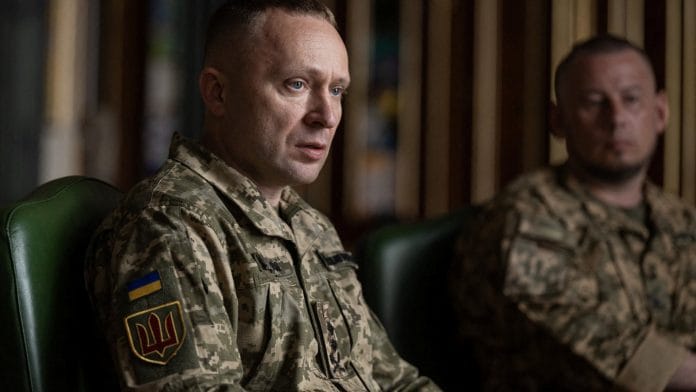


Mykhailo Drapatyi is the military commander-in-chief with the hardest job in Europe and most likely one of the youngest.
At 43, he’s been handed responsibility for masterminding Ukraine’s continued fight against Russia’s invasion. Propelled through the ranks by his experiences fighting in a dozen years of war, he’s arrived at the apex of his career at a potentially pivotal moment for the Ukrainian army.
His appointment was a reluctant concession by President Volodymyr Zelenskyy to protesters in Kyiv and other major cities who’d turned out to demand the ouster of what they regarded as the bureaucratic old guard in Ukraine’s military.
The target of their ire was Oleksandr Syrskyi, the commander-in-chief who’d won out in a conflict with the popular defense minister, Mykhailo Fedorov, the 35-year-old champion of Ukraine’s cutting-edge drone program. After first dismissing Fedorov to try to resolve the crisis, Zelenskyy this week bowed to public demands to replace Syrskyi.
Now Drapatyi picks up the baton.
The new commander literally burst onto the scene for many Ukrainians in 2014 when he led a column of armored vehicles crashing through a barricade erected by Kremlin-backed forces in the city of Mariupol as Russia fueled a separatist insurgency.
He was then a batallion commander sent by the government in Kyiv to repel the incursion. In a rare 2023 interview with the Ukraїner W YouTube channel that was released in full this week, Drapatyi said his driver had hesitated and asked what to do as they approached the blocked road.
“I told him, ‘Hit the gas!’” he recalled. Video of the incident quickly went viral, showing Drapatyi’s vehicle briefly airborne after breaking through the barrier at high speed before bouncing onto the road and speeding away.
Russian President Vladimir Putin’s forces captured Mariupol during the full-scale invasion of Ukraine in 2022. By then, Drapatyi was a general commanding frontline troops in southern Ukraine.
In 2024, Drapatyi was made commander of Ukraine’s Ground Forces, the country’s third most senior military post. But in June 2025, he resigned after a Russian missile strike hit a Ukrainian military training ground, killing 12 soldiers and wounding 60 others, saying he took responsibility for the casualties.
Zelenskyy accepted the resignation then appointed him Commander of the Joint Forces, insisting Drapatyi remain in the ranks.
“We must change the culture within the army,” Drapatyi said in a post on Telegram later that day, “toward the value of every life of a Ukrainian soldier who took up arms to defend Ukraine.”
That’s a theme he’s returned to repeatedly in his career and a message that resonates with many Ukrainians weary of a war that’s now in its fifth year and opposed to broader mobilization to replenish the ranks.
Many men are seeking to avoid military service, hundreds of thousands have fled the country, and confrontations between potential conscripts and draft officers, some of them violent, have become increasingly common.
“Human life is the highest value,” Drapatyi said in his interview to Ukraїner W. “Equipment can be replaced. People can’t.”
After Zelenskyy sided with the veteran Syrskyi and dismissed Fedorov earlier this month in an attempt to resolve tensions between them over reforms and strategy, the protesters and many in the younger generation of Ukraine’s military made clear they wanted a different outcome.
The demonstrators who were demanding Fedorov’s reinstatement also called for Drapatyi’s promotion.
For them, Syrskyi, who’ll be 61 on Sunday, symbolized an approach to war that was overly reliant on infantry assaults resulting in heavy casualties, what’s known as a meat-grinder tactic more commonly associated with Russia.
The issue was further amplified last month when Ukrainian journalists published an investigation into a unit closely associated with Syrskyi, alleging widespread abuse of recruits by commanders. The brigade denied wrongdoing.
Pavlo Yelizarov, a prominent Ukrainian military officer known by the callsign “Lazar” and now deputy commander of Ukraine’s Air Force, first met Drapatyi in the Kherson region in the spring of 2023 and was advocating for wider use of drones.
“What surprised me most was Drapatyi’s adaptability. He came from a conventional military background and initially knew little about drones, but he quickly saw their advantages,” Yelizarov said in a telephone interview.
While he said he respects Syrskyi, Yelizarov said he believed Drapatyi’s greatest strength is his ability to adapt to the changing nature of the war. Asked to compare the two commanders, he replied: “They are completely different. It’s like water and butter.”
Fedorov’s insistence on technology as the counterbalance to Russia’s manpower advantage and the best way to preserve soldiers’ lives resonated with Ukrainians, too. Drone strikes targeting Russian supply routes behind the front lines and deep into Russia itself also boosted military and public morale.
“It was Fedorov who put Drapatyi’s name into the public conversation,” said Volodymyr Fesenko, head of Kyiv’s Penta Research Institute. “He signaled that he had an ally in the military and a credible alternative to Syrskyi, making Drapatyi an acceptable — and symbolic — choice for protesters.”
Fedorov described Drapatyi’s appointment as army chief as “a breath of fresh air” and a “new hope” for the military in the war. He’s demanding reinstatement as defense minister, though Zelenskyy is resisting so far.
There are only three roles that truly shape the course of the war alongside the troops on the battlefield, Fedorov told reporters in a statement. They are president, defense minister, and commander-in-chief.
In his 2023 interview, Drapatyi said the war had produced a new generation of leaders and that Ukraine’s military was gradually shedding its former Soviet mindset.
“Although, let’s be honest, many people still haven’t left it behind,” he said.
The challenge now rests with him to continue modernising Ukraine’s military strategy including through technology while simultaneously waging daily battles to repel Russian forces.
“Whatever I do in life, I do it properly,” Drapatyi told Ukraїner W. “I do it responsibly, so I never have to be ashamed of the result.”
Disclaimer: This report is auto generated from the Bloomberg news service. ThePrint holds no responsibility for its content.