






By Maria Tsvetkova and Dan Fastenberg
NEW YORK, Sept 7 (Reuters) – Scott Larsen was 4 years old when his dad, the New York City firefighter he was named after, was killed in the collapse of the World Trade Center on September 11, 2001.
His father, then 35, had recently been temporarily assigned to Lower Manhattan from his normal firehouse in Woodside, in the borough of Queens, when a pair of jets hijacked by al Qaeda Islamist militants crashed into the Twin Towers. He was one of 343 members of the New York City Fire Department who died in the attack 25 years ago.
The two jets as well as a third piloted into the Pentagon and a fourth downed in Pennsylvania killed about 3,000 people in an unprecedented attack that left behind tens of thousands of grieving spouses, parents and children and stunned the world.
The events of September 11, early in President George W. Bush’s first term, profoundly reshaped U.S. national security policy and led to decades-long wars in which more than 900,000 died, primarily in Iraq and Afghanistan.
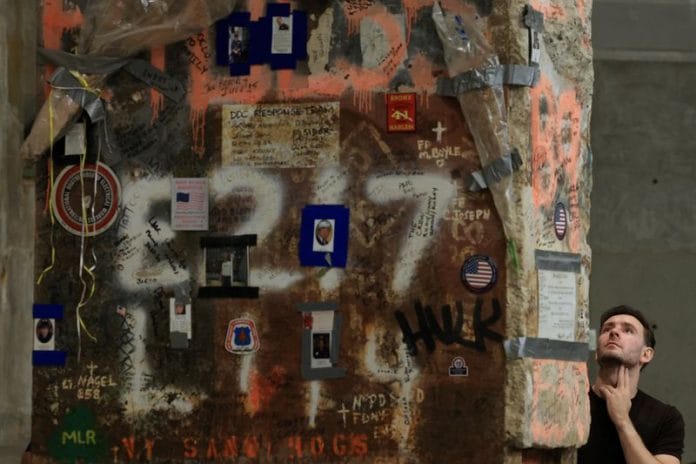
They also changed the course of individual lives, inspiring some children of victims to follow their parents into emergency service, steering others toward military, medical or public-service careers, and leaving survivors, responders and millions of Americans still reckoning with the legacy of that day.
These are the stories of three of them.
‘HIS MEMORY COMES UP EVERY DAY’
Larsen followed in his father’s footsteps. He joined the New York City Fire Department, seeking and securing an assignment to the same Woodside firehouse where his dad had served.
“It was something in me. I just always wanted to go here,” Larsen, now 29, said during an interview at the firehouse.
He’s far from alone — 58 children of FDNY firefighters who died on 9/11 have done the same, according to data collected by the International Association of Firefighters.
At the firehouse, Larsen is surrounded by reminders of his father, whose name is engraved on a memorial plaque and painted on a fire truck. Photographs of him hang in the kitchen and break room.
“His memory comes up every day, honestly,” he said. “There is never a day I come here and I don’t look at him.”
Larsen is the third generation of firefighters in his family. His younger brother, born two days after 9/11, has passed the entrance exam and hopes to join the FDNY next year.
“Hopefully, when I have a son or a daughter, either one, they’ll continue on the legacy,” Larsen said.
‘THIS WAS PERSONAL’
Dr. Michael Crane never stopped helping rescue workers.
As devastating as the initial death toll was, it wasn’t the end of the story. Tens of thousands of police, firefighters, utility workers and construction workers responded to the wreckage in downtown New York.
Known as “the pile,” it towered about five stories high and the search for survivors, and later remains, continued for months beneath lingering clouds of dust.
As medical director at New York electric utility Con Edison, Crane’s job was to protect the rescue and cleanup workers, including making sure each had a properly fitted respirator.
Getting the respirators to the crews turned out to be the easy part — once in use they quickly clogged with dust. Many simply tossed their respirators aside.
In the early days of the recovery effort, a young man showed up at Crane’s office with a severe cough after working on the Ground Zero pile. When Crane told him to take a few days off and get treatment, the man refused.
A member of the young man’s family was buried somewhere beneath the rubble, Crane recalled in an interview at Mount Sinai Hospital, where he now serves as medical director of the World Trade Center Health Program.
“At that moment I realized this was not just some type of national thing or state thing, this was personal,” Crane, 74, said. “This was personal to a lot of these guys who had lost people down there.”
The government-funded World Trade Center Health Program provides health care for 9/11-related illnesses to more than 150,000 responders involved in rescue and recovery efforts and survivors who lived, worked or studied in the disaster area, according to data collected through June 30 by the U.S. Centers for Disease Control and Prevention.
As of June 30, people in the program had received roughly 85,000 certifications for World Trade Center-related health conditions. About half were linked to inhaling or swallowing toxic dust and about 30% were for cancer. More than 9,000 responders tracked by the program have died since 9/11, though officials say it’s difficult to determine the role that 9/11 played in their deaths.
A quarter-century after the attacks, Crane is still deeply affected by the recovery workers.
“You fall in love with these people,” he said. “They are amazing, just resilient, funny, a little bit crazy. And even, despite what they’ve been through, really mentally tough and proud of what they did.”
‘I DIDN’T LISTEN TO MY GUT’
Like so many affected by 9/11, Michael Tuohey lives with unanswerable questions.
As an airline customer service agent, Tuohey helped two of the hijackers check into their flights at Portland International Jetport in Maine, the starting point of a journey that ended in American Airlines Flight 11 crashing into the North Tower of the World Trade Center.
Mohammad Atta and Abdul Aziz al Omari arrived just a half hour before their flight.
Tuohey scanned the men’s paper tickets to see whether they had been recently purchased or paid for in cash, which would have raised red flags even by pre-9/11 standards. But the tickets had been bought weeks in advance, paid for with credit cards, and were for first class.
“I was getting a vibe from the older, shorter guy that he didn’t like being there,” Tuohey said, referring to Atta. “And I’m thinking: it’s 5:30 in the morning. Nobody wants to get up at 5:30 in the morning.”
Later, in the aftermath of the attacks, U.S. intelligence failures that missed the al Qaeda plot would be widely dissected. The Department of Homeland Security would be created, safety procedures at airports revamped and the nation ushered in a web of new security laws.
But as the first glimmers of sunlight warmed the eastern skies over Portland that crisp fall morning, Tuohey had no way of knowing the horrors the morning would bring.
“My gut instinct was good but there were laws, there were laws against profiling people,” said Tuohey, now 80 and retired. “I didn’t listen to my gut. And it turned out to be an awful thing. But it wasn’t that I was right. It’s just that it could have changed something. Not that it would have, but it could have. Who knows?”
(Additional reporting by Brian Snyder and Erica Stapleton, writing by Scott Malone; editing by Paul Thomasch and Deepa Babington)
Disclaimer: This report is auto generated from the Reuters news service. ThePrint holds no responsibility for its content.