



The stunning comeback that secured Luiz Inácio Lula da Silva a fourth term as president of Brazil has given the politics of Latin America a major twist. The colossus of South America will remain on a leftist track, countering the remarkable rightward shift across the region.
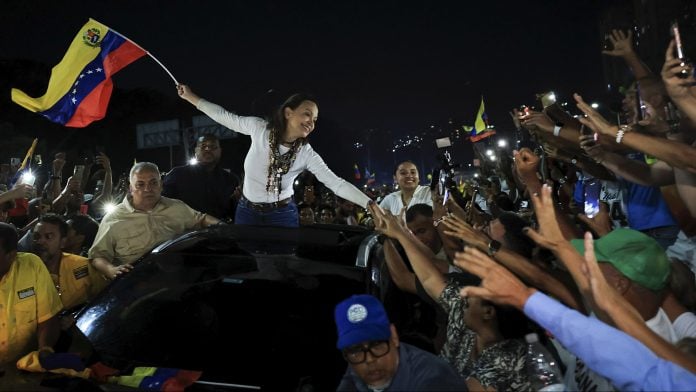
But for the US, Brazil’s election may not have been the most important event in Latin America this week. Rather, it was the return of Venezuela’s opposition leader (and Nobel Peace Prize laureate) María Corina Machado. While her return from exile is to be celebrated, it may seriously complicate the Donald Trump administration’s ambitious project to remake the politics, economics and infrastructure of the nation with the world’s largest proven oil reserves.
What is the best way for the US to navigate the shifting political winds in South America? How can the US help Venezuela recover in a way that benefits both Washington and Caracas? And will this week’s events set back the “Donroe Doctrine,” Trump’s plan to reinforce US hegemony over the Western Hemisphere?
I know Latin America well, as a native of southern Florida and former commander of US Southern Command, which has military responsibility for Latin America and the Caribbean. Seemingly forever, the region has been held back by intractable challenges: poverty, coups, corruption, drug smuggling, gangs, insurgencies and the malign influence of Communist Cuba. I’ve met many leaders of the region, including Lula and the former Venezuelan strongman Nicolás Maduro.
I first encountered Lula in March 2005, when he was in his first term as president and I was a vice admiral and senior military assistant to Secretary of Defense Donald Rumsfeld. Despite their vastly different backgrounds — Rumsfeld a Princeton-educated former Navy pilot and staunch Republican, Lula a former union organizer and metalworker — the two hit it off immediately.
The talks focused mainly on cooperation between the US and the Brazilian police and military in counternarcotics. We also covered Brazil’s leadership in the United Nations stabilization mission in Haiti, which Rumsfeld was keen to encourage given the US commitments in Iraq and Afghanistan. On those topics, the discussion was fruitful.
The main point of contention was Venezuelan leader Hugo Chávez, who was shifting large amounts of oil revenue to leftist regimes in Central and South America. Rumsfeld and Lula agreed to disagree on that one. I came away with a lot of respect for the Brazilian leader for his good humor and ability to hold his own with the prickly Rumsfeld.
What a difference a couple of decades can make. Chávez died of cancer in 2013, and his hand-picked successor, Maduro, is in jail in New York. Colombia’s insurgent group, the Revolutionary Armed Forces of Colombia (FARC), demobilized a decade ago. And while Lula perseveres, right-wing governments are in power in Ecuador, Panama, Peru, Argentina, Chile, Bolivia and elsewhere.
But perhaps the most striking change is that the US is pursuing an interventionist strategy in a region it has so often ignored. And Venezuela is now the crux of the effort.
The US faces a delicate balancing act: forging stability and facilitating resource extraction while using a light enough touch to avoid blowback from the Venezuelan people. Secretary of State Marco Rubio is off to a good start in achieving three key US objectives.
The most urgent priority is to get Venezuelan oil and gas out from under sanctions and onto the market. This won’t just help stabilize the country, but over time will help reduce the soaring costs of hydrocarbons that threaten the global economy. This won’t be easy: Much of Venezuela’s crude is heavy and high in sulfur, making it challenging to extract and refine in any circumstances, and even more so given the nation’s dilapidated oil infrastructure.
The second goal is to create business opportunities for US oil, gas and construction firms. The reconstruction and reindustrialization of the Venezuelan economy afford a huge business opportunity with mutual benefit for both nations. Given its natural resources, Venezuela should be the most prosperous nation on the Caribbean.
Finally, neither of those goals is achievable without political stability. The Trump administration should press for a democratic election under international monitoring, but not to rush them. The US has called for first rebuilding a neutral supreme court and national election commission, among other steps.
The likely contenders are clear: Machado and interim President Delcy Rodríguez, who represents the remnants of the old Chavista regime, but who has largely cooperated with the US since Maduro’s arrest. Machado’s desire to hold a free and fair elections by mid-2027 seems too ambitious; putting them off until at least 2028 would be a more realistic target for meeting necessary conditions.
Washington has three potential allies for its Venezuela strategy: Colombia, Brazil and the Organization of American States (OAS).
Colombia, which under President Abelardo de la Espriella is squarely aligned with the Trump administration, can take on several specific tasks. These could include joint Colombia-Venezuela raids on drug gangs that operate on both sides of the border, likely in conjunction with the US Joint Interagency Task Force South in Key West, Florida.
Increased economic ties are a win-win. For example, Venezuela could send natural gas to Colombia, which could be used in part to send electricity back across the border. Trade in food, industrial goods, consumer products and fertilizers could be vastly increased if the nations expanded crossing points for trucks and streamlined customs operations.
One prickly issue: The neighbors need to find a way to create safe conditions for the return of 3 million Venezuelans who fled to Colombia over the last decade.
As for Brazil, Lula’s reelection will make cooperation more challenging for the White House than it would have been under his right-wing opponent, Flávio Bolsonaro. But Brasília and Washington have common interests in regional stability, counternarcotics and other issues. Brazil could help Venezuela directly with food, medicine and construction materials — building on the assistance rushed in after last summer’s devastating earthquakes. The OAS, while not a powerful organization, can provide a forum for discussion and give the effort regional legitimacy.
The US should also keep a close eye on Venezuela’s neighbor to the east: oil- and gas-rich Guyana. There is tense recent history: In December 2023, Maduro staged a referendum endorsing Venezuela’s longstanding claim to roughly two-thirds of that smaller nation’s territory. The English-speaking former British colony should be integrated into any regional plan for the reconstruction of Venezuela to ensure its continued sovereignty.
Success in Venezuela is about far more than that country’s security and prosperity: It will be the sharpest test of Trump’s Donroe Doctrine. The US effort needs to focus on involving Venezuela’s neighbors (including Lula), getting its oil onto global markets, maintaining the attention of the already overloaded Rubio, and ensuring free and fair elections. Tough, but not impossible.
This report is auto generated from the Bloomberg news service. ThePrint holds no responsibility for its content.