





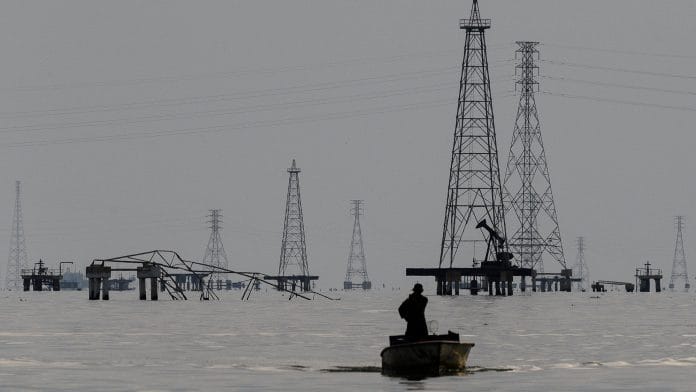



For more than a decade, most major Western oil companies have had little access to Venezuela’s reserves, the world’s largest, owing to a wave of nationalizations of their operations in the country in the mid-2000s and subsequent US sanctions. President Donald Trump intends to change that.
By removing Venezuela’s president, Nicolas Maduro, in an audacious Jan. 3 military strike and blockading its oil exports, the Trump administration aims to take control of the country’s dilapidated oil industry. Trump is urging Exxon Mobil Corp., Chevron Corp., ConocoPhillips and others to invest $100 billion to rebuild the sector. He says this will create “tremendous wealth” for the American people, the Venezuelan people — and of course the oil companies.
The companies themselves are cautious if not circumspect. Exxon Chief Executive Officer Darren Woods called Venezuela “uninvestable” in its current state.
What are Trump’s plans for Venezuela’s oil?
American navy ships in the south Caribbean have been seizing sanctioned Venezuelan oil vessels for weeks, effectively giving the US control over the country’s crude exports, the most valuable part of its economy. With no other option, Venezuela — under acting President Delcy Rodriguez — is now selling most of its oil to US refineries on the Gulf Coast. Before the US blockade, most of Venezuela’s oil went to China.
But Trump has much grander goals. His energy secretary, Chris Wright, has said the US would control future sales of Venezuelan oil. Trump says he wants to “increase oil production to levels never seen before.” He says that necessitates the participation of US oil companies, many of which had their assets in Venezuela nationalized two decades ago by Maduro’s predecessor, Hugo Chavez.
At a Jan. 9 White House meeting with oil executives, Trump said the companies must invest their own dollars at their own risk. The president said the US government would ensure physical security in Venezuela, however two weeks later, Wright told Bloomberg Television the US has no plans to provide security to oil company personnel operating there. but
According to Trump, the realization of his plan will lower gasoline prices in the US, keep Russia and China out of America’s backyard, and make the relevant parties a lot of money.
What do Venezuelan authorities say about Trump’s plan?
In her first state of the union message on Jan. 15, Rodriquez proposed opening up Venezuela’s oil industry to more foreign investment. She suggested legal reforms to lawmakers, including changes in the hydrocarbons law that the government relied on for nationalizations. The proposals would loosen the grip of the national oil company Petróleos de Venezuela SA (PDVSA) while preserving state ownership of reserves. .
Rodriguez seemed eager to appease Trump. In a Jan. 3 interview with the Atlantic, he appeared to threaten her life, saying, “if she doesn’t do what’s right, she is going to pay a very big price, probably bigger than Maduro.”
What would US oil companies stand to gain?
It’s not every day that companies are presented with the possibility of developing the world’s largest oil reserves. Industries in countries with large reserves tend to be dominated by state-owned oil companies. That’s been the case in Venezuela, as it is in Saudi Arabia, Russia and Iran.
With the energy transition moving more slowly than many expected, and fossil fuel demand forecast to stay strong through 2050, Venezuela presents a once-in-a-generation opportunity for US oil companies to lock in production for decades to come.
What do the oil companies say?
Chevron, which has continued to operate in Venezuela under a sanctions waiver and accounts for about a quarter of the country’s output, has pledged to boost its production — now at 240,000 barrels a day — by 50% over the next two years. Some other companies have made positive noises without committing funds. But others, such as Exxon, which has had its assets in Venezuela nationalized twice, say that before they’d return, they would need to see durable political and legal reform there.
Companies say they would need to see a stable government, the rule of law, regulatory changes to protect foreign investments, and long-term commercial agreements before they could invest the billions of dollars that would be necessary. Exxon added that it would need an explicit invitation from the Venezuelan government if it were to invest.
What would it cost to rebuild Venezuela’s oil industry? How long would it take?
Crude production in Venezuela has plunged more than 70% since the late 1990s, when the country pumped more than 3.2 million barrels a day. Its current daily output, of just under 1 million barrels, accounts for less than 1% of global consumption. It could increase that 20% within a few months, analysts say. However, that wouldn’t contribute significantly to the global market. The US alone pumps 13.8 million barrels of oil daily.
It would require massive investments to restore Venezuela’s industry to what it was before Chávez came to power in 1999, replacing a market-oriented economy with his version of socialism. To get to 3 million barrels a day by 2040 would cost about $183 billion, according to Rystad Energy, an Oslo-based consultancy.
Revitalizing the industry is complicated by the fact that Venezuela’s oil is heavy. Light oil bursts out of wells under natural pressure and flows easily through pipelines and storage tanks to get to ships. Not so Venezuela’s viscous crude. Companies typically add naphtha, an extremely light hydrocarbon, to loosen it up. That adds costs and complexity.
Because it’s heavy and also sour — that is, high in sulfur content — Venezuelan oil also needs specialist equipment to be refined, which adds still more to costs.
Why did Venezuela’s oil industry decline?
The collapse traces back to the early 2000s, when Chávez’s socialist revolution brought the industry under tighter state control, driving out foreign investment and experienced managers at PDVSA.
Chávez dismantled PDVSA’s meritocratic system and packed the company with political loyalists. A string of accidents plagued pipelines and oil facilities, including a deadly 2012 explosion at the Cardon refinery complex, one of the largest in the world, causing production to crater and forcing the OPEC nation to import fuel for its needs. Though crude oil prices soared to more than $100 a barrel in the mid 2000s, the industry was further rocked by money-laundering cases and international indictments of senior officials.
US pressure has also played a role in the nation’s oil troubles. More than 100 years of US involvement in the sector made Venezuela one of Washington’s strongest regional allies. As democratic backsliding and repression in Venezuela grew, the US imposed financial sanctions on PDVSA in 2017 and oil sanctions in 2019. The sanctions barred most oil trade and financing with PDVSA while permitting a few licensed exceptions.
The restrictions led to the further deterioration of PDVSA’s facilities, which are highly dependent on US technology that the company is banned from importing.
What’s the history of US involvement in Venezuela’s oil industry?
US oil companies were the main architects of Venezuela’s oil industry starting a century ago, building the country into a leading US supplier. Venezuela became a founding member of OPEC in 1960.
The industry was nationalized in the mid-1970s and reopened to foreign investment in the 1990s. Chávez expropriated major US oil projects in 2007. Exxon and ConocoPhillips pulled out and later won sweeping international arbitration awards for the seizure of their assets.
Chevron was the only US oil company to remain in Venezuela. The Houston-based company currently has a restricted license from the US Treasury Department to operate in four joint ventures with PDVSA.
Disclaimer: This report is auto generated from the Bloomberg news service. ThePrint holds no responsibility for its content.
Also read: The real risk to Iran’s oil industry is from labour strikes, not bombs