



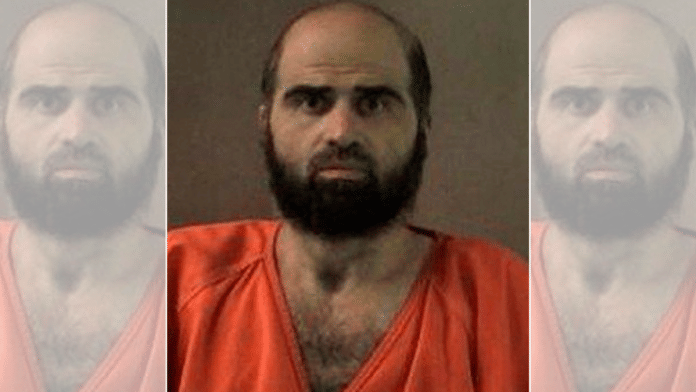
New Delhi: US President Donald Trump Monday ordered the rare use of a firing squad to execute a former US Army major who killed 13 people at the Fort Hood military base in Texas in 2009.
Nidal Hasan, 56, will be the first person in the US to face a military firing squad since the end of World War II in 1945. It will also be the first military execution by any method since 1961.
“Secretary of War Pete Hegseth has recommended — and President Donald J. Trump has approved — death by U.S. Army firing squad for convicted terrorist Nidal Malik Hasan, the jihadist who opened fire on unarmed American soldiers at Fort Hood in 2009. He killed 13 people and wounded 32 others while shouting ‘Allahu Akbar‘ during the attack,” Parnell said in an X post.
“The Secretary of the Army will set the time and place of the execution. Judgement day for Hasan has finally come,” he added.
Secretary of War Pete Hegseth has recommended — and President Donald J. Trump has approved — death by U.S. Army firing squad for convicted terrorist Nidal Malik Hasan, the jihadist who opened fire on unarmed American soldiers at Fort Hood in 2009. He killed 13 people and wounded…
— Sean Parnell (@SeanParnellASW) October 5, 2026
Hasan opened fire at Fort Hood on 5 November, 2009, killing 12 active-duty, unarmed soldiers and a retired serviceman and injuring 32 others. The former army psychiatrist was sentenced to death after being convicted in 2013 on 45 counts of premeditated murder for opening fire with a laser-sighted handgun inside a medical facility at the Texas military base.
The shooting occurred weeks before Hasan was scheduled to be deployed to Afghanistan. The US-born citizen of Palestinian descent, in his trial, said that he targeted soldiers who were preparing to deploy to Afghanistan because he wanted to protect the Taliban and its leaders from the US military.
“There was adequate provocation that these were deploying soldiers that were going to engage in an illegal war,” Hasan told the military judge during his trial.
Hasan first entered a processing center at Fort Hood and opened fire on troops gathered there for final medical checks before deployment. As soldiers tried to flee, he followed them through a back door and confronted police officers. He was arrested after an exchange of gunfire with two police officers and was left partially paralysed and confined to a wheelchair.
Military history
The last army soldier to be executed by firing squad was Eddie Slovik, who was shot in January 1945, during the final months of World War II in Europe after being convicted of desertion by a military court, according to the American broadcaster CNN. Among an estimated 50,000 American deserters during World War II, he was the only one executed.
The last army execution by any method occurred in 1961 at Fort Leavenworth in Kansas, when John Bennett was hanged after being convicted of raping and attempting to kill an 11-year-old Austrian girl.
Both of them were of private rank, the most junior rank in the US Army corresponding to a sepoy in the Indian Army.
Since 1916, the US military has executed 135 service members, according to the Death Penalty Information Center. Fifteen crimes can be punishable by death, and every military execution requires presidential approval. The president also has the authority to commute a death sentence.
Once the president approves an execution, the method and date are determined by the secretary of the Army, according to a May 2026 article in the US military’s Army Lawyer journal. The article said the execution date must fall between 60 and 150 days after presidential approval.
Besides Hasan, three other soldiers are on death row at Leavenworth, the Defense Department’s only maximum-security facility. All were convicted of murder, among other offenses, according to the article.
Return of firing squad
Firing squad execution has also re-emerged as an option in the broader US death-penalty system. In April, the Trump administration added death by firing squad to the list of permissible federal execution methods, alongside gas asphyxiation and electrocution, for the most serious federal crimes.
The number of federal execution options was expanded partly because of growing difficulties in obtaining drugs for lethal injections.
Hasan is one of four military prisoners awaiting execution, a process that requires presidential approval as well as appellate review. His case is distinct from the majority of executions in the US, where capital punishment is legal in 27 states.
Firing-squad executions remain rare, with the most recent taking place in South Carolina in March last year. Brad Sigmon became the first person executed by firing squad in South Carolina and the first in the United States in 15 years. Mikal Mahdi was executed by the same method on 11 April.
In 2024, the South Carolina Supreme Court ruled that firing squad, lethal injection and the electric chair were all legal methods of execution. The court said a firing squad was not cruel because a prisoner would not suffer for more than 15 seconds.
At least six people have been executed by firing squad since the United States reinstated the death penalty in 1977.
Trump, a supporter of the federal death penalty, reinstated firing squads as an execution method on his first day back as president in January 2025. At least five states have firing squads authorised by law, according to the Death Penalty Information Center. The Utah Supreme Court halted the scheduled 5 September 2025, firing-squad execution of death-row inmate Ralph Menzies. He later died of natural causes in November 2025.
Trump’s approval of Hasan’s execution comes in the backdrop of Tennessee’s plans to execute a woman for the first time in more than 200 years going wrong last week. Prison personnel’s botched attempt to administer a lethal injection left Christa Pike alive but unconscious and hospitalised on life support, according to the UK’s national public service broadcaster BBC.
“There’s nothing Donald Trump loves more than the power to kill,” Death Penalty Action, an advocacy group opposed to capital punishment, was quoted saying in a report, arguing that he had overseen more executions during his first term than any president since Franklin D. Roosevelt.
(Edited by Tony Rai)