





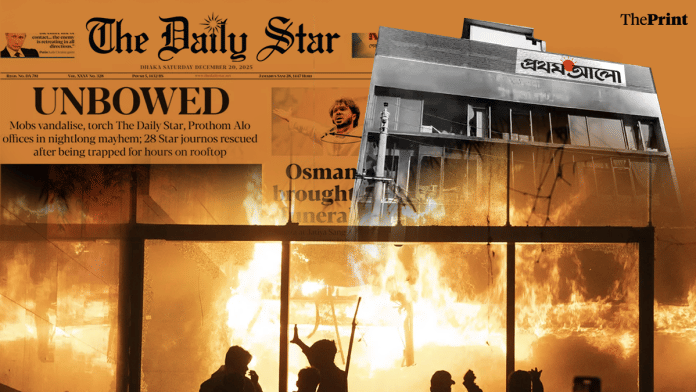



New Delhi: 19 December 2025 was the first morning in 27 years when there was no Prothom Alo. For a country accustomed to waking up with its most influential daily in hand, the absence felt heavier than silence.
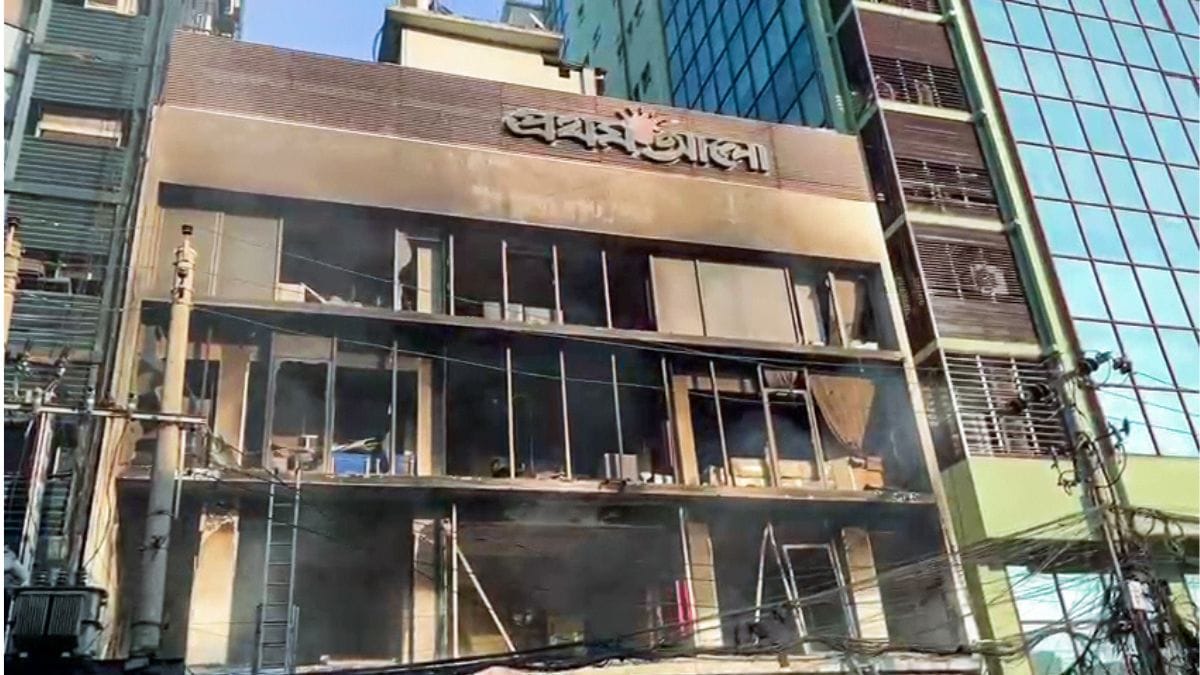
In fact, there were arson attacks by coordinated mobs on Bangladesh’s two most influential newspapers, The Daily Star, the country’s leading English-language newspaper, and Prothom Alo, its most widely read Bengali paper, in a rare moment when the nation’s press itself became the target of mob violence.
The Daily Star Editor-in-chief Mahfuz Anam said that in Bangladesh’s 53-year history, no media organisation had ever faced an arson attack like the one they witnessed on 18 December.
As deathly smoke began to fill up the corridors of the In The Daily Star headquarters, 26-27 staff members fled to the roof, where they waited to be rescued. As a matter of fact, they had a long wait. One journalist, Zyma Islam wrote a chilling message on Facebook: “I can’t breathe, you are killing me.”
Down below, fire engines had reached the street, but were unable to approach the building for many hours as it was surrounded by the mob.
“This was not about burning a building,” Mahfuz Anam, the paper’s editor said in a public meeting later. “They wanted to kill the staff of The Daily Star.”
The paper’s consulting editor, Kamal Ahmed, told ThePrint that while no staff members were physically injured, being trapped inside the building during the fire left them deeply traumatised.
“They survived without serious physical injuries, but the psychological impact is enormous. It has been traumatic not just for those colleagues, but for everyone in the organisation,” he said.
For Prothom Alo, the battle was was equally grim. Even though their server building escaped damage, printing and online operations had to be suspended for the first time in decades.
But just for a day. They were back in 24 hours.
“Early the next morning after the attack, senior members of the newsroom convened an emergency meeting where they decided to push ahead with publishing the paper the very next day,” Sajjad Sharif, the Executive Editor of Prothom Alo told ThePrint.
In the face of adversity, both organisations were defiant. The Daily Star’s front page carried a single word: “Unbowed”.
Sharif wrote a similar op-ed titled, “Yet, we will not bow our heads”.
“Readers from all walks of life shared photographs of the newspaper on social media. There were hundreds of posts expressing relief and happiness that the paper had returned after just one day. For journalists, it was a deeply affirming moment,” Sharif said.
The speed of the recovery, he said, was the result of collective resolve within the newsroom.
“Everyone worked with extraordinary commitment. That is the kind of resistance a free press shows.”
What the editorials said
Both newspapers used their first editions after the attacks not just as a reaffirmation of their indomitable spirit, they also framed the violence as a turning point for Bangladesh’s press and, by extension, its politics.
The Daily Star editorial refused to see it as an isolated act of anger against the press and called for accountability.
“Thankful as we are, we cannot help but take note of the government’s relaxed attitude towards the safety and security of news outlets despite previous threats and efforts to disrupt their operations. Both The Daily Star and Prothom Alo have been under repeated threats from different quarters but they were neither dealt with seriously nor investigated,” the editorial read.
“This attack of Thursday night that continued through the early hours of Friday is not merely an attack on two newspapers. It is an attack on independent journalism, freedom of speech, and the sanctity of private property. This must not be taken lightly,” it added.
Decades of confrontation
Prothom Alo’s editorial adopted a more expansive civic register, situating the attack within Bangladesh’s long struggle over pluralism and dissent.
“Many have since been describing the date as one of the darkest days in the history of Bangladesh’s media. The roots of the incident, however, lie further back—after the July mass uprising. From that period onward, certain anti-democratic, far-right individuals and groups launched a planned campaign of propaganda and venomous attacks against Prothom Alo,” Sharif wrote.
He also added that while the attacks on Prothom Alo reached their peak under Sheikh Hasina’s rule, the reality is that “journalism in Bangladesh has never been free from pressure under any government”.
“The freedom of the media is inextricably linked to the democratic condition of a country. Indeed, the degree of press freedom is a reliable barometer of how democratic a government is. In Bangladesh, that barometer has never reached the desired level,” he said in his editorial.
For much of its three-decade history, The Daily Star has been shaped by confrontation—be it with governments, generals or political dynasties. Founded in 1991, the paper rose to prominence for its outspoken coverage of Bangladesh’s defining political rivalry: The bitter contest between Sheikh Hasina’s Awami League and Khaleda Zia’s Bangladesh Nationalist Party (BNP).
By the early 2000s, it had overtaken older competitors like The Bangladesh Observer and Weekly Holiday, becoming the largest-circulating English-language newspaper in the country, with a readership concentrated among urban elites, business leaders and diplomats in Dhaka and Chittagong.
But that prominence came with risk. In 2007, amid military-backed rule, the editor-in-chief Mahfuz Anam publicly rebuked the army chief, General Moeen U. Ahmed, for proposing political reforms, arguing that such interventions lay beyond the army’s constitutional mandate. In a widely read column, he also criticised the caretaker government for arresting Sheikh Hasina—a stance that placed the paper at odds with the generals.
Two years later, The Daily Star published an investigative report implicating Tarique Rahman, Khaleda Zia’s son, and figures linked to Hawa Bhaban, the BNP’s power centre, in the 2004 Dhaka grenade attack that killed 24 people. Rahman was later sentenced to life imprisonment.
Interestingly, the arson attacks came a week before Rahman formally returned to Bangladesh after a 17-year exile to contest elections, cleared of all 87 charges against him by the Mohammad Yunus-led interim regime.
In 2015, Sheikh Hasina’s government suspended all state advertisements in the paper, a significant financial blow in a media market heavily dependent on government notices, before later restoring them.
In a 2022 essay titled “Can we really have a free and fair election?” Anam warned of democratic backsliding under the Hasina government. Over the next two years, he wrote repeatedly about shrinking civic space, press freedom, the now-repealed Digital Security Act and the weakening of electoral institutions.
After last year’s political upheaval and the formation of an interim government, The Daily Star continued to scrutinise state power under Yunus and, editors say, that scrutiny made the paper vulnerable.
The full extent of the damage is still being assessed, Ahmed said, but preliminary estimates place The Daily Star’s losses at around Tk 40 crore (approximately Rs 29 crore).
Access to the newspaper’s premises had been restricted until Tuesday as the area was being treated as a crime scene. With the removal of security barriers, preparations are now underway to make the building operational again. Ahmed said limited operations from the office could resume within the next two weeks.
Asked about the possibility of further attacks, Ahmed acknowledged that risks remain but expressed confidence that authorities would act to prevent any escalation. “There is outrage across the country and a broader coalition of unity against this kind of violence,” he said. “We do not expect the government to fail again.”
‘Didn’t publish for first time in 27 years’
Prothom Alo was founded in 1998, and the Bengali-language daily grew from an initial circulation of 42,000 to more than half a million copies a day. According to the National Media Survey, its print edition reaches 6.6 million readers daily and its digital platform is the most visited Bengali-language website in the world.
Its reporting has often blended advocacy with investigation. Early exposés on acid attacks and violence against women helped push the government toward stricter laws regulating acid sales.
But its reach has also made it a frequent target. Islamist groups have repeatedly accused Prothom Alo of offending religious sentiments. In 2007, a cartoon published in its satirical supplement sparked nationwide protests, a temporary ban and the jailing of the cartoonist. Later, controversies followed over books and columns alleged to mock religious texts.
Tensions escalated again in late 2024, as Bangladesh witnessed escalating protests against both papers. Demonstrators accused them of supporting the former government of Sheikh Hasina and being anti-Islam and pro-India. Protests took place nationwide in cities like Barisal, Chittagong, Sylhet and Rajshahi, demanding their boycott and shutdown.
On social media, the newspapers were repeatedly labelled biased and accused of spreading propaganda. Editors described the protests as orchestrated intimidation.
“Post the August upheaval, all of us had hoped for a restoration of democracy. In a democratic state, you cannot simply obstruct the distribution of a newspaper. There are other ways to address grievances. This is an act by some members of the social sphere, to intimidate amid a shift in power. But we will not be bogged down,” Sharif had then told ThePrint.
‘We have entered the era of murder’
At a protest meeting days after the arson attacks, in an extempore speech, Anam spoke about an video circulating online that showed a mob preventing fire engines from approaching the burning building.
“I don’t know if you’ve seen that video. But when people openly say they want to kill journalists, this cannot be dismissed as an accident or a moment of rage,” he said.
Echoing remarks by BNP Secretary General Mirza Fakhrul Islam Alamgir, he warned the national press that reaction was no longer enough.
“We cannot just react. We have to stand together and respond collectively,” Anam said. “We have entered the era of murder. Freedom of expression is now far away; we have to demand the right to live first.”
He described how attackers blocked exits and prevented fire services from approaching the burning building.
“If this were only about property,” he said, “they could have told our colleagues to leave. They didn’t. This is not about one newsroom,” Anam told the press. “It is about the survival of journalism itself.”
“Critical journalism is not only necessary for freedom of journalism; it is an opportunity for good governance,” he said. “Why would I criticise you (the government) using false information? Bureaucracy will never tell you the truth, intelligence agencies will never tell you the truth. Even your party colleagues will not tell you the truth. The only institution that will speak the truth is an independent media.”
(Edited by Viny Mishra)
Also read: Violence over Osman Hadi is about Islamist Bangladesh. India-baiting is a distraction