





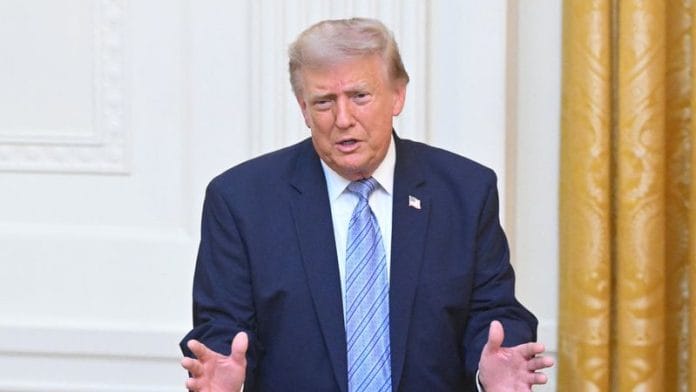


US President Donald Trump’s plan to impose steep tariffs on generic medicines has unsettled Indian drugmakers and put the spotlight on their strategy in their biggest export market.
The NSE Nifty Pharma Index slipped for a second straight session in Mumbai on Thursday after closing 1.3% lower on Wednesday. Sector heavyweights Sun Pharmaceutical Industries Ltd. slid as much as 0.8% and Cipla Ltd. fell as much as 1.8% on Thursday.
Trump said in a Truth Social post Wednesday that non-patented drugmakers would have two years to move production to the US or face a 100% import tariff, which would double a year later. Markets are still awaiting details of the executive order.
“This is a very surprising news for the industry,” said Mahesh Doshi, an executive committee member at the Indian Drug Manufacturers Association, or IDMA, that represents over a thousand drugmakers. “None of us were expecting this.”
The move also threatens to upend the supply of low-cost medicines relied on by millions of Americans, with Indian drugmakers serving as the largest source of generic therapies for the US. In 2024, medicines from India accounted for more than half of all prescriptions for birth-control, anti-depressants and hypertension treatments. India, often dubbed the “pharmacy of the world,” also hosts the highest number of manufacturing plants approved by the US Food and Drug Administration outside the US.
Trump’s proposed tariff level “essentially closes the door to those generics going to the US” and will make the drugs more expensive, unless there’s a carve-out for Indian drugmakers, said Nathan Gray, senior research fellow at the Institute for International Trade, Adelaide University.
‘Unscrambling the Egg’
Drug making is a globally integrated industry where compounds required for finished products come from all over the world, Gray added. “Unscrambling that egg is nearly impossible, particularly when it comes to pharmaceuticals.”
There’s still uncertainty around whether Indian drugmakers can “reshore” to the US as Trump wants them to, and whether the economics support producing generics on American soil. Pharmaceuticals are among India’s top three exports to the US, totaling $10.5 billion in the year ended March 2025, according to official data.
“It is not practical to move operations to the US,” Erez Israeli, chief executive officer at Dr. Reddy’s Laboratories, told reporters Wednesday, adding that it will likely have to raise prices for US customers. The drugmaker got about a third of its revenue from North America in the financial year ended March 31.
“Two years is not a window you can create a generic drug ecosystem in,” said Namit Joshi, chairman at the Pharmaceutical Exports Council of India. He cited concerns around manpower availability and backward integrated ecosystems that includes the availability of active pharmaceutical ingredients — the building blocks in drug manufacturing.
Some drugmakers might consider shifting production to the US for high-margin products, potentially through technology transfers or contract manufacturing, said Vishal Manchanda, a sector analyst with Systematix Group. The other option would be to reduce reliance on US revenue and expand into other markets, he added.
A note by Bernstein Research pointed to the opportunity to scale up production in the US relatively quickly. A 2022 survey of generic drugmakers found that 37 US manufacturing sites had nearly 50% excess capacity.
“We believe large Indian biopharma companies, which supply about 65% of US generics volumes, can expand capacity as most already operate a network of manufacturing plants in the US,” Bernstein analysts led by Eve Burstein wrote.
Wait and Watch
Larger Indian drugmakers are in wait-and-watch mode as the fine print of Trump’s announcement is still pending. Indian Pharmaceutical Alliance, the lobby that represents them, said that it will continue to engage with the US administration.
While Dr. Reddy’s continues to evaluate opportunities and is open to investing in the US, it is “not going to do anything special because of the announcement,” Israeli said.
A trade pact struck with the US in February stipulated that India would “receive negotiated outcomes with respect to generic pharmaceuticals and ingredients.” The trade deal has, however, not been closed yet.
India’s foreign minister S. Jaishankar has not yet raised the latest tariff issue with his US counterpart Marco Rubio during their meeting in Manila, the US Secretary of State said Wednesday. “I would expect them to be concerned about it, but they didn’t raise it today,” Rubio said. “But they might have with others in our system.”
The Indian industry and government “are closely working with the US government to find an amicable solution that is in the best interest of the patients,” said Viranchi Shah, a past president at industry body IDMA.
Disclaimer: This report is auto generated from the Bloomberg news service. ThePrint holds no responsibility for its content.