







By Luiza Ilie
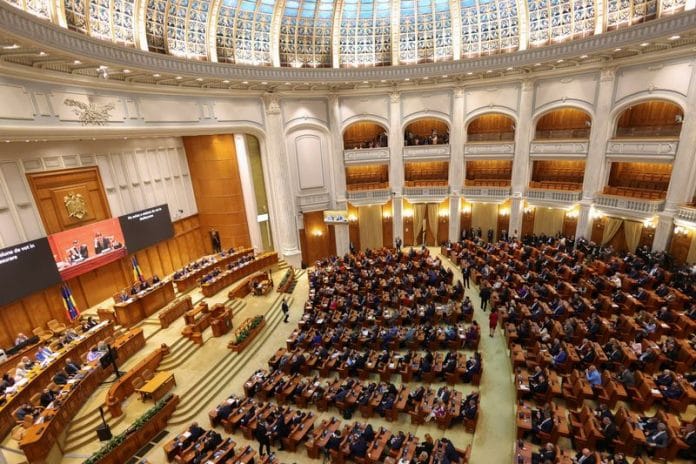
BUCHAREST, June 22 (Reuters) – Romania’s Prime Minister-designate Adrian Vestea failed to win parliament’s vote of confidence late on Monday after the far-right opposition refused to back him, extending a political crisis that threatens the country’s access to EU funds and its credit ratings.
Centrist President Nicusor Dan must now nominate another prime minister, who will have 10 days to assemble a cabinet and seek parliament’s approval.
Under Romanian law, the president can dissolve parliament and call an early election if two prime minister-designates fail to win parliament’s backing within 60 days.
Romania’s next parliamentary election is not until 2028, and the European Union state has never held snap polls. With the opposition hard-right Alliance for Uniting Romanians (AUR) leading opinion surveys, analysts widely expect parliament to endorse the president’s next nominee.
The president nominated Vestea, a member of the centre-right Liberal Party, without consulting the party in what analysts said was a forceful attempt to rebuild a pro-European government capable of carrying out reforms and cutting the EU’s largest budget deficit.
A previous pro-European broad coalition government led by Prime Minister and Liberal Party head Ilie Bolojan collapsed in early May when the leftist Social Democrats, parliament’s biggest party, quit and teamed up with the far right opposition to file a no confidence vote.
Vestea’s cabinet had the full support of the Social Democrats, but the Liberals and two smaller parties in the previous coalition refused to support him, leaving his fate in the hands of the far right opposition.
AUR, parliament’s second-largest party, ultimately declined to back Vestea, with its leader George Simion demanding that mainstream parties refrain from labeling AUR as “extremist.”
AUR, which has 38% to 41% in opinion surveys, opposes aid for Kyiv. It also voted against a law to shoot down Russian drones that breach national airspace near the border with Ukraine, and has been a vocal critic of the European Union, including its SAFE rearmament initiative.
Vestea needed 233 votes for his government to pass. He got 189.
Given parliament’s fragmentation and the Liberals’ refusal to form another coalition with the Social Democrats, a minority government is the most likely scenario, lawmakers across parties have said.
The minority government could be made up of the leftists or of the three centre-right parties in the previous coalition, including the Liberals.
“Minority cabinets have a hard time governing, but either version would be democratically transparent, at least,” said Sergiu Miscoiu, a political science professor at Babes-Bolyai University.
(Reporting by Luiza IlieEditing by Gareth Jones and Sanjeev Miglani)
Disclaimer: This report is auto generated from the Reuters news service. ThePrint holds no responsibility for its content.