


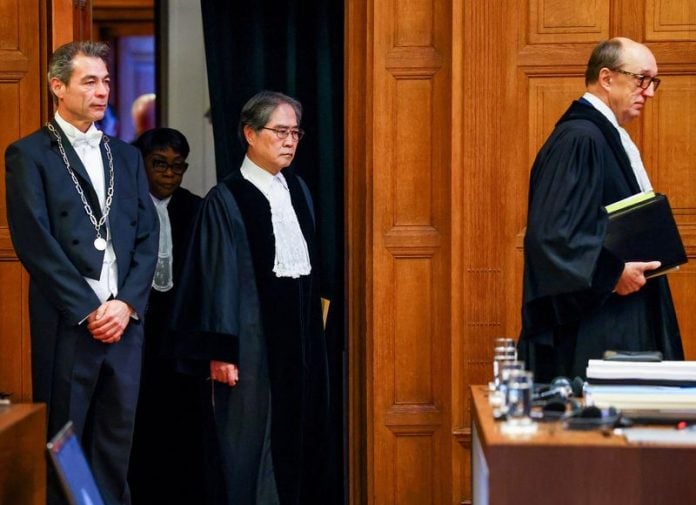
Nov 19 (Reuters) – The International Court of Justice in The Hague ruled on Thursday that Myanmar committed state-sponsored genocide against the Muslim Rohingya minority population in 2017, the first time it held a state responsible for genocide.
The case, filed by predominantly Muslim Gambia, has been closely watched by governments, lawyers, rights groups and Rohingya communities for its implications for how states are judged under the 1948 Genocide Convention.
Here are some initial reactions to the verdict:
AMNESTY INTERNATIONAL:
“After years of denial, impunity and suppression of truth, this ruling is a historic and authoritative recognition of the atrocities committed against the Rohingya and a rare moment of justice for survivors, victims and their families.”
YASMIN ULLAH, ROHINGYA ACTIVIST AND MEMBER OF GAMBIA’S DELEGATION WHICH FILED THE CASE:
“Today is a day of justice. I am a survivor of genocide, and I stood in the Court as part of The Gambia’s delegation. Today the world’s highest court has looked at what was done to the Rohingya and named it for what it was. Genocide. Let me say that again … genocide, the crime of crimes. The Rohingya never needed a court to tell us what happened to us. (…) We needed the world to hear it, and today it has.”
A 30-YEAR-OLD ROHINGYA FROM INSIDE MYANMAR, WHO ASKED NOT TO BE NAMED DUE TO FEAR OF REPRISAL:
“To begin with, I got chills when I heard the verdict that this was genocide. (…) Even now, we still see hate speech on social media. I hope this judgment will lead the people of Myanmar to realize themselves that our country did commit genocide against the Rohingya, and in the future, I hope people will treat one another as human beings, without discriminating by religion or ethnicity and without looking down on anyone.”
SHEIKH HASINA, BANGLADESH PRIME MINISTER AT THE TIME OF THE EXODUS:
“Bangladesh played a central role in the investigations and in gathering crucial evidence from witnesses and survivors in the refugee camps. Those efforts have now come to a successful conclusion. This is a proud moment for Bangladesh.”
MARIA ELENA VIGNOLI, SENIOR INTERNATIONAL JUSTICE COUNSEL AT HUMAN RIGHTS WATCH:
“Myanmar should swiftly comply with the court’s judgment and end its oppression of the Rohingya. Concerned governments should strongly support the Rohingya and promote justice for atrocities, press Myanmar’s junta to comply with the judgment, and ensure the safe and voluntary return of Rohingya refugees to Myanmar.”
RAWAN ARRAF, EXECUTIVE DIRECTOR OF AUSTRALIAN CENTRE FOR INTERNATIONAL JUSTICE:
“The ICJ’s ruling on the genocide against the Rohingya is a landmark moment for accountability but it must also force us to confront the role technology can play in enabling mass atrocities. In Myanmar, social media algorithms helped amplify anti-Rohingya hatred and ethnic violence, demonstrating how technology can become a tool of persecution.”
WAI WAI NU, ROHINGYA ACTIVIST AND EXECUTIVE DIRECTOR OF WOMEN’S PEACE NETWORK:
“For decades, the Burmese military tried to erase our identity, deny our existence, and dismiss our suffering. By finding that Myanmar committed genocide, ordering a guarantee of non-repetition, and ordering restitution and compensation, the world’s highest court has permanently shattered that state-sponsored lie.”
NAY SAN LWIN, ROHINGYA ACTIVIST AND CO-CHAIR OF ARAKAN ROHINGYA NATIONAL COUNCIL:
“For the Rohingya, justice means the restoration of our citizenship, recognition of our identity, and our safe and dignified return home. Our struggle will continue until that day comes.”
JAMES GOLDSTON, EXECUTIVE DIRECTOR OF OPEN SOCIETY JUSTICE INITIATIVE:
“At a moment when international law and the institutions that uphold it face growing pressure, the Court’s decision reaffirms the vital role they play in establishing truth, assigning responsibility, and protecting the values that bind our common humanity.”
RUSHANARA ALI AND JEREMY HUNT, BRITISH LAWMAKERS AND CO-CHAIRS OF THE APPG ON BURMA:
“The British government must resume regular rounds of sanctions against the Myanmar military and, as penholder on Myanmar at the UN Security Council, must bring a resolution to the Council compelling enforcement action.”
(Reporting by Reuters, compiled by Basile Day and Romolo Tosiani in Gdansk, editing by Milla Nissi-Prussak)
Disclaimer: This report is auto generated from the Reuters news service. ThePrint holds no responsibility for its content.