





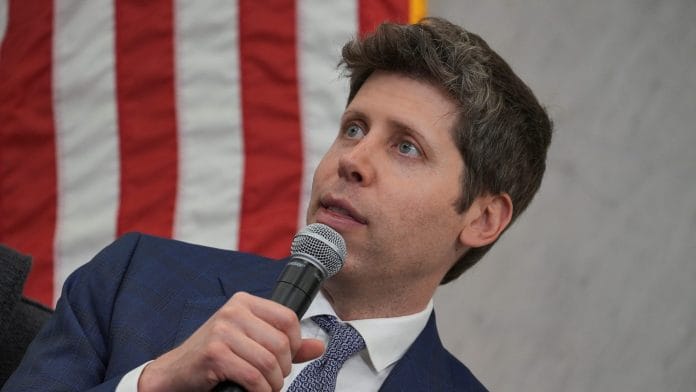


About three years ago the nonprofit board of OpenAI fired its chief executive officer, Sam Altman, because of complaints that he wasn’t “consistently candid” with its members. Effectively, he wasn’t deemed fit to fulfil the company’s noble mission of benefiting humanity, though he was reinstated after a staff revolt.
OpenAI today is still controlled by a nonprofit board, but one with a new set of members who are putting the company under more pressure to deliver investor returns. There’s little chance of another dramatic termination. But with Altman’s pharaonic spending under scrutiny, they may nudge him to follow the lead of his more prudent chief financial officer, Sarah Friar.
The board, which includes business heavyweights such as former Salesforce co-CEO Bret Taylor and ex-Genentech Inc. executive Sue Desmond-Hellmann, has been asking Altman tough questions about his splurge on data-center deals just as OpenAI is missing important revenue and user growth targets. While ChatGPT hit 900 million weekly active users last year, the company has said nothing about reaching the tantalizing 1 billion mark.
OpenAI’s board must be wondering whether the notoriously evasive figure at its helm is becoming more of a risk than an asset, as he looks to spend more than $600 billion renting servers from Microsoft Corp., Oracle Corp. and Amazon.com Inc., while pushing toward an initial public offering in the last quarter of 2026 ahead of rival Anthropic PBC.
It doesn’t help that Altman is mired in an ugly legal battle with Elon Musk over his company violating its nonprofit status, which OpenAI has a fair chance of losing, according to Bloomberg Intelligence.
Silicon Valley corporate boards have long tended to support even the most outrageous whims of their founder CEOs, driven by the notion that the tech industry is propelled by visionaries who sometimes need a decade or more to see their dreams come to financial fruition. The mantra has a checkered history of success. While Steve Jobs was a rewarding bet, Mark Zuckerberg’s notoriously obsequious board chose to greenlight his failed multi-billion dollar bet on the metaverse.
OpenAI’s board at least has the prospect of an eventual successor-in-waiting with Friar. A former CFO of Jack Dorsey’s payments company Square Inc. (now Block Inc.) and former CEO of Nextdoor Holdings Inc., she has been a cautious counterpart to Altman, sensibly pointing out that the company could struggle to honor future computing contracts if it doesn’t make revenue fast enough, and that it’s moving too quickly toward an IPO.
Friar is right. Mid-to-late 2027 is more realistic for OpenAI’s listing, as that would give public-market investors a more reliable sense of how the company will turn its mammoth spending into cash flow.
The hard truth for Altman is that Anthropic is probably further along the road to IPO readiness thanks to its cleaner focus on selling AI tools to businesses and its more disciplined finances. His rival is spending far less on data centers, for instance, its biggest deal being a $100 billion, five-year commitment to Amazon’s cloud service. Last November, Altman touted $1.4 trillion in similar commitments over the next eight years, a figure he has since pared back to that still giddy $600 billion.
It may be an encouraging sign that Altman is listening to a level-headed voice on cost discipline, but Friar joins a roster of leaders who’ve had to grapple with Altman’s autocratic style. Former executives Ilya Sutskever and Mira Murati helped orchestrate the effort to oust him in late 2023. And before that Dario Amodei decamped with more than half a dozen OpenAI employees to form Anthropic, believing Altman too reckless.
Once again OpenAI’s governance is in the spotlight. Earlier this month Fidji Simo, the chief operating officer, announced she was taking medical leave. Friar had reported to Simo rather than the CEO, remarkable for a company heading toward a blockbuster stock-market listing.
Altman appears to have tried to put distance between himself and Friar by not including her in some conversations on data-center spending. That would follow a pattern of behavior similar to when OpenAI’s old board was blindsided by the launch of ChatGPT, only finding out about it on Twitter. Altman and Friar say any talk of discord between them is “ridiculous.”
In fairness, Altman has a point in wanting to purchase more computing power, so he can quickly launch new AI models and keep ahead of rivals such as Google and Anthropic. But board members with experience of the dotcom boom and bust, like Taylor and Desmond-Hellmann, might see echoes of the rush to buy fiber optic cables in 1999, which ended up unused for more than a decade before internet revenue finally started to pick up.
It is unlikely that Altman faces the prospect of being fired (again). That would be far too destabilizing ahead of an IPO. But the board’s members would do well to nudge him toward following Friar’s lead, as her fiscal discipline could be critical in keeping the stock market debut from going very wrong. OpenAI has a financially responsible person in its C-suite, but she’ll need far more sway for that to count for the company’s future shareholders.