



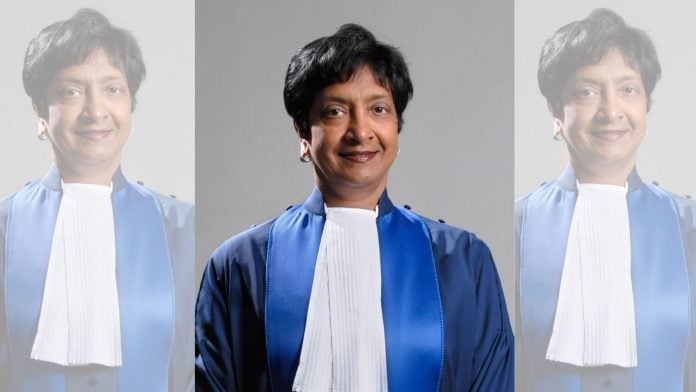
New Delhi: Navanethem “Navi” Pillay, who has been awarded the 2026 Nobel Peace Prize, began her legal career in a country where apartheid restricted access to education, employment and justice. Decades later, she would serve on international courts dealing with genocide and crimes against humanity, and head the United Nations human rights office.
Born in Durban, South Africa, on 23 September 1941, to an Indian Tamil family, Pillay grew up under apartheid. After studying at the erstwhile University of Natal, she became a lawyer at a time when racial discrimination restricted opportunities for non-white professionals. Her career would take her from defending political prisoners in South Africa to helping develop international criminal law.
From apartheid-era courts to the judiciary
Pillay established her own law practice in Natal in 1967. Unable to find employment at white-led law firms because of apartheid-era discrimination, she took up cases involving anti-apartheid activists and political detainees.
Her work included challenging the treatment of prisoners and bringing allegations of torture to public attention. She also fought for political prisoners on Robben Island to have access to legal representation. Among those imprisoned there was Nelson Mandela, another Nobel Peace Prize awardee, who had been jailed for his opposition to apartheid.
Pillay went on to study at Harvard Law School in 1988, where she earned a doctorate in law, before moving into international judicial service.
When she was appointed as a judge to South Africa’s High Court in 1995, after the end of apartheid, she became the first non-white woman to do so.
The Rwanda tribunal and a landmark judgment
Pillay’s most significant contributions to international criminal law came through her work at the International Criminal Tribunal for Rwanda (ICTR), set up after the 1994 genocide. Pillay served on the tribunal as a judge beginning 1995, and became its president in 1999.
The tribunal was established by the United Nations to prosecute those responsible for the genocide.
One of the cases before it was the trial of Jean-Paul Akayesu, the former mayor of Taba. In a landmark judgment delivered in 1998, the tribunal found Akayesu guilty of genocide and crimes against humanity.
The judgment also recognised that rape and sexual violence could constitute acts of genocide when committed with the specific intent to destroy, in whole or in part, a protected group. It was among the first international judgments to establish this connection between sexual violence and genocide.
Pillay was one of the judges on the trial chamber that delivered the ruling. The judgment became an important precedent in international criminal law, recognising that sexual violence during armed conflict could form part of a genocidal campaign rather than being treated as a separate or incidental offence.
Her work at the Rwanda tribunal was followed by a five-year stint as a judge at the International Criminal Court (ICC) in The Hague, from 2003 to 2008. The ICC prosecutes individuals accused of genocide, war crimes, crimes against humanity and, under specified conditions, the crime of aggression.
As UN human rights chief
In 2008, Pillay was appointed the UN High Commissioner for Human Rights, which is responsible for promoting and protecting human rights worldwide and addressing violations through monitoring, advocacy and engagement with governments. She held the position until 2014.
During her tenure, Pillay pressed for the application of human rights standards across countries and called for greater protection of vulnerable groups. She also supported efforts to abolish the death penalty and pushed for the recognition of the rights of lesbian, gay, bisexual and transgender people.
Also Read: 3 scientists won a Nobel for figuring out how light can switch nerve cells on and off
Gaza and the Rohingya
Pillay went on to chair the UN Independent International Commission of Inquiry on the Occupied Palestinian Territory, including East Jerusalem, and Israel.
In September 2025, amid the ongoing conflict in the Middle East, the commission concluded that Israel had committed genocide against Palestinians in Gaza. It also found that senior Israeli officials had incited genocide. Israel rejected the findings. The commission’s conclusions were based on its examination of conduct during the war and statements by Israeli authorities; they were findings of a UN commission of inquiry, not a final judgment by an international court.
Pillay has also served as an ad hoc judge at the International Court of Justice in The Gambia v. Myanmar, a case concerning allegations of genocide against the Rohingya under the Genocide Convention. In 2022, the court rejected Myanmar’s preliminary objections and ruled that it had jurisdiction to hear the case. The proceedings concern Myanmar’s obligations under the convention and are separate from criminal proceedings against individual defendants.
The Nobel Peace Prize for Pillay brings renewed attention to the role of international law in investigating genocide, war crimes and human rights violations, and holding those responsible to account.
Edited by Sunanda Ranjan
Also Read: Anne Carson is a literary Houdini. Her diabolical brilliance got her the Nobel