





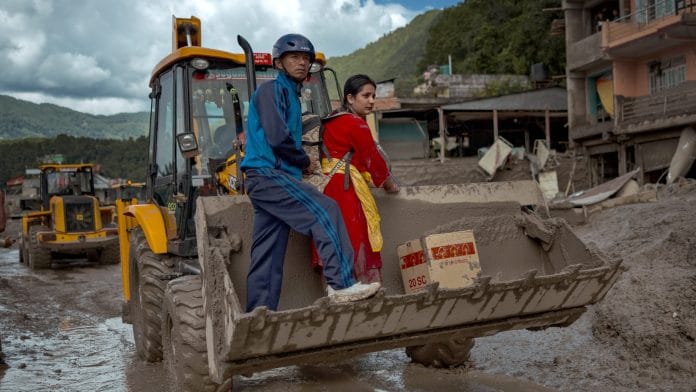

Nepal will need at least “a few billion dollars” to recover from the devastation caused by flash floods, prompting the $45 billion economy to seek international funding for a massive reconstruction effort, according to Finance Minister Swarnim Wagle.
At least 469 people have been confirmed dead, a toll that’s expected to rise in the coming days after flash floods sent an avalanche of rock, mud and water through a Nepalese valley near the border with China, wiping out bridges, roads and entire settlements. More than 1,500 people are missing across Nepal and China, including visitors from India, Malaysia, Australia, the UK and the US.
“Cumulatively, I think the losses and damages when they will be finally quantified in a week or so, will amount to at least a few billion dollars,” Wagle told Haslinda Amin in an interview to Bloomberg Television. “Preliminary estimates are quite worrying.”
The finance minister’s comments come after Nepal’s billionaire businessman Binod Chaudhary told Bloomberg News that he wouldn’t be surprised if rebuilding costs hit $5 billion. His Chaudhary Group spans 12 business verticals, from food and telecom to infrastructure and banking.
Nepal has a long experience in dealing with natural disaster as its location in the Himalayas makes it vulnerable to earthquakes, landslides and flash floods. A major earthquake in 2015 killed nearly 9,000 people and required a multi-year rebuilding effort requiring billion of dollars.
Wagle said the first phase of disaster management involving rescue and relief is in motion. In the second phase, the government plans to put in place temporary shelter, providing basics including food, water, electricity, and telecommunications, and possibly “cash for work initiatives.”
Multilateral institutions including World Bank and Asian Development Bank have committed funds for humanitarian needs, while neighboring countries including India and China have provided supplies and financial assistance, the minister added.
“The World Bank has committed to siphon off at least 10% of its un-dispersed allocation for other projects to these humanitarian needs. So that will amount to about $160 million,” Wagle said. ‘Similarly, the Asian Development Bank has committed $5 million.”
New Delhi sent more than 10 tonnes of supplies including medicines, tents and solar lamps, followed by another 35 tons aboard an Indian Air Force heavy transport aircraft on Thursday.
Wagle said Nepal would need a “different kind of a fundraising campaign” to rebuild damaged infrastructure and would consult the International Monetary Fund on the crisis’s impact on its external finances and potential support.
Nepal has an established bilateral mechanism for channeling aid from both the Indian and Chinese government, he said.
On warnings of a second outburst, the minister said the government is aware of the risks and people are being evacuated to safe grounds.
“There’s no one there,” he said. “Right now, the river basin that might be potentially be affected is really uninhabitable.”
Disclaimer: This report is auto generated from the Bloomberg news service. ThePrint holds no responsibility for its content.