






By Gopal Sharma, Sahana Bajracharya, Liz Lee and Ethan Wang
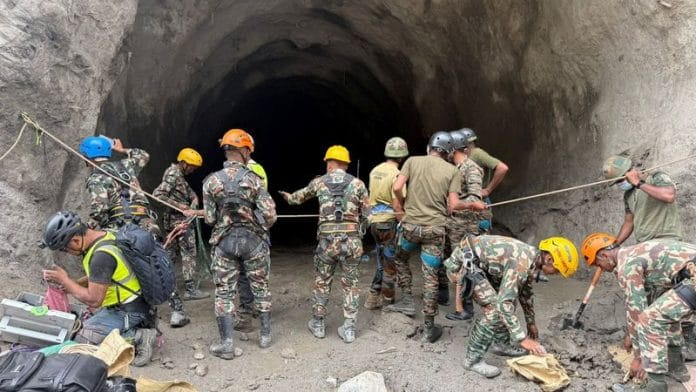
KATHMANDU/BEIJING, Sept 1 (Reuters) – Nepali rescuers built temporary bridges to reach remote areas and dug through the ruins of hydropower projects in the Himalayas to rescue close to 300 trapped workers, nearly a week after catastrophic floods left a trail of destruction across the country’s towns and valleys.
At least 639 people remain stuck in several devastated hydropower stations that have become the focus of rescue efforts, the country’s disaster management authority said on Tuesday, with the total death toll going up to 987. About 4,000 are still missing.
“Thousands of citizens have lost their homes, families, loved ones and property,” Prime Minister Balendra Shah said in a late-night social media post on Monday. “The government understands the immense pain they are enduring.”
Over 11,000 people have been rescued across the affected region while power and communication lines had been restored in some areas, he said, promising support for those displaced by the glacier collapse that sent a deluge of ice, rock and mud sweeping through the impoverished nation’s border region with China. The calamity poses a massive challenge for Shah’s six-month-old government.
“We did not have the time to grab anything before fleeing,” said a woman survivor from the hard-hit Rasuwa district who said she walked to Nuwakot with scores of villagers who survived. “What we were wearing is the only pair of clothes we have. And even they are wet from rain.”
Rescue teams had managed to restore road networks to Nuwakot, one of the worst-affected districts, facilitating rescue operations and distribution of relief material, Shah said.
Police official Bipin Regmi said a search team recovered 24 bodies from a house in Betrabati village in Nuwakot district.
“We are reaching new areas and recovering bodies,” Regmi told Reuters.
FOREIGN HELP FLOWS IN
In China, rescue teams worked through the night to reopen access to the Nepali border, on a steep mountain gorge with unstable cliffs on one side and fast-flowing river channels on the other.
Beijing will send DNA testing experts to disaster-hit areas at the Nepal-China border as well as a second batch of relief supplies later on Tuesday, its foreign ministry said, adding that equipment would include drones and water purification.
South Korea, nine of whose nationals were working at a hydropower project and are missing, also said it will send a 44-member emergency relief team to support search-and-rescue operations in the Rasuwa region.
Nepal last week turned down foreign involvement in general search and rescue but said it needed specialised services and advanced technological support in areas such as life-detecting machines, large refrigerators, Bailey bridges.
Giant neighbours India and China have led the foreign assistance, and the U.S., Japan, South Korea, Singapore, Australia, EU countries, and the UAE, have also contributed.
“Some of the support has already arrived,” foreign ministry spokesperson Lok Bahadur Chhetri told Reuters.
Aid worth more than $42 million had poured into the country after the disaster, Shah said, and the government expected the contributions to increase.
RESCUE EFFORTS FOCUS ON HYDROPOWER STATIONS
Shah said 279 workers had been rescued from hydropower projects, with joint teams of Nepal, India and China working on search and rescue operations.
Pictures and videos shared by rescue teams showed earth-moving equipment digging and shovelling mud and rocks under lights in the dark of the night as workers watched. Soldiers used torchlight in a big pit they had created to look for space to get into one tunnel.
“Our first rescue observation at Trishuli Hydro Power plant shows that it is not humanly possible to go into the tunnel,” Asish Gurung, a mountain guide helping in the tunnel rescue, told Reuters from Haku village in Rasuwa district.
“We need machines like bulldozers and excavators. There are two of them here now. One is not functioning and the other is being repaired. There may be about 500 people trapped inside,” he said.
There has been a boom in hydropower projects in Nepal since the turn of the century as the mountainous country sought to take advantage of its Himalayan water resources to address chronic domestic power shortages and exploit prospects for selling electricity to southern neighbour India.
Hydropower projects in Nepal’s mountains need tunnels to carry water through the steep terrain, allowing developers to exploit the sharp elevation drop between Himalayan rivers and powerhouses to generate electricity.
NEPAL PM HIGHLIGHTS CLIMATE CHANGE RISKS
A total of 583 foreign nationals were still missing, the disaster management authority said, as family members desperately pursued news of their loved ones.
An Australian hiker who went missing after the flood was located after she made contact with the Australian embassy on Saturday, Australian media reported.
Cara Severino, 26, was trekking in the Langtang area when the flood hit and said in a statement that she survived because of the “amazing people” she was with at a national park when the flood hit.
PM Shah said the catastrophic event signalled the growing risks that the Himalayan region faces.
“The region must therefore remain vigilant. The time has come for us to strongly raise before the international community the disasters we are experiencing as a consequence of climate change,” Shah said in his post.
Last week’s flood was “caused by glacier instability under the long-term effects of global warming”, China’s state broadcaster said on Monday.
(Reporting by Gopal Sharma, Sahana Bajracharya, Liz Lee, Ethan Wang; Writing by Shilpa Jamkhandikar; Editing by Saad Sayeed and YP Rajesh)
Disclaimer: This report is auto generated from the Reuters news service. ThePrint holds no responsibility for its content.