



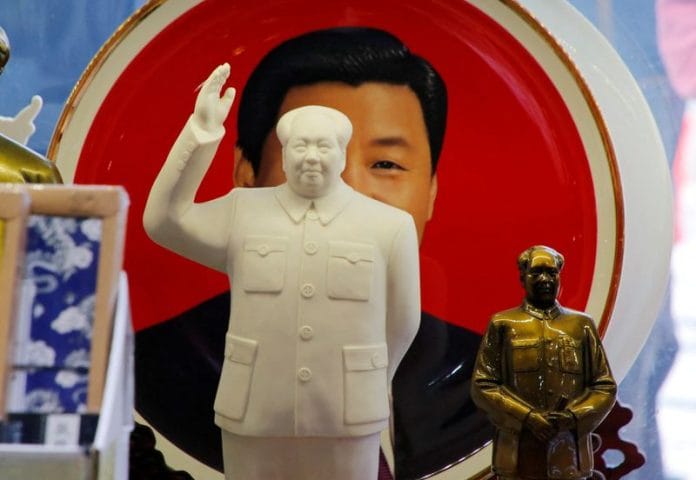

BEIJING, Sept 9 (Reuters) – China on Wednesday marked half a century since the death of Mao Zedong, founder of the People’s Republic, who brought roughly a quarter of the world’s population under Communist Party rule and whose spectre still haunts China’s future.
Mao’s death on September 9, 1976, at age 82, mourned by many and welcomed by some who suffered under his nearly three-decade rule, also hastened the end of the Cultural Revolution, a frenzied mass movement he launched in 1966.
The party later condemned the Cultural Revolution as a grave error for which Mao bore primary responsibility, but still reveres him, saying his achievements outweigh his mistakes.
Mao’s 6-metre-high portrait overlooks Beijing’s Tiananmen Square, the symbolic centre of Chinese political power. His preserved body lies in the Chairman Mao Memorial Hall, where visitors from across the country queue to pay respects.
Many still idolise Mao as the nation’s saviour. The mausoleum extended hours for Wednesday’s anniversary, expecting a surge in visitors.
During the Cultural Revolution, a distrustful and ageing Mao mobilised students and supporters against perceived “class enemies,” including leaders accused of “taking the capitalist road,” unleashing upheaval that fractured the bureaucracy, paralysed the economy and triggered violence and persecution.
The decade of turmoil also left a complex imprint on generations of leaders who followed Mao, including President Xi Jinping.
XI UNDER PERSECUTION
Xi’s father, former vice premier Xi Zhongxun, was purged and brutally persecuted in the lead-up to and during the Cultural Revolution, while the family home was ransacked.
The teenage Xi was labelled a “reactionary student,” subjected to interrogation and coercive political study and even threatened with execution.
“Because I had a stubborn streak and refused to be bullied, I offended the rebel faction,” Xi said in a 2000 interview with a state-run magazine. “Everything bad was blamed on me … I wasn’t even 15.”
In 1969, like many others of his generation, Xi was sent to the countryside and spent seven years in a poverty-stricken village in northwestern China.
“The Cultural Revolution was a profoundly disillusioning experience for Xi,” said Joseph Torigian, an expert in Chinese politics at American University.
But “he still saw something redemptive in the campaign,” which toughened him and showed the dangers of state collapse and that the party needed a clear road map to socialism, Torigian added.
THE LONG SHADOW
Xi has not publicly blamed Mao for either his family’s suffering or other tragedies he witnessed.
Since becoming China’s top leader in 2012, he has instead argued that the post-Mao reform era should not be used to repudiate the Maoist years, while increasingly echoing Mao-era practices.
Unlike his immediate predecessors who — prompted by Deng Xiaoping’s reforms in the aftermath of Mao — sought to cautiously loosen the leader’s grip, Xi has unapologetically consolidated power, cultivated personal authority and stressed ideological conformity and strict party discipline.
He is on course to become the longest-serving paramount leader of the People’s Republic, after Mao, having broken with reform-era term limit norms meant to curb excessively concentrated power and reduce the risk of another personality cult.
Xi has also had his own name formally attached to the state ideology enshrined in both the party and state constitutions, a feat no other since Mao has managed while in office.
“The iconography of Maoism, the charisma, and very specific language and symbols — these remain immensely powerful,” said Kerry Brown, director of King’s College London’s Lau China Institute. “Xi has reinstated some of this with strong nationalism and populism,” he added.
One reason Xi shies away from more direct criticism of Mao is that he “wants to take the party back to its glory days when everyone was shaped by zeal and enthusiasm,” Torigian said.
The question, he added, is whether Xi’s approach will prove lasting, “or whether, like Mao before him, Xi is unintentionally creating pressure for change that will push China in a new direction after he’s gone.”
(Reporting by Beijing Newsroom; Editing by Philip McClellan and Kate Mayberry)
Disclaimer: This report is auto generated from the Reuters news service. ThePrint holds no responsibility for its content.