



By Ben Makori
SHERFIELD ON LODDON, England, Oct 4 (Reuters) – Flydubai’s flight FZ1073, which plunged 16,000 feet in about 30 seconds before being levelled out and landing safely, would have felt like a “vertical roller coaster”, according to an aviation instructor who recreated the descent in a flight simulator for Reuters.
The steep fall, after an attack on the captain by the co-pilot during a flight on Wednesday, would have put huge strain on the Boeing 737 MAX 8 aircraft – as well as the passengers and crew, said Alberto Paduanelli, owner of ALPA Simulation in Sherfield on Loddon, southern England.
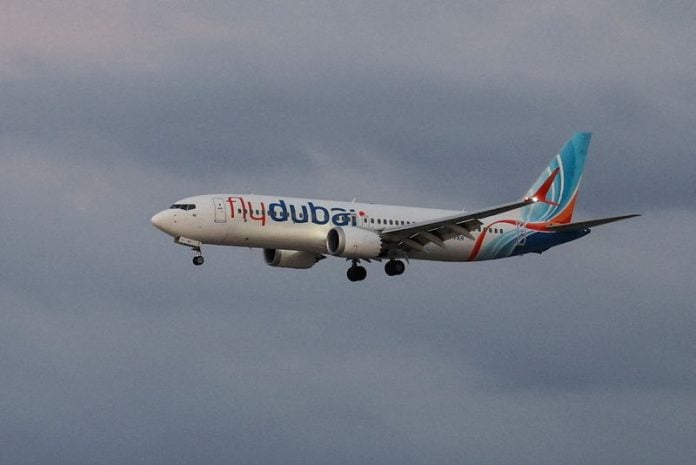
The co-pilot of the flydubai jet, which was bound for Israel from Dubai, attacked the pilot with an emergency crash axe, the United Arab Emirates prosecutor general said on Saturday, calling the incident a “terrorist attack”.
The co-pilot was identified as Hammam al-Hammami, an Omani national, two sources with knowledge of the investigation told Reuters. UAE authorities did not immediately respond to a request for confirmation of his identity. Reuters could not independently reach al-Hammami for comment.
Flydubai says the circumstances surrounding the incident are still under investigation and it cannot comment further. Oman has yet to comment on the incident.
“A plunge of 16,000 feet (4,877 metres) over 30 seconds will feel like you are over on a very, very vertical roller coaster,” Paduanelli said, sitting at the controls of the simulator cockpit.
“The difference is that on the roller coaster, you know what’s happening,” he said, adding that with a sudden drop “you feel the negative g-force on your body”.
For passengers who are not strapped in, “Your body will literally lift from the seat”, he said.
Using a simulator to recreate the incident, Paduanelli said the aircraft’s autopilot disconnected before the plunge began, causing the jet to accelerate rapidly.
US President Donald Trump has praised the Boeing jet for withstanding the severe forces put on it during the incident. The plane was levelled out after passengers overpowered the co-pilot, before a reserve crew of pilots onboard landed the plane.
“It was an amazing show of precise and powerful structural planning and design,” Trump posted on Truth Social, adding that the 737 Max “was able to withstand G Forces and Strain far beyond what it was designed and expected to do”.
Boeing did not respond to a request for comment.
Aircraft are designed and tested to withstand substantial aerodynamic loads, but Paduanelli said a prolonged high-speed dive can place extreme strain on an airframe.
“This was nothing but a miracle that nothing was hurt apart from the captain, unfortunately, and that two pilots were onboard,” Paduanelli said.
Details about al-Hammami’s past have trickled out.
Royal Air Maroc told Reuters he did a three-month training with the airline in 2025 but his application to work there afterwards was rejected. Buckinghamshire New University in Britain said he did a distance-learning course in aviation management with the institution, but no pilot training.
An Australian Federal Police spokesperson said on Sunday that authorities there were investigating al-Hammami’s “links to Australia”. A source briefed on the investigation said the co-pilot studied at a university in Melbourne.
(Reporting by Ben Makori; Additional reporting by Praveen Menon, Alexander Cornwell, Joanna Plucinska and Federico Maccioni; Writing by Adam Jourdan;Editing by Helen Popper)
Disclaimer: This report is auto generated from the Reuters news service. ThePrint holds no responsibility for its content.