





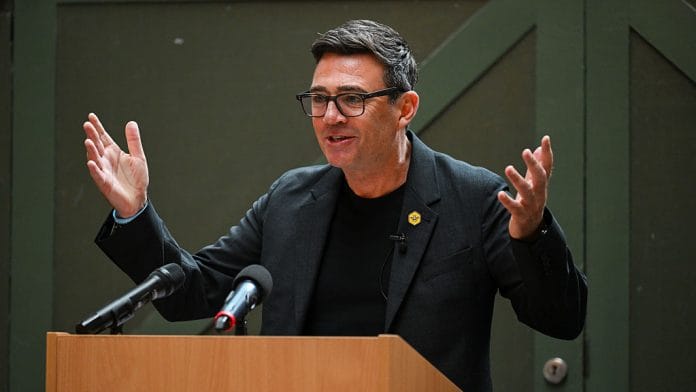


New Delhi: Andy Burnham, a pro-workers’ rights activist, proponent of increased defence spending, and a critic of Israel’s military campaign in Gaza, is set to become Britain’s next Prime Minister after receiving overwhelming support from Labour Members of Parliament (MPs) Friday to succeed Keir Starmer.
Starmer announced his resignation in late June, just short of two years after leading the party to a landslide general election victory in 2024.
Burnham received nominations from 322 of Labour’s 403 MPs on the first day of the leadership process—far exceeding the 81 required to enter the contest. With no serious rival expected to emerge, the 56-year-old Makerfield MP is likely to be formally confirmed as Labour leader on 17 July and appointed Prime Minister by King Charles III on 20 July.
He would become Britain’s seventh Prime Minister in 10 years.
Burnham’s expected ascendancy represents an extraordinary return to Westminster for a politician who has spent nearly a decade building his reputation and political prowess outside of London, as the mayor of Greater Manchester.
From Liverpool to Manchester to Westminster
Born in Liverpool on 7 January 1970 and raised in the nearby town of Culcheth, Andrew Murray Burnham studied English at Fitzwilliam College at the University of Cambridge. He has said the 1984-85 miners’ strike—a year-long confrontation between Margaret Thatcher’s Conservative government and mineworkers resisting widespread pit closures and job losses—helped shape his political outlook and encouraged him to join the Labour Party as a teenager.
Burnham worked as a parliamentary researcher and for the National Health Service (NHS) before being elected MP for Leigh, Great Manchester in 2001. He rose rapidly under the New Labour governments of Tony Blair and Gordon Brown, serving as chief secretary to the Treasury, culture secretary, and health secretary.
He contested the Labour leadership twice: finishing fourth in 2010 and second to Jeremy Corbyn in 2015. His likely victory in 2026 has consequently been described, by Burnham himself, as a case of “third time lucky”.
Burnham left Parliament in 2017 to become Greater Manchester’s first directly-elected mayor, which is the position in which he established a national profile and acquired the nickname “King of the North”.
He is married to Marie-France van Heel, whom he met at university, and the couple have three children. A Roman Catholic by upbringing, Burnham is also a football, cricket, and rugby enthusiast.
‘King of the North’
As mayor, Burnham presented himself as an advocate for regions neglected by governments based in Westminster. His confrontations with Boris Johnson’s Conservative administration over financial support for Greater Manchester during the COVID-19 pandemic strengthened his reputation as a defender of northern England. His advocacy for northern England as mayor of Greater Manchester earned him the nickname “King of the North”.
Burnham’s administration has also brought Greater Manchester’s buses under public authority, expanded support for the homeless, and pushed for greater regional authority over housing, transport, and skill.
This record forms the basis of what Burnham calls “Manchesterism”: a political programme centred on decentralising power, rebuilding local industry, and encouraging cooperation between local governments, businesses, and community organisations.
Burnham has promised Britain’s “biggest rebalancing of power”, including the country’s largest council-house building programme since the post-war period, greater public control over utilities, and a partial transfer of Downing Street operations to a proposed “Number 10 North” in Manchester.
Burnham belongs to Labour’s more economically interventionist wing, which favours greater public investment, stronger workers’ protections, and a larger government role in essential services. However, he has said he will retain the government’s fiscal rules—that routine public spending must be covered by tax revenues, while national debt must fall as a proportion of the economy.
He describes his approach as an attempt to combine economic discipline with more ambitious state intervention. Drawing on his experience as Greater Manchester mayor, Burnham also plans to transfer more authority and funding from Westminster to regional mayors. He has argued that locally elected leaders understand their areas better than the central government and should, therefore, have greater control over transport, housing, skills, and economic development.
Starmer’s downward tumble and the Makerfield vote
Starmer entered Downing Street in July 2024 with a commanding parliamentary majority and a promise to restore stability after years of Conservative turmoil. But his popularity declined amid policy reversals, controversies, deteriorating public services, and dissatisfaction over standards of living and immigration.
Labour’s heavy losses in the May 2026 local elections intensified pressure on Starmer. Several ministers resigned, while around a quarter of Labour MPs publicly called for him to step down.
Enter Burnham’s opportunity, whose route back to Westminster came through the Makerfield by-election in northwest England on 18 June. Because Labour rules require its leader to be a sitting MP, returning to the House of Commons was essential to any leadership bid. Burnham won the seat with 54.8 percent of the vote, defeating Reform UK, which received 34.5 percent. This decisive result strengthened the sentiment among Labour MPs that Burnham could reconnect the party with working-class voters and counter Nigel Farage’s populist movement.
Starmer initially insisted he would fight any challenge, but proceeded to announce his resignation on 22 June after further pressure mounted from ministers and MPs.
Foreign policy and next steps
Burnham’s foreign policy agenda has pledged continued support for NATO, Britain’s nuclear deterrent, Ukraine, and closer security ties with Britain’s traditional allies, namely, the US and Europe. He has also called for Britain to rebuild its military and defence-manufacturing capacity, arguing that domestic defence investment could help reindustrialise economically struggling regions.
On Gaza, Burnham has signalled a departure from Starmer, who initially resisted calls for an immediate ceasefire in the opening months of the war in 2023. Burnham has since apologised for Labour’s early position.
“Labour’s initial response to the treatment of Gaza caused huge hurt. We got it wrong and I am sorry for that,” Starmer said in a social media post on 2 July, promising the party would do better under his leadership.
Burnham has also vowed to increase pressure on Israel through possible sanctions against Israeli ministers and settlers implicated in violence, tighter restrictions on arms licences, and curbs on goods produced in Israeli settlements in the West Bank that are illegal under international law.
Burnham must still satisfy the remaining requirements of Labour’s leadership process, including securing the necessary support from affiliated organisations.
Once confirmed as the Labour party leader, Starmer will formally tender his resignation to the King, who will invite Burnham—as leader of the party commanding Commons majority—to form a government.
Burnham’s first major task will be assembling a Cabinet that is capable of uniting Labour’s competing factions. The larger challenge awaiting him will be in demonstrating that the regional model that made him successful in Manchester can be effectively applied to a country facing weak growth, strained public services, a cost-of-living crisis, and growing political fragmentation.
(Edited by Amrtansh Arora)
Also Read: US strikes India-linked Chabahar port in Iran as West Asia conflict intensifies