





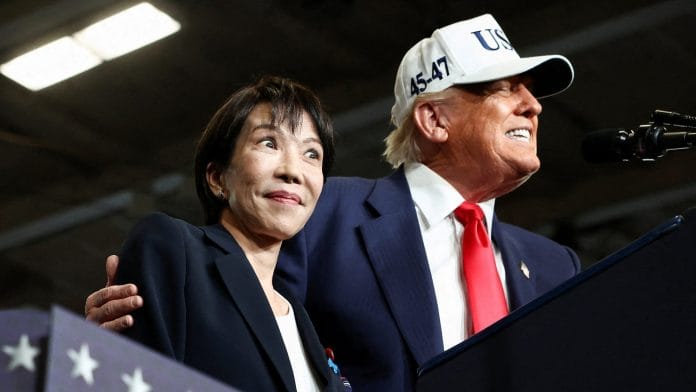



Tokyo: Sanae Takaichi had warned her first summit with Donald Trump in Washington could be “extremely difficult,” after the US asked her to deploy warships to Iran. Instead, she showcased Japan’s deep ties with the US — and her own agility on the world stage.
Takaichi smiled politely during the only obvious moment of tension during their Oval Office meeting on Thursday, when Trump referenced the Japanese attack on Pearl Harbor in 1941. Otherwise, the Republican leader praised Takaichi, highlighted new areas of economic cooperation and pledged to speak up for Tokyo when he eventually meets Chinese President Xi Jinping.
“We’ve had tremendous support and relationship with Japan on everything,” Trump said, after greeting Takaichi with a hug outside the White House. Takaichi explained the legal limits to the support Japan can offer in defending the Strait of Hormuz because of her nation’s pacifist constitution, which America helped to write.
For US allies from Australia to South Korea who Trump had named and berated for refusing to deploy battleships to help open the narrow waterway, Takaichi’s warm reception in Washington will be a welcome signal the Republican leader won’t necessarily hold a grudge, as his spiraling war in the Middle East approaches its fourth week.
In large part that’s because Trump sees Japan as a key ally in countering China. Efforts by Takaichi to bolster her country’s military have reinforced that view, along with joint work in reducing supply chain reliance on Beijing, which currently dominates production of the rare earths underpinning global manufacturing.
“Takaichi is likely breathing a sigh of relief after emerging relatively unscathed from her meeting,” said Bloomberg Economics’ Adam Farrar. “She received a remarkably positive reception from the president, despite a few awkward comments, underscoring the strength of their personal relationship.”
Since taking office last year, Takaichi has shown flair for forging personal connections, from open displays of affection with Italy’s Giorgia Meloni to drumming with South Korean leader Lee Jae Myung. That signature style was on display in Washington. As Takaichi prepared for a carrot velouté and Maine lobster dinner, she wished Trump’s youngest son happy birthday, adding that his good looks came from his parents.
For his part, Trump called Takaichi an “amazing friend” and lauded her landslide election victory last month as a declaration of strength and confidence from the Japanese people “who love you.”
Economic Sweeteners
While Takaichi didn’t come to Washington offering warships, she’d prepared plenty of economic sweeteners.
That included plans to construct small modular nuclear reactors in Tennessee and Alabama at a cost of as much as $40 billion, as well as projects for natural gas generation facilities in Pennsylvania and Texas for a total of around $33 billion.
Those offers come after the announcement only last month of a combined $36 billion investment for a US oil export terminal, gas power plant and synthetic diamond manufacturing facility. Such deals are part of a $550 billion fund established under a US-Japan tariff truce, although Tokyo is still far from fulfilling that whole pledge.
Still, such commitments have helped keep goodwill with Trump, as have plans for closer military cooperation that could address some munitions shortages caused by the Iran war. In a statement after the meeting, the US said Japan would rapidly quadruple production of SM-3 interceptor missiles — among the systems in high demand in the Middle East to defend against Iranian missiles and drones.
Japanese efforts highlighted by Takaichi to put diplomatic pressure on Tehran to stop its attacks on neighboring countries likely also contributed to Trump’s declaration early in the sitdown that Japan was “really stepping up to the plate” on Iran.
Mira Rapp-Hooper, a US National Security Council official in the Biden administration, said other policy initiatives under Takaichi, such as plans to loosen restrictions on military exports and discussions to boost defense spending beyond 2% of gross domestic product are underpinning a strong bond with the US.
“Japan is doing more to provide for its own security and doing more for US, while also showing a willingness to take on a constructive role in the Middle East,” said Rapp-Hooper, now a senior adviser at The Asia Group.
Takaichi’s strategy going into the meeting was to focus on shared efforts to deal with energy price surges, a key concern for Trump as the war pushes gasoline prices higher. Following the summit, Takaichi said she wanted to help expand production of energy resources and increase crude oil imports from the US, including potentially creating a US oil stockpile in Japan.
A rare moment of discord came when a Japanese reporter asked Trump why the US hadn’t informed its allies in advance about plans to attack Iran. “We wanted surprise,” Trump said. “Who knows better about surprise than Japan? Why didn’t you tell me about Pearl Harbor?”
Takaichi became visibly tense, casting glances to her advisers, but the moment passed quickly. A Japanese foreign ministry official said the subject didn’t come up in closed-door talks between the leaders and there was little immediate reaction from the Japanese press, who focused on Trump’s praise for Takaichi.
Japan’s sudden attack on the US naval base in Hawaii in 1941, a move that prompted the US to declare war on Japan, retains a strong emotional resonance in the US. But in Japan it’s a less emotive issue than the US atomic bombings of Hiroshima and Nagasaki in 1945 that led to the end of the Pacific War.
Another positive for Takaichi was a pledge by Trump to “praise Japan” when he meets Xi at a delayed summit. That was the most direct support Trump has shown for Japan since China last year reacted angrily to her remarks on self-ruled Taiwan.
After the summit, Takaichi said she’d agreed to stay in close contact with Trump over both China and North Korea.
“The alliance is outwardly stronger after this visit,” said Jeremy Chan, a senior analyst at Eurasia Group and a former US diplomat. That is “an unalloyed victory for Takaichi.”
This report is auto-generated from Bloomberg news service. ThePrint holds no responsibility for its content.
Also Read : Japan says no plan to send warships to Strait of Hormuz despite pressure from Trump