





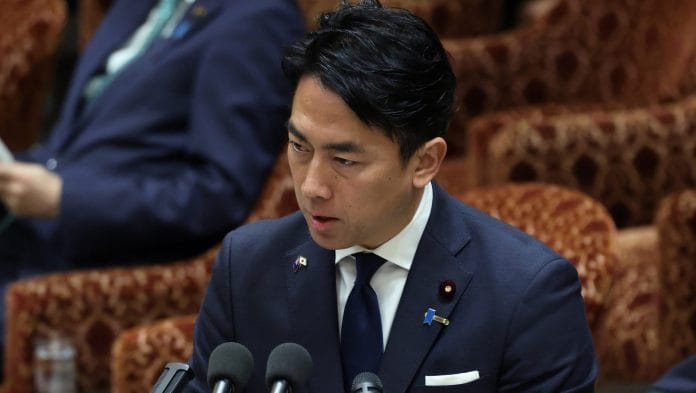



Japan’s defense minister said the nation currently has no plans to send warships to the Strait of Hormuz after US President Donald Trump put pressure on Tokyo to do so ahead of a summit meeting with Prime Minister Sanae Takaichi later this week.
“What is most important is to put our efforts, including our diplomatic efforts, into calming the situation,” Defense Minister Shinjiro Koizumi said in parliament on Monday, a message Takaichi echoed, saying she aims to discuss the matter with Trump with that goal in mind.
“We are currently examining what can be done to protect Japan-related vessels and the lives of their crew, though of course it will be within the limits of Japan’s laws,” Takaichi said.
Japan’s prime minister could face further pressure from Trump to take action when they meet at the White House on Thursday. The demand has put Takaichi in an awkward spot as she considers the legal and political implications of sending ships while trying to avoid letting Trump’s demand overshadow her first summit talks with him in Washington.
She avoided giving a direct answer when asked how she would respond should Trump ask directly for support during her visit to Washington.
“That request hasn’t officially been made yet, so it’s hard to answer that question based on a hypothetical situation. The Japanese government is currently considering how to respond to the situation,” she said.
Japan is reliant on the Middle East for about 90% of its oil, making it a stakeholder in the conflict, while it also has strict laws in place forbidding it from involvement in active conflict unless its own existence is deemed under threat.
Koizumi said that broadly speaking it is possible to conduct a maritime security operation with Self-Defense Force ships in special circumstances where Japanese ships need protection, Japanese lives or assets are at risk, or there is a need to maintain stability. But Koizumi declined to comment on whether the current situation in Iran warranted such a mission.
“I will refrain from responding to the hypothetical question of whether the SDF can take such action, given the situation in Iran is shifting minute by minute, moment to moment,” he said.
Japan has a pacifist constitution that strictly limits the country’s use of force to self-defense. Reinterpretations and tweaks to the legal framework over past decades have lowered the bar for some of those limits, but the threshold for involvement in an active conflict in which Japan isn’t directly under attack remains high.
The ruling Liberal Democratic Party’s policy chief Takayuki Kobayashi on Sunday downplayed the possibility that Japan would send warships to secure the Strait of Hormuz anytime soon, saying it would be a “challenging” decision that faced a high hurdle.
“I think this is a decision that must be made very carefully given the ongoing conflict,” Kobayashi said.
The topic is a sensitive one for the Japanese public and a misstep could trigger broader concern.
An Asahi newspaper poll conducted over the weekend found that 82% respondents did not support the US attack on Iran, while just 9% said they did. Some 51% of respondents didn’t approve of Takaichi’s ambiguity on whether the attack was legally problematic or not, while 34% said they support her response so far.
A separate survey by broadcaster FNN showed that about 61% of people supported how Takaichi has handled the situation so far by avoiding criticism of the US and Israel while being critical of Iran’s actions. About 35% were opposed.
The Asahi poll showed that support for Takaichi remained the same, while FNN showed a slight dip in her ratings to 67.1%, a relatively high level by historical standards.
Japan’s first overseas military deployment since World War II was the deployment of six minesweeper ships to the Persian Gulf in April 1991. That took place more than a month after the US wrapped up its Desert Storm operations that concluded the Gulf War.
Last week, Takaichi said that Japan wasn’t planning to send minesweepers to the Middle East given the conflict there is ongoing.
Defense Minister Koizumi’s comment on sending ships came a day after an overnight phone call with US Defense Secretary Pete Hegseth on Sunday evening.
The US defense secretary provided an update on the latest in the Middle East and spoke about the outlook, according to a statement released by Japan’s Defense Ministry. Koizumi sought to continue communicating with the US and other related countries on the matter, the statement said.
Hegseth also said that “the situation in the Middle East is not one that changes the posture of the US military in Japan, and that they will continue to be fully prepared,” according to the statement.
The reassurance comes amid concerns over whether more US firepower might be shifted from the Asia-Pacific region to the Middle East for military operations against Iran if the war drags on.
Disclaimer: This report is auto generated from the Bloomberg news service. ThePrint holds no responsibility for its content.