






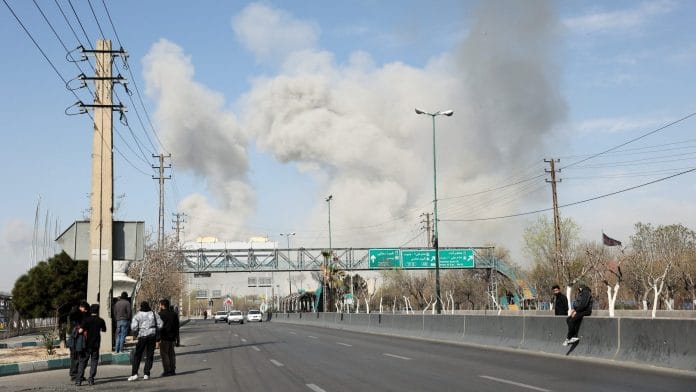



You can’t accuse the US of mission creep one week into a war, especially when the initial goals for Operation Epic Fury were so broadly defined as to be unknowable. But taking President Donald Trump’s four-to-five-week timeframe for hostilities as a guide, the launch of a Kurdish ground insurgency to help bring about regime change would qualify.
This way lies forever war, though not in the way that’s usually meant. I don’t believe for a second that Trump will put regular American troops on the ground in Iran or stay for years. I mean the kind of forever war that the US and Israel start, and walk away from.
There’s no question that a Kurdish insurgency could change the outlook for this conflict. It’s clear from Israel’s increasing focus on striking Iran’s domestic security and political architecture that the desired end-state is a change — or at least collapse — of the Tehran regime. Trump looks to be on board, if unrealistic in insisting that the Islamic Republic should give him a say in choosing its next leader.
The president has also said he would welcome the Kurds’ military involvement, and he has been on the phone with their leaders. Military formations have been seen preparing on the Iraqi side of the border with Iran. The Iranians have made preemptive missile strikes against them. Local markets in Iraq have seen a sudden surge in sales of warm weather and other gear needed for the frontier’s high mountains. They seem just to be waiting for a green light.
Though regime change has never been achieved by air power alone, it has been done in conjunction with a local ground insurgency, so there is some logic to creating one. But the example was Libya, where the continuing chaos 15 years later should give more pause than encouragement.
I have a lot of sympathy for the plight of the Kurds. They were among the greatest victims of the callous and spectacularly ignorant European dispensation of borders that emerged from the collapse of the Ottoman Empire after World War I. This is a geographically contiguous, linguistically and culturally distinct nationality of 30 million-plus people who emerged from that carve up with no state of their own.
Divided between Turkey, Iraq, Syria and Iran, the Kurds could hardly have been unluckier in the leaders and security services that have ruled them since. These have included Iraq’s Saddam Hussein and Syria’s Bashar al-Assad, with their respective Mukhabarats, as well as Iran’s Ali Khamenei and his Islamic Revolutionary Guard Corps, to name just the highlights.
Turkey for a long time effectively garrisoned the Kurdish population along its Iranian and Syrian borders. Mustafa Kemal Ataturk’s words, “How Happy is the one who says: I am a Turk,” were carved into hillsides to remind locals they were in fact “Mountain Turks,” because in the state’s view there was no such thing as a Kurd. The language was banned until 1991, and restricted until 2004. For 42 years, the Kurdistan Workers’ Party, whom I visited in their hideouts in Iraq’s mountains, fought a brutal and often terrorist insurgency with the Turks that cost 40,000 lives.
This situation has proved catnip to military planners and intelligence agencies in Washington and Tel Aviv for decades. Here was a large, aggrieved population, motivated to fight and with a story that could be sold to Western publics. Not only were they underdogs, but Kurdish militant organizations were often secular Muslims, with unveiled female fighters in their ranks.
Time and again, when the US has needed allies on the ground — whether against Saddam in Iraq, Isis in Syria, and now perhaps against the IRGC in Iran — it has turned to the Kurds and their ready pool of troops. It rarely worked out well, either for them or the region.
In 1972, the US and Israel armed a Kurdish insurgency against Saddam to weaken Iraq on Iran’s behalf, only to then abandon them as soon as the Shah cut a deal with Baghdad in 1975. Once the Kurds were left alone, retribution was swift. Thousands of Kurdish Peshmerga fighters were killed.
“Covert action should not be confused with missionary work,” Henry Kissinger said when the House Intelligence Committee grilled him about this betrayal. That was true. But it said nothing about whether either the operation, or the abandonment that followed, had ultimately served the interests of the US or of regional stability.
A few years later, the US switched to backing Iraq in its eight-year war against a new Islamist regime in Tehran. Saddam remained suspicious of Kurdish loyalties, with some cause, and by the end of the war he had gassed whole Kurdish villages from the air, killing thousands.
The war crime took place in 1988. Three years later, during the first Gulf War, the US again encouraged Kurds to rise up against Baghdad. This time, when Washington stopped the war short of regime change, it at least organized a no-fly zone over the Kurdish areas of Northern Iraq to avoid a repeat. Yet the situation in Iraq remained unstable and a second Gulf War followed. The Peshmerga this time provided crucial ground troops for the US invasion. The Kurds emerged from the rubble in a better place, but the main result of that war was to empower Iran — and here we are.
The case this time for a Kurdish insurgency is that it might distract IRGC forces away from Tehran and encourage the rest of the population to rise up, overthrow the government, and usher in a kinder, gentler regime. That would be ideal and nothing is impossible.
But throwing Kurdish insurgents into the mix would be a Hail Mary pass that could go badly wrong. First, the Kurdish fighters have to get through a few 3,000-meter-high passes in the Zagros mountains, making them vulnerable and forcing an on-foot, gradual infiltration that would likely limit the impact. This would be neither quick nor clean.
Second, though most Iranians despise their leaders and would love to see the Islamic Republic destroyed, they are proud nationalists. They know their country is no more than 60% ethnic Persian, and have watched other multi-ethnic countries in the region — Iraq, Libya and Syria — shatter. They may well conclude that the goal of a CIA/Mossad-backed Kurdish insurgency is simply to tear their country apart.
You can see the benefits to Israel of an Iran so weakened it can be excluded from threat calculations for a generation. But Israel is almost 2,000 km (1,243 miles) from Tehran. For Iranians themselves, for their neighbors in Central and South Asia, Iraq or the Gulf states — and for global energy markets — this would be a recipe for instability. And that can’t be good for the US, either.
This column reflects the personal views of the author and does not necessarily reflect the opinion of the editorial board or Bloomberg LP and its owners.
Marc Champion is a Bloomberg Opinion columnist covering Europe, Russia and the Middle East. He was previously Istanbul bureau chief for the Wall Street Journal.
Disclaimer: This report is auto generated from the Bloomberg news service. ThePrint holds no responsibility for its content.
Also read: Trump brings the Age of Humiliation for friends. Modi needs stoicism abroad, humility at home
Better sense has prevailed. Or perhaps President Erdogan has. This folly will not play out.