





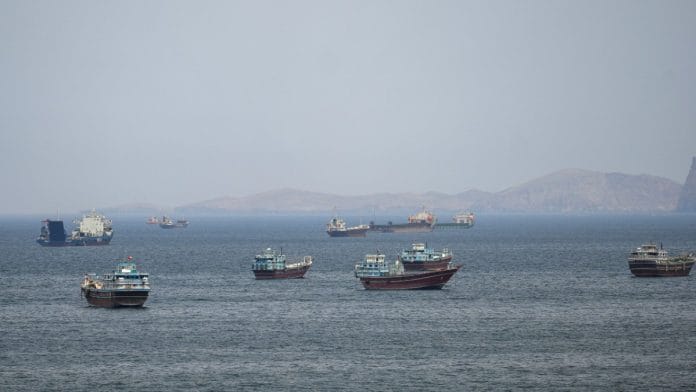


New Delhi: Iran’s Islamic Revolutionary Guard Corps (IRGC) Wednesday seized two container ships in the Strait of Hormuz and opened fire at three others, escalating tensions in one of the world’s most critical shipping lanes amid a fragile ceasefire in West Asia.
The naval arm of IRGC said it had intercepted what it described as “violating” vessels and directed them toward the Iranian coast. Among them was the Liberia-flagged Epaminondas, which ship-tracking data showed was bound for Mundra Port in Gujarat.
The British military’s United Kingdom Maritime Trade Operations (UKMTO) centre reported that at least two ships were targeted, with Iranian media later reporting that a third vessel, Euphoria, was also attacked.
Two of the three ships targeted by Iran were part of a convoy operated by Mediterranean Shipping Company, the world’s largest shipping firm, BBC reported. The MSC Francesca and MSC Epaminondas, along with four other ships, had been stranded in the Persian Gulf since before the conflict began. According to maritime intelligence firm Linerlytica, the other vessels namely MSC Clara, MSC Grace, MSC Margrit XIII and MSC Madeleine, have since safely reached the eastern side of the Arabian Sea.
Those four ships appeared to switch off their transponders to conceal their positions while navigating the high-risk route. Two additional container ships also managed to escape. The MSC Francesca and MSC Epaminondas, however, were seized by IRGC, reportedly for inspection. Details about damage or injuries on Euphoria are yet to emerge.
Iranian semi-official news agency Fars described the actions as a “lawful” assertion of control over the strait. “The ‘EPAMINODES’, which had endangered maritime safety by tampering with navigation systems without the necessary permits, were seized by the IRGC Navy and guided to Iran’s coast,” it said.
Adding, “Disrupting the order and safety of the Strait of Hormuz is our red line.”
Roughly a fifth of the world’s oil and gas supplies pass through the strait. Despite a ceasefire extension announced by US President Donald Trump Wednesday, shipping traffic through the strait has seen limited vessel movement since the initial US-Israeli strikes inside Iran on 28 February.
The seizure of the India-bound ship followed an earlier incident last week involving ships linked to India. New Delhi summoned Iran’s ambassador, Mohammad Fathali, after Iranian gunboats fired on at least two Indian-flagged vessels attempting to pass through the strait. One of the ships was a large crude carrier transporting approximately two million barrels of oil from Iraq to India.
Iran’s foreign minister, Seyed Abbas Araghchi, said last week that the strait was “completely open” following a ceasefire agreement involving the US, Israel and Iran. But, Iranian military officials later said control had reverted to stricter oversight because of what they described as repeated violations by the US.
Trump, meanwhile, in a Truth Social statement Wednesday said he had “directed our military to continue the blockade” of Iranian ports, describing Iran as “collapsing financially” and “starving for cash” as a result of the standoff.
Iranian officials dismissed the ceasefire extension as meaningless. Mahdi Mohammadi, an adviser to Iran’s Speaker of Parliament Mohammad Ghalibaf, said the move was “a ploy to buy time for a surprise strike” and warned that continued pressure would be met with a military response.
تمدید آتش بس از جانب ترامپ هیچ معنایی ندارد. طرف بازنده نمی تواند شرایط تعیین کند. تداوم محاصره تفاوتی با بمباران ندارد و باید به آن پاسخ نظامی داد. ضمن اینکه تمدید آتش بس از جانب ترامپ قطعا به معنای خرید زمان به منظور ضربه غافلگیرانه است. زمان ابتکار عمل ایران است.
— Mahdi Mohammadi (@mmohammadii61) April 21, 2026
(Edited by Amrtansh Arora)
Also Read: As Strait of Hormuz shuts again, uncertainty grips global trade & energy markets