





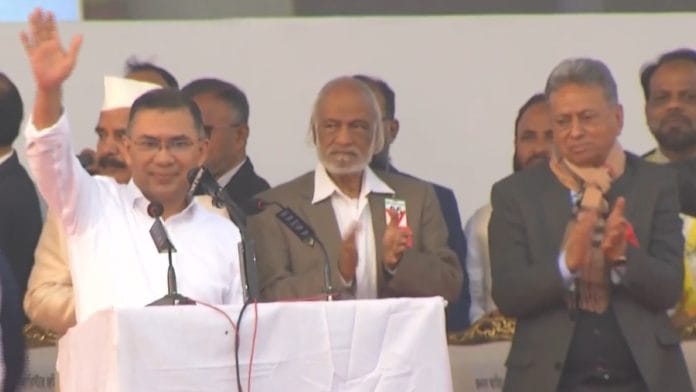



New Delhi: In his first public address after returning to Bangladesh after nearly 17 years in exile, Bangladesh Nationalist Party (BNP) acting chairperson Tarique Rahman launched a scathing attack on what he described as Sheikh Hasina’s “dictatorship”. He warned against violence by “hegemonic powers” and unveiled his electoral campaign.
Speaking at a massive public meeting in Dhaka’s Purbachal Thursday afternoon, Rahman invoked Martin Luther King Jr’s iconic “I Have a Dream” speech.
“As a member of the Bangladesh Nationalist Party, I want to say: I have a plan for the people of my country, for my country,” he said.
Rahman added that his plan is designed to promote national development and enhance the lives of ordinary citizens. “Today, this plan is for the benefit of the people of the country, for the development of the country, for changing the fate of the people of the country.”
The implementation of this plan, he said, would require the cooperation of citizens “who represent the power of democracy.”
His speech was in line with BNP’s shift towards a more liberal approach, with focus on women and children, public security and aspirations of the working class and minorities.
Opening his address with the words “Dear Bangladesh”, Rahman outlined a vision for a “safe Bangladesh” inclusive of all communities.
“This country has people from the hills as well as from the plains,” he said. “People of various religions, including Muslims, Buddhists, Christians, and Hindus, live here. We want to build a Bangladesh together—the kind of Bangladesh a mother dreams of.”
Rahman arrived in Dhaka earlier in the day from London with his wife Zubaida and daughter Zaima, amid massive security arrangements and a large-scale mobilisation of BNP supporters. His return marks one of the most consequential political developments in Bangladesh in the lead-up to the national elections in February.
Rahman framed Bangladesh’s recent turmoil through a historical lens, drawing parallels between the Liberation War of 1971, the 7 November 1975 soldiers’ and people’s uprising, and recent mass movements. “Our beloved homeland was achieved in 1971 through the sacrifice of the blood of millions of martyrs,” he said. “Similarly, on 7 November 1975, a revolution of soldiers and the people took place to protect the country from imperialists.”
He went on to cite the July uprising and events of 2024, saying, “Students and people of this country, including people from all walks of life, farmers, labourers, housewives, men and women, madrasa students—people of all parties, classes, and professions—protected the independence and sovereignty of this country on 5 August.”
‘Osman Hadi became martyr’
Rahman paid tribute to those killed during the recent protests, including Osman Bin Hadi, a student leader associated with the 2024 movement. “A few days ago, Osman Hadi, a member of the courageous generation of the ’24 movement, was killed; he became a martyr,” he said. “Hadi wanted democracy to be established for the people of this country.”
“If we are to repay the debt of the blood of those who were martyred in the ’24 movement, including Osman Hadi, and those who were victims of enforced disappearances and killings during the previous dictatorship, then let us build the Bangladesh we aspire to,” he said.
Hadi, a prominent student leader associated with the radical platform Inquilab Moncho, was shot on 12 December. He died later the same day in Singapore. His death triggered demonstrations across Dhaka and other cities, including protests near Indian diplomatic missions in Rajshahi and Chittagong. In Mymensingh, a Hindu man was lynched during the unrest.
In his speech, Rahman also stressed public safety as a central priority, “Where a woman, a man, or a child, whoever it may be, can leave their home safely and return home safely.”
He added, “There are millions of farmers and labourers. These people have expectations from this state…If we all unite today, we can fulfil the expectations of these millions of people.”
The BNP leader issued repeated warnings against provocation and violence, particularly to party workers and young supporters. “The agents of various hegemonic powers are engaged in conspiracies,” he said. “We must be patient. We must protect the peace and order of this country at all costs.”
Calling for ethical governance, Rahman pledged to rule with justice. “Let us all pledge that those who will be in charge of governing the country in the future will all try their best to govern the country in the light of the justice of Prophet Muhammad (peace be upon him).”
He also spoke about his mother, former prime minister Khaleda Zia, who remains hospitalised in Dhaka and sought prayers from citizens for her recovery. “As a son, my heart is with my mother, by her bedside in that hospital room,” he said. “But I cannot abandon the people who have dedicated their lives to the soil and people of this country.”
Rahman ended his speech with a final appeal for calm. “We must ensure at all costs that people can live in safety,” he said. “Whether it is a child, a woman, or a man, people of all ages, classes, professions, and religions must be safe.”
The political context in Bangladesh has significantly shifted since Rahman’s time. BNP has distanced itself from Jamaat-e-Islami, an Islamist political outfit, and has sought to rebrand itself as a more pluralist party following the ban on Hasina’s Awami League.
Following a 17-month stint in detention under a military-backed caretaker government led by Fakhruddin Ahmed, Rahman moved to London in 2008. He was accused of hatching a plot to assassinate Hasina, among other charges he consistently denies.
The Yunus administration acquitted him in all 84 cases. His return, initially delayed due to security concerns, was confirmed after the announcement of election dates.
Rahman’s homecoming comes at a critical juncture as Bangladesh prepares for parliamentary elections scheduled for 12 February. The BNP is widely expected to emerge as the largest party. A December survey by the US-based International Republican Institute suggested that with Awami League banned, the party is on course to win the most seats.
(Edited by Insha Jalil Waziri)
Also Read: Another chapter in India-Bangladesh diplomatic rollercoaster: Tit-for-tat summons to Bangladesh envoy