



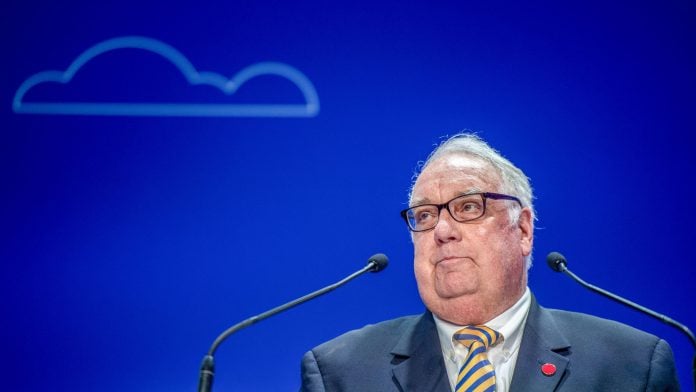
Facts are facts, so let’s just state it plainly: Howard Buffett is a nepo baby. And this is one of the rare cases where I think we should be OK with it.
Howard, 71, wouldn’t have been tapped as chairman of Berkshire Hathaway Inc. if it weren’t for his dad — the 96-year-old Warren Buffett, who on Friday became chairman emeritus. “He is getting it because he’s my son,” Warren bluntly told the Wall Street Journal last year. The same was true when Howard was named to the board 33 years ago.
That is kind of the point. Chief Executive Officer Greg Abel runs the company, but “Howard will guard its culture and values — both worth more than anything on our balance sheet,” the elder Buffett wrote in a letter to shareholders last week. “Think of Howard as a policy the shareholders own and hope never to claim against.”
What Buffett has done is split his job into two. The CEO responsibility has gone to a professional manager, while the role of custodian and steward remains in the family. This is the logical outcome at a company where shareholders were attracted to Buffett’s moral philosophy as much as his investing principles. Abel is heir to the business, but Howard is inheriting the duty of guarding his father’s legacy. This structure is designed to separate some of the benefits of a family business — a long time horizon, institutional memory, an unusual amount of skin in the game — from the downsides of installing a scion in the CEO job.
Buffett has left no room for confusion over who is in charge of what. Howard won’t be involved in the day-to-day operations of the company and will instead focus on governance, where he is most experienced. No one in the company is going to defer to Howard over Abel on investment advice. It also allows for more and better oversight than if Abel were to have taken on both the chairman and CEO roles.
Plenty of research has found that naming a descendant to the top job can come at a cost. But evidence against putting family in management shouldn’t be conflated with a case against having family in charge of stewardship. Running the business and protecting the family’s legacy may very well be two different jobs that do not always require the same skills.
To be clear, Buffett never made it any secret that this was how he planned for the company to evolve. He told 60 Minutes some 15 years ago that he was confident in son’s ability to lead the Berkshire board. And in his 1993 letter to shareholders, the year Howard became a Berkshire director, he laid out the three different manager/owner scenarios in public companies: one with no controlling shareholder, the second with a controlling owner who is also the manager and the third with a controlling owner who is not involved in management.
Berkshire fell into the second category at the time of Buffett’s writing more than three decades ago, but he acknowledged that it would someday transition into the third. When that day came, Berkshire would go “forward with a vitally interested, but non-management, owner and with a management that must perform for that owner.” It’s this third scenario that Buffett thought would lead to the best management. “In the second case the owner is not going to fire himself, and in the first case, directors often find it very difficult to deal with mediocrity or mild over-reaching,” he wrote.
The model of professional management paired with a family chair is one several Fortune 500 companies have turned to as they’ve grappled with the question of what to do with successive generations. Today at Ford Motor Co., Estee Lauder Cos Inc. and Marriott International Inc., grandsons or great-grandsons of the companies’ founders serve as chairman or executive chairman while non-family CEOs runs the operations.
The most instructive example of this model is Walmart Inc., where three generations of the founding family have now chaired the board but none have occupied the CEO’s office since founder Sam Walton retired from the role in 1988. Barron’s Andy Serwer, a longtime chronicler of Walmart and its founding family, has described the Walton’s stewardship as “one of Walmart’s greatest advantages, a singular symbiotic relationship that has almost no parallel in American business.” Today, Walton’s grandson-in-law, Greg Penner, holds the chairman role. Walmart took some heat when it named Penner to the job 2015, but the stock has returned more than 400% during his tenure.
The Walton family’s unusually long-term mentality has given Walmart the room to invest in ways that might make other boards balk. In 2015, when then-CEO Doug McMillon pitched a multi-billion dollar investment that included increasing the company’s minimum wage, the board not only approved it but told him to move faster. Executives credited the board’s willingness to think long term with the company’s ownership and governance structure. The board knew the market would react negatively and that operating income would fall for several years, but it wanted the management team to act with the next half-century in mind, not just the next decade. The $2.7 billion investment in employees ended up bolstering not only sales but remaking the company’s reputation.
As companies mature, the kneejerk reaction is often to ask how to get the family out of the business so it can professionalize. The better question may be where the family still best fits in. Buffett’s answer is that the next generation inherits the responsibility for the company’s legacy. That’s something different from inheriting a right to the top job.
This report is auto generated from the Bloomberg news service. ThePrint holds no responsibility for its content.
Also Read: Warren Buffett steps down, son Howard takes over as chairman of Berkshire Hathaway