





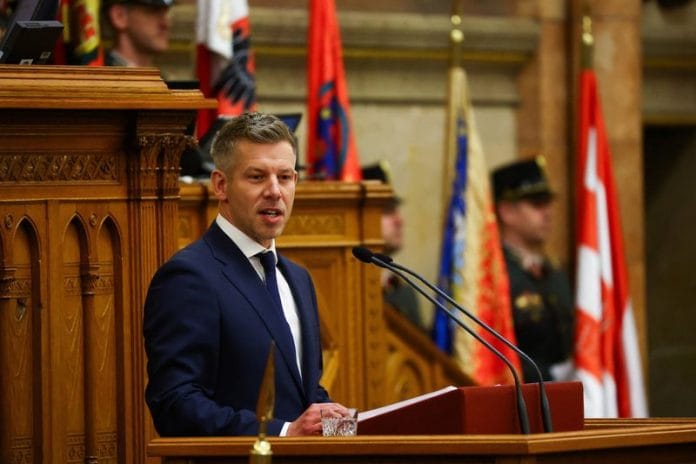


BUDAPEST, May 13 (Reuters) – Hungary’s new government, under Prime Minister Peter Magyar, was sworn in earlier this week, replacing Prime Minister Viktor Orban’s administration after 16 years.
Ministers detailed their policies ahead of their inauguration and the following are key plans for change:
ECONOMY
Hungary’s government wants to establish a new economic model focused on productivity, higher added value, skilled workers and a predictable economic and business environment that creates a level playing field for corporates.
Finance Minister Andras Karman said on Tuesday that overpriced public procurements under the Orban government boosted the budget deficit and distorted the economy.
The 2027 budget will be submitted by the end of October, laying a predictable path towards lowering the budget deficit to 3% by 2030 from around 7% this year and there will be a review of public spending to prevent money being drained by corruption.
Karman has also pledged to sustainably reduce public debt, which will require growth and disciplined fiscal policy.
EUROPEAN UNION
Magyar has repeatedly pledged to bring home European Union funds frozen over rule-of-law issues under the Orban government. The government hopes to secure 6.4 billion euros ($7.49 billion) in grants and 3.9 billion euros in loans from the EU’s pandemic recovery fund. Cohesion funds, meant to help less developed member states catch up economically, will be spent on education, healthcare, housing and energy efficiency.
The new government will also launch a debate on euro adoption and aims to meet the criteria for joining the euro by 2030.
Justice Minister Marta Gorog said that legislation in Hungary must again reflect international and European legal standards, including common EU values. She said that the government plans to amend the “child protection law” restricting access to LGBTQ+ content after a ruling by the European Court of Justice in April.
ENERGY
The new government will review the financing and implementation of the Paks nuclear power plant expansion project, which was awarded in 2014 without a tender to Russia’s Rosatom.
It also plans to diversify energy sources while maintaining access to both pipelines carrying oil to Hungary, which is seen as an advantage. Under Orban, Hungary relied mostly on Russian oil and gas imports.
FOREIGN POLICY
Foreign Minister Anita Orban said on Monday that Hungary’s main alliances are the European Union and NATO and that the government plans to rebuild trust in Hungary, which was eroded under the previous government.
Magyar’s government also aims to rebuild central European cooperation based on the friendship between Poland and Hungary.
Anita Orban also said that she aims to maintain an equal and transparent relationship with Russia, while the United States will continue to be a key ally in security and the economy.
She reiterated that Budapest will not send soldiers or weapons to Ukraine, it will not take part in a 90-billion euro EU loan and does not support accelerated EU accession for Ukraine. The Hungarian government says Ukraine should start the regular accession process, at the end of which Hungary will hold a binding referendum on its EU accession.
FACING THE PAST
Magyar’s government is setting up an office to recover financial assets that were allegedly misappropriated or lost to corruption under the Orban government. The National Asset Recovery and Protection Office will be set up by parliament and will start working on July 1.
The Tisza government also plans to open the archives of the communist-era secret police by October.
TAXES
The government plans to introduce a wealth tax for high earners and review the system of tax benefits. It will cut value-added tax on prescription medicine, firewood, fruit and vegetables and plans to launch personal income rebates for low-income earners.
Finance Minister Andras Karman said that sectoral taxes will remain in place for the time being, as changes in this area will have to be long-term and predictable, as they account for significant revenue. Viktor Orban’s government introduced special taxes on banks, the oil industry, utility companies, retail chains and telecom companies.
CHECKS ON THE PM’S POWER
The finance, justice, education and health ministers will have veto power on any legislation before it goes to parliament to provide a check on the prime minister’s power. The government also plans a change in the electoral law that would make it impossible for anyone to serve as prime minister for more than two terms.
($1 = 0.8550 euros)
(Reporting by Anita Komuves; Editing by Sharon Singleton)
Disclaimer: This report is auto generated from the Reuters news service. ThePrint holds no responsibility for its content.