



Sept 8 (Reuters) – Yemen’s Tehran-backed Houthi movement fired missiles and drones at Saudi Arabian cities and energy facilities on Tuesday, part of a wider regional escalation more than six months into the U.S. war with Iran.
Renewed warfare between the Houthis and Saudi Arabia threatens to reignite Yemen’s frozen civil war and worsen risks to Red Sea shipping, further disrupting Middle Eastern energy exports already choked by Iran in the Strait of Hormuz.
WHO ARE THE HOUTHIS?
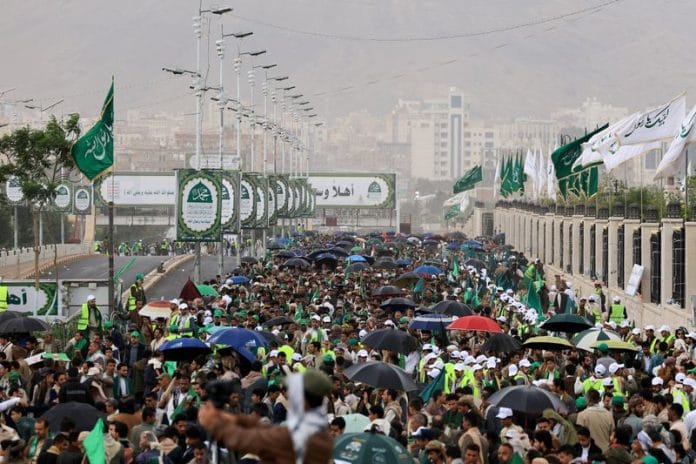
The Houthis are a military, political and religious movement that rules over most of northwest Yemen and has disrupted global trade and energy markets with attacks on cargo ships and tankers in the Red Sea.
It began firing on ships in the Red Sea and launching drones and missiles at Israel in 2023, saying it was doing so in support of Palestinians during Israel’s war in Gaza that began the previous year.
Those attacks on Red Sea shipping, as well as on Saudi Arabia, resumed this year in response to the United States’ war on the Houthis’ close ally Iran.
WHAT DO THE HOUTHIS WANT?
The group emerged in far north Yemen in the 1990s as a revival movement for the Zaydi sect of Shi’ite Islam, which had once ruled Yemen but whose northern heartland had become impoverished and marginalised.
It fought a series of guerrilla wars against Yemen’s national army and a brief border conflict with Sunni Saudi Arabia.
When longtime president Ali Abdullah Saleh was brought down in the 2011 ‘Arab spring’ protests, the group consolidated its control over northern Yemen, rejecting a Gulf-backed political transition.
With Iranian support, the group’s secretive leader, Abdul Malik al-Houthi, was meanwhile turning his faction of mountain fighters into a force of tens of thousands.
In 2014 they seized the capital Sanaa, driving the internationally recognised government south towards Aden.
WHAT’S BEHIND THE HOUTHI CONFLICT WITH SAUDI ARABIA?
Fearful of growing Iranian influence in Yemen and chaos on its borders, Saudi Arabia led a military intervention against the Houthis in early 2015 to dislodge the group, restore the government and revive the transition plan.
The resulting civil war triggered one of the world’s biggest humanitarian crises and led to years of bitter fighting and devastating air strikes by Saudi Arabia and its coalition partners including the United Arab Emirates.
However, neither side was able to gain much ground in Yemen’s mountainous terrain, and the Houthis remained in control over the northwest, where most of the population lives.
They demonstrated significant missile and drone capabilities, attacking oil installations and vital infrastructure in Saudi Arabia and the United Arab Emirates.
After years of fighting, the U.N. brokered a 2022 truce between the warring sides in Yemen that maintained peace until this year.
HOW MUCH DAMAGE CAN THE HOUTHIS DO WITH ATTACKS IN THE RED SEA AND SAUDI ARABIA?
The group’s attacks on Red Sea shipping in 2023-25 significantly disrupted global trade, forcing cargo ships travelling between Europe and Asia to take a long, expensive route around Africa.
Their threats to oil tankers during the Iran war have added to the squeeze on energy out of the Gulf after Tehran mostly choked off the Strait of Hormuz, adding to a global oil crisis.
Some Houthis missile and drone attacks have caused significant damage in Saudi Arabia and the UAE over the years, but have proven less effective against targets further north such as Israel.
LINKS WITH IRAN
Iran champions the Houthis as part of its regional “Axis of Resistance”, which includes Lebanon’s Hezbollah and Iraqi Shi’ite militias, though its ties with the Yemeni movement are less clear than with those other groups.
The Houthis do not recognise Iran’s supreme leader as their ultimate religious authority in the same way Hezbollah and the Iraqi groups do. Their motivations are also mainly domestic, though they are ideologically aligned with Iran.
The U.S. says Iran has armed, funded and trained the Houthis with help from Hezbollah. The Houthis deny being an Iranian proxy and say they develop their own weapons.
(Cimpiled by Timour Azhari, Maha El Dahan, Nayera Abdullah, Michael Georgy and Angus McDowall, Editing by Timothy Heritage)
Disclaimer: This report is auto generated from the Reuters news service. ThePrint holds no responsibility for its content.