







By Philip Blenkinsop
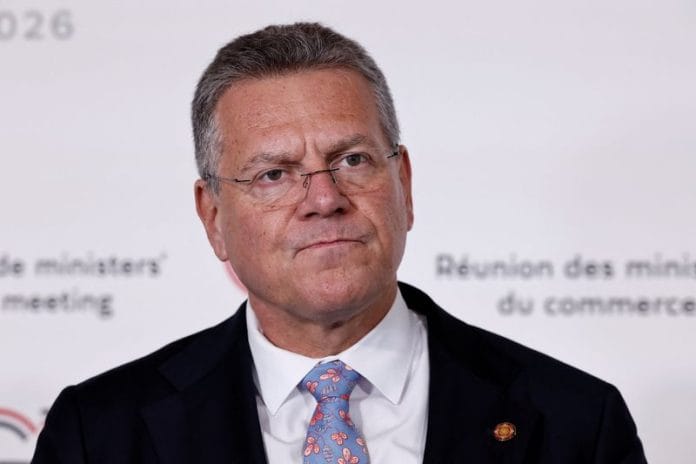
BRUSSELS, June 5 (Reuters) – The European Commission is weighing legislation that could force companies in sensitive sectors to cut reliance on single suppliers – notably in China – and diversify to at least three sources, European Trade Commissioner Maros Sefcovic said on Friday.
The proposal would be part of a broader review of EU trade defences due by the third quarter, including steps to speed up anti-dumping and anti-subsidy cases and potential new measures to tackle overcapacity.
“Diversification now requires a dedicated instrument,” Sefcovic told a conference of the European Policy Centre think tank in Brussels. “We understand the urgency for critical minerals, but every high-risk sector must be weaned off single supplier dependence.”
Sefcovic said that by having at least three different sources of ‘critical supplies’, companies would be shielded from general supply chain disruptions and government policies such as the export restrictions that China has imposed on certain rare earths. He did not specify what sectors or suppliers would be high-risk or critical.
Sefcovic said EU leaders meeting in Brussels for a summit on June 18 to 19 would discuss economic security and likely provide guidance regarding what tools the Commission should focus on.
Five EU countries issued a paper last month urging the EU to revamp trade measures to defend itself more effectively against cheap imports.
The trade commissioner noted there were already EU policies encouraging companies to diversify if they relied on one source for 40% of certain supplies.
“Should this need to be reinforced and made more concrete? I think this is what we will look at,” he said.
Sefcovic also said any measure would need to be coordinated with industry and include a transition period.
“I know that times are hard and the economic situation is very challenging, but we need to work with them (industry) on how they would integrate this risk premium into their business operations. It was not needed before… this has changed,” he said.
(Reporting by Philip Blenkinsop;Editing by Elaine Hardcastle)
Disclaimer: This report is auto generated from the Reuters news service. ThePrint holds no responsibility for its content.