




In times of crisis, the oil industry delivers a perennial warning: “You can’t print barrels.” While central banks can — and do — run their presses to soothe financial markets, the same option isn’t available in energy markets. And if conjuring crude is implausible, delivering diesel out of thin air is even more impossible.
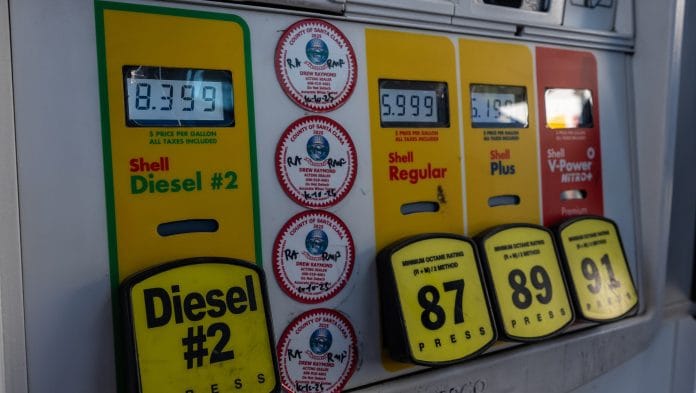
Right now, the world wishes it had a diesel printer as two wars — US-Iran and Russia-Ukraine — combine to create an enormous shortage, pushing the cost of the fuel to all-time highs. In the US, the retail price topped $6 a gallon last week for the first time; it was about $3.50 at the beginning of the year. In the wholesale market, it’s changing hands above $5, pointing to further pain at the pump.
The energy industry can be forgiven for feeling déjà vu: It battled a similar shortage in the jet-fuel market earlier this year, as holidaymakers fretted their summer vacation plans would be ruined. Sadly, increasing diesel output is a lot harder.
Diesel is the world’s most-consumed refined petroleum product, accounting for nearly 30% of total oil demand. The trucking industry swallows about half of the world’s output, with railway freight, construction, factories, mining and agriculture absorbing the rest. The current shortage and accompanying elevated prices hurt some countries more than others; China and India are more dependent on the fuel, while the US uses twice as much gasoline. Even so, officials are worried: US National Economic Council Director Kevin Hassett told Fox News on Friday that the cost of diesel was “a major concern for us.”
The crux of the crisis is a shortage of global refining capacity. That’s partly due to the wars themselves, but it’s also an unintended consequence of actions taken to ease the global shortfall in crude.
Let’s start with the direct effect. About a year ago, Russia and the Persian Gulf nations exported 2.2 million barrels a day of diesel; flows have since plunged by around 75% to 520,000 daily barrels in August, according to Kpler, an energy intelligence firm. Russia accounts for nearly half of the decline, as attacks by Ukraine have crippled many of its largest refineries.
Saudi Arabia accounts for another significant percentage. Unlike Kuwait, the United Arab Emirates and Iraq, Saudi Arabia has so far made only limited use of clandestine tanker runs across the Strait of Hormuz; its exporting refineries inside the Persian Gulf have remained largely idle since the war began.
Then there’s the indirect impact. China has reduced its crude imports since the US-Iran conflict started. Previously, Beijing bought about 11.5 million barrels a day of crude; last month, its daily purchases amounted to little more than 7 million barrels, according to Vortexa, another energy consultancy. As China buys less oil, it’s also cutting back on refining, in turn curtailing its typically large exports of diesel. So by reducing oil imports, China is simultaneously worsening the scarcity of refined products.
Other factors are also in play. The US and Japan have both tapped their large strategic petroleum reserves, but those are mostly in the form of crude, rather than refined products. The releases have eased the pressure in the oil market but done very little for diesel. American oil producers have also responded to higher prices by boosting drilling, a move that’s echoed in Canada, Brazil, Venezuela, Argentina and Guyana. But, again, that only boosts the flow of crude: While shale drillers can increase output in a matter of weeks or months, adding refining capacity takes years.
The only — partial — solution is a combination of running existing refineries harder and letting elevated prices kill some demand. Both are happening.
There’s nothing like record margins to prompt every plant to go into what the industry calls “max diesel” mode. Of course, “max” is relative; refineries can tweak their operations here and there, but typically can’t boost diesel output by more than a couple of percentage points before engineering limits prevent further increases. And boosting diesel means reducing output of other refined products, mostly jet fuel. Over the summer, US and European refiners have been focused on making as much fuel for airlines as they could.
Refineries are complex machines, capable of processing multiple streams of crude into dozens of different petroleum products. For simplicity’s sake, the industry measures refining margins using a rough calculation called the “3-2-1 crack spread” — for every three barrels of oil a refinery “cracks,” or processes, it generates two barrels of gasoline and one barrel of distillate fuel such as diesel.
This month, the 3-2-1 spread — the difference between the cost of a barrel of oil and the premium available from selling those refined products — has surged to about $65, a record high. History illustrates the magnitude of the rally. From 1985 to 2021, the crack spread averaged about $10.50. Even between 2004 and 2008 — the so-called golden age of refining, when Chinese oil demand exploded — it never surpassed $30. As refining has become ever more lucrative in recent months, every plant outside Russia, the Middle East and China is running as fast as it can.
Unfortunately, the large size of the diesel market, at about 29.5 million barrels a day, means significant shifts in refinery output would be needed to move the dial on either supply or prices. To put this into perspective, jet fuel has a daily volume of less than 8 million barrels, so relatively small changes in refining output and airline consumption were able shift the supply and demand balance more easily.
With that in mind, short of the two wars ending, the diesel shortage is set to persist for the foreseeable future. The only relief on the horizon comes from the weather: The recurrent El Niño phenomenon typically brings fewer hurricanes to the US Gulf of Mexico and warmer winters to some regions. So far this season, storm activity in the Atlantic, measured by the so-called accumulated cyclone energy indicator, has been the tamest since 1950, according to data compiled by Colorado State University. Thus, American oil refineries in Texas and Louisiana have suffered less disruption than usual, improving their productivity.
And if the winter is warmer than normal, as long-range weather models suggest, demand for heating oil will decline in Europe and North America, easing pressure on the wider diesel market.
Betting on favorable weather, however, is hardly a strategy. Ultimately, higher diesel prices should push demand lower, rebalancing the market — but that carries an economic cost, particularly for those countries that are more reliant on the fuel.
Disclaimer: This report is auto generated from the Bloomberg news service. ThePrint holds no responsibility for its content.