




New Delhi: Democrats are gaining ground ahead of the 3 November US midterm elections, leading in several key Senate battlegrounds and threatening Republican control of Congress. The challenge for Donald Trump is compounded by history: The president’s party has lost House seats in 18 of the 20 midterm elections held since 1946.
Trump has spent the final days of the campaign travelling across the country to rally support for Republican candidates, warning voters that a Democratic victory could undo his administration’s policies. At a rally in Kansas—his 30th in this campaign—he made an unusually direct appeal to supporters, asking them to vote for Republicans as though he himself were on the ballot.
“I’m closing it down—this is it, I had to come here to make sure that Roger got elected,” Trump said, referring to Republican Senator Roger Marshall, who is facing a challenge from Democrat Adam Hamilton.
“I didn’t want to take a chance,” Trump added, asking supporters to turn out for Marshall and other Republican candidates.
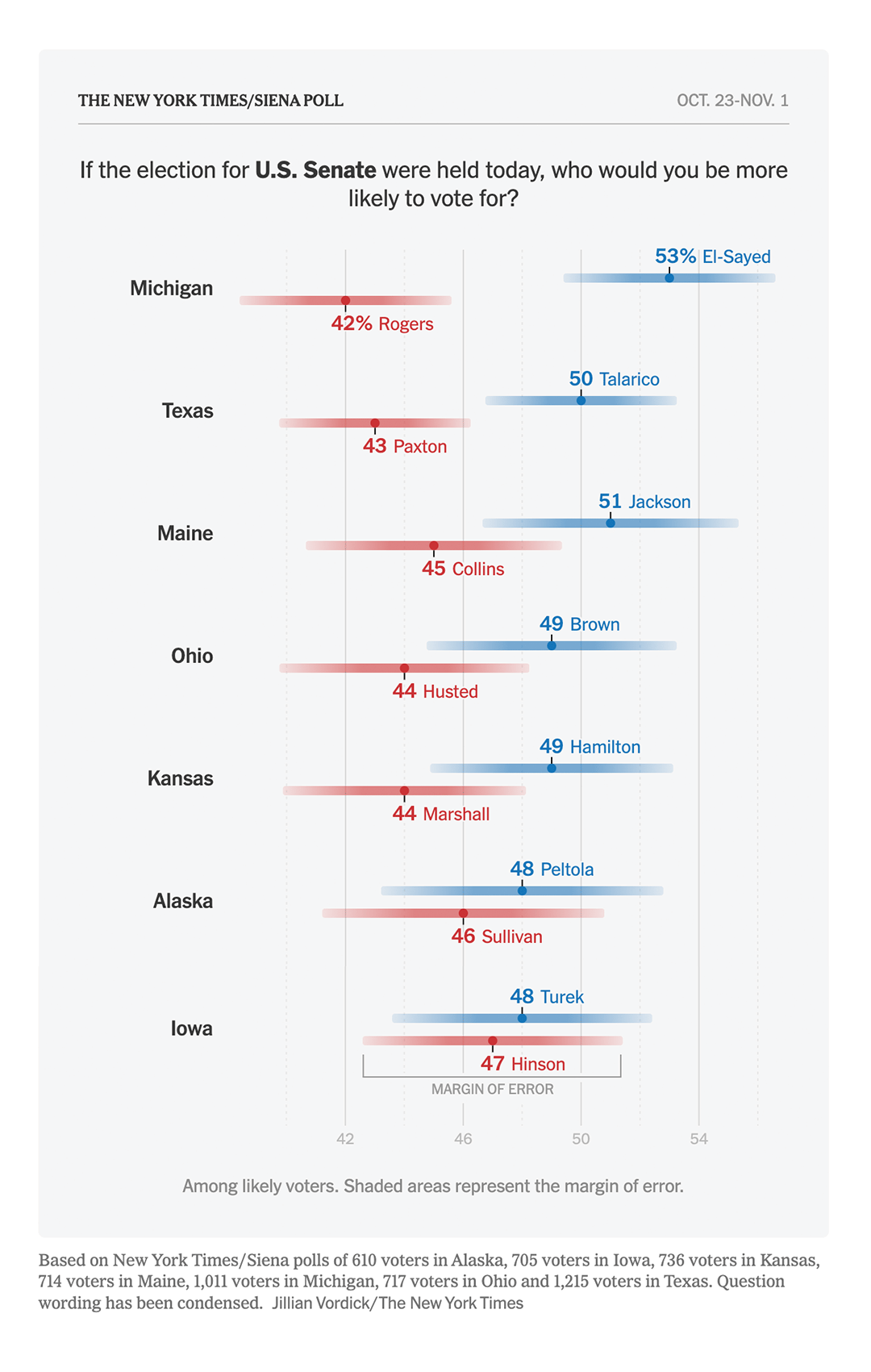
But the latest polling suggests that the president’s efforts may not be enough to prevent a Democrat resurgence. Surveys by The New York Times and Siena University show Democrats leading in five of the seven states considered crucial to determining control of the Senate, with the race effectively tied in a sixth.
Democrats are ahead in Kansas, Maine, Ohio and Texas, with narrower leads in Alaska and a close contest in Iowa. In Michigan, where Democrats already hold the Senate seat, their candidate, Abdul El-Sayed, leads Republican Mike Rogers by 11 percentage points.
A Democratic victory in several of these states would be particularly significant because Texas has not elected a Democratic senator since 1988, while Kansas has not done so since 1932.
Why it matters
The midterm elections will determine which party controls the two chambers of the US Congress for the final two years of Trump’s presidency. Republicans currently hold a 53-47 majority in the Senate and 218 of the 435 seats in the House of Representatives.
All 435 seats in the House are being contested, along with 35 of the Senate’s 100 seats. Democrats need to gain at least four Senate seats, while defending the seats they already hold, to take control of the upper chamber.
More than 51 million Americans had already voted before Election Day, according to the University of Florida’s Election Lab, exceeding the early-voting total recorded during the 2022 midterms.
Unlike India’s parliamentary system, where voters elect members of Parliament and the government is formed by the party or coalition commanding a majority in the Lok Sabha, the United States elects its president separately from Congress.
The US Congress, the country’s federal legislature, has two chambers: The House of Representatives and the Senate. The president may lead the executive branch, but Congress controls legislation, federal spending and several important oversight powers.
Members of the House serve two-year terms, meaning all 435 seats are contested every two years. Senators serve six-year terms, with roughly one-third of the 100 seats coming up for election during each midterm cycle.
Midterm elections take place halfway through a president’s four-year term and are often treated as a referendum on the president’s performance. The results can substantially change the balance of power in Washington.
If Republicans retain control of both chambers, Trump will have a greater chance of advancing his legislative agenda. A Democratic takeover of either chamber, however, could make it harder for the administration to pass laws, approve spending and implement policy changes.
A Democrat-controlled House could also intensify congressional investigations into the administration. The House also has the power to even initiate impeachment proceedings, although removing a president requires a two-thirds majority in the Senate.
Why are Democrats gaining ground?
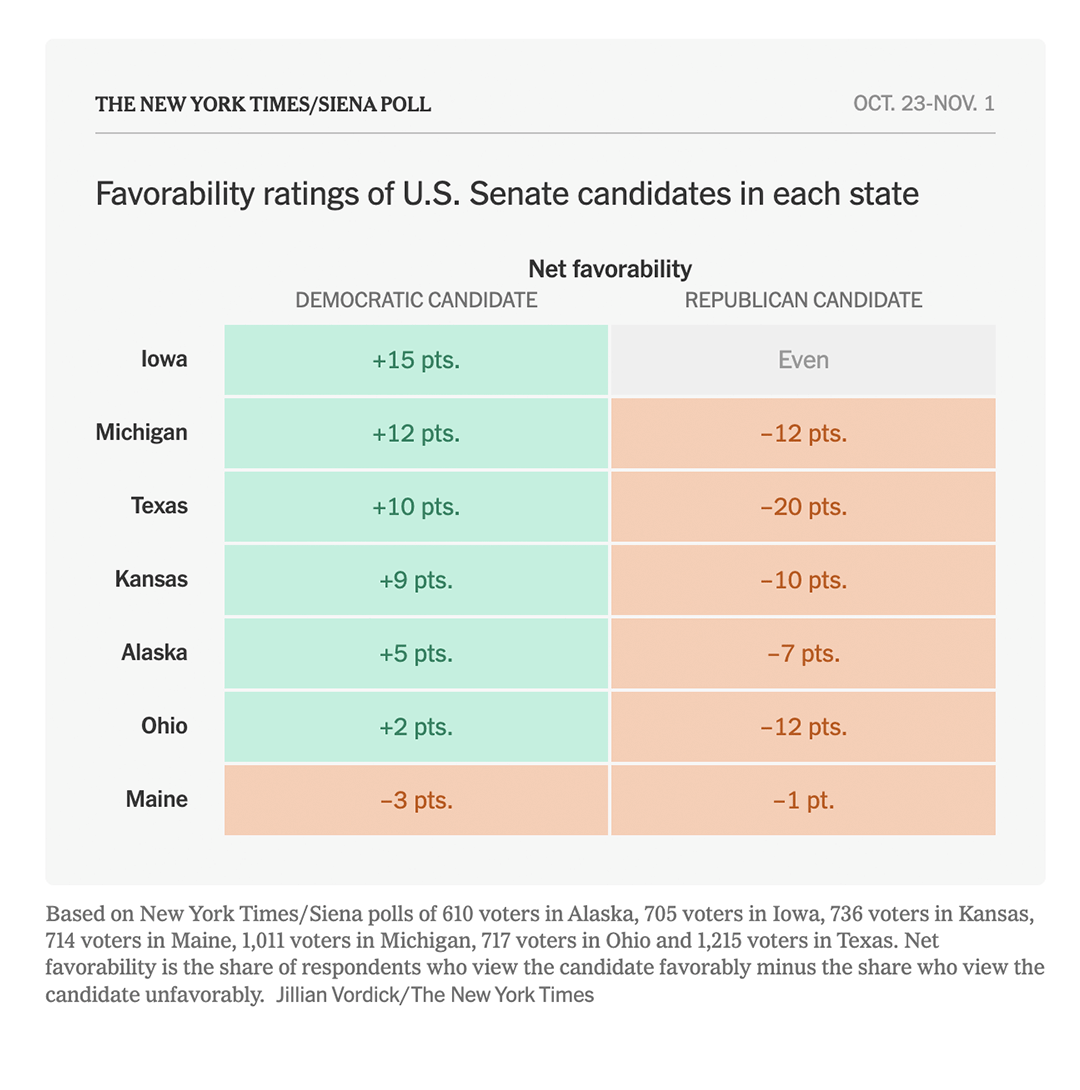
Economy appears to be one of the biggest vulnerabilities for Republicans. The Times-Siena surveys found that only 38 percent of likely voters across the seven battleground states approved of Trump’s performance as president. Dissatisfaction with the cost of living and his administration’s handling of the economy has weakened Republican support, including among some voters who backed Trump in 2024.
Democrats hold a nine-point advantage over Republicans on the issue of the cost of living, leading in every state surveyed. They have also gained ground among younger voters, Latino voters and independent voters.
The findings suggest that Trump’s earlier gains among younger and Latino voters may not be translating into sustained support for Republican Senate candidates. The party is now winning only about a quarter of younger and Latino voters in the states covered by the surveys.
Republicans have also lost some support among white working-class voters, a key constituency in Trump’s political coalition. In 2024, Trump won an estimated 66 percent of white voters without college degrees. In the seven states surveyed now, Republican candidates are now winning about 56 percent of this group.
The economic pressures are particularly visible in agricultural states such as Kansas. Rising diesel prices following the war with Iran and the administration’s decision to drop import tariffs on foreign beef have unsettled farmers and ranchers, traditionally important Republican constituencies, according to the surveys.
The polls also suggest that Democrats have benefited from Trump’s declining popularity over foreign policy. The war with Iran and its impact on energy prices have added to voters’ economic anxieties.
There are, however, reasons to be cautious about the polls. Some voters remain undecided, and those who made up their minds in the final month of the campaign favoured Republicans by nine percentage points. Pollsters have also struggled in previous elections to accurately measure support for Trump, whose voters may be less likely to participate in surveys, the NYT noted.
In US presidential politics, seven states are widely considered to be the crucial swing states: Arizona, Georgia, Michigan, Nevada, North Carolina, Pennsylvania, and Wisconsin.
The term ‘swing states’ is specific to the United States and stems from its Electoral College system, under which the outcome in individual states plays a crucial role in determining who becomes president.
According to the NYT surveys, for midterms, Democrats are ahead in all seven states likely to decide control of the Senate: Michigan, Kansas, Texas, Maine, Ohio and, more narrowly, in Alaska and Iowa.
History of midterm setbacks for presidents
History often offers little comfort to the party occupying the White House. Midterm elections have traditionally been difficult for the president’s party, with voters often using them to express dissatisfaction with the administration. The party in power typically loses seats in the House of Representatives.
Since 1946, the United States has held 20 midterm elections. In 18 of them, the president’s party lost seats in the House of Representatives. The party’s prospects could be further weakened by Trump’s approval ratings.
Historically, every president since Harry S. Truman whose job approval fell below 50 percent in the month before a midterm election went on to lose House seats. In other words, a president entering the midterms with approval ratings below that threshold has consistently faced losses in the House.
But there have also been exceptions.
In 1998, President Bill Clinton’s party gained four House seats amid public opposition to Republican efforts to impeach him. According to Gallup, his average approval rating during his second term was 60.6 percent, the highest recorded for any second-term US president from Harry S. Truman to Joe Biden.
President George W. Bush also defied the usual pattern in 2002. In the aftermath of the September 11 attacks, Republicans gained eight seats in the House and made gains in the Senate, benefiting from a surge of public support for the president.
Of the 20 midterm elections held between 1946 and 2022, six resulted in relatively small shifts of fewer than 10 House seats, while seven saw changes of between 11 and 39 seats. The remaining seven were wave elections, in which more than 40 seats changed hands.
At least five House seats have changed party hands in every midterm election since 1946. A net swing of just five seats from Republicans to Democrats in 2026 could therefore be enough to give Democrats control of the House.
But more recent records show why mid term polls are critical. The past presidents—Bill Clinton, George W. Bush, Barack Obama, Donald Trump and Joe Biden—all began their presidencies with their party controlling both chambers of Congress. Each lost control of the House or Senate within their first two years in office.
Republicans suffered a major setback under George W. Bush in 2006, losing 30 House seats amid growing opposition to the Iraq war and the administration’s handling of the conflict.
In 2010, Barack Obama’s Democrats lost 63 House seats, as voters turned against his administration during the economic recovery following the financial crisis.
Trump’s own first midterm election, in 2018, produced a divided result. Republicans gained seats in the Senate but lost control of the House, handing Democrats an important platform to investigate the administration.
Why the elections matter for India
The outcome of the midterms will have consequences beyond Washington, including for India’s trade, technology and defence relationship with the United States.
Congress has significant authority over federal spending, foreign commerce and oversight of the executive branch. A change in its political composition could therefore affect how easily Trump implements policies that have direct implications for India.
Trade is one of the biggest areas of concern. The Trump administration imposed steep tariffs on Indian goods in 2025, citing India’s continued purchases of Russian crude oil. Following negotiations, the two countries announced an interim framework in February 2026 under which the US said it would apply an 18 percent reciprocal tariff rate to Indian-origin goods.
A Democrat takeover of the House could bring closer congressional scrutiny of the administration’s tariff policies and its handling of trade negotiations. It could also complicate Trump’s ability to pursue further changes in trade policy.
However, a change in congressional control would not necessarily mean an end to protectionist measures. Both Republicans and Democrats have increasingly supported policies aimed at protecting American industries and domestic supply chains.
Immigration is another important issue for India. In September 2025, the Trump administration introduced a $100,000 fee on new H-1B visa applications, a move that affected Indian professionals and the country’s information technology industry, which relies heavily on access to the American labour market.
Congressional scrutiny could influence debates around immigration and the administration’s implementation of visa policies, although a Democrat majority would not automatically reverse the changes.
Defence and technology cooperation are also important. India and the US have expanded cooperation in areas such as advanced technology, semiconductors and defence under initiatives including the Transforming the Relationship Utilising Strategic Technology (TRUST) framework. A change in congressional leadership could affect oversight and funding priorities, but the broader strategic interest in countering China’s influence has bipartisan support in Washington.
(Edited by Viny Mishra)
Also read: Explainer-How Trump’s noncitizen voter lists could affect the midterms