




By Sarita Chaganti Singh, Shivangi Acharya and Saurabh Sharma
NEW DELHI, Sept 12 (Reuters) – The BRICS group of emerging economies has agreed on a joint declaration, sources told Reuters on Saturday, a significant diplomatic breakthrough as its leaders began summit talks in New Delhi, aiming to boost the bloc’s global clout.
Host India’s Prime Minister Narendra Modi said that the bloc had come of age and it was time to translate its unity and consensus into concrete results on the global stage, as he opened the meeting.
The summit, hoping to bridge divisions between members Iran and the United Arab Emirates over the Gulf conflict, is being held as the United States and Iran resume tit-for-tat strikes in their six-month-old war.
That followed a pause in fighting for much of August, while the Iran-aligned Houthi rebels in Yemen tightened their grip in the Red Sea region.
Negotiators had agreed on a joint declaration unlikely to name any country but which will condemn unilateral aggression by any country, four sources told Reuters, adding that the bloc’s leaders were expected to approve the document later on Saturday.
The sources declined to be identified as they are not authorised to speak to the media. The foreign ministry of host India did not immediately respond to a request for comment on the declaration.
The negotiations saw differences on several contentious issues but India led sustained consultations to bridge competing positions and build consensus among members, said an Indian source with direct knowledge of the development.
Against the backdrop of ongoing conflicts and heightened tensions in the Gulf region, securing consensus presented a particularly complex diplomatic challenge, the source said.
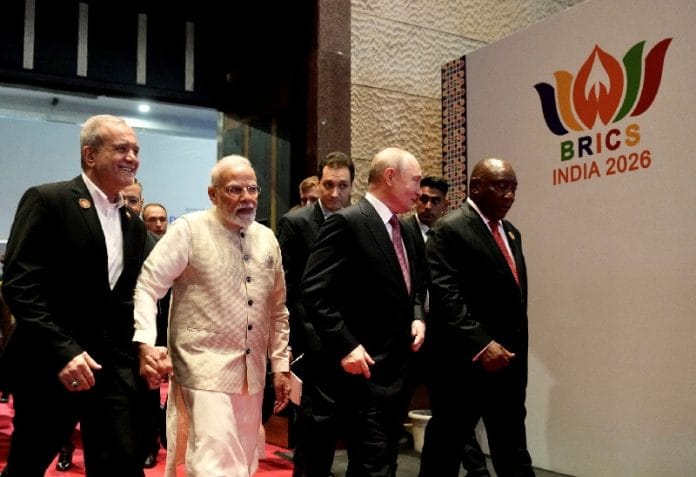
PUTIN, XI, PEZESHKIAN, RAMAPHOSA IN ATTENDANCE
Foreign policy experts had said the key test for the bloc would be finding language on the Middle East crisis that both Abu Dhabi and Tehran could accept, clearing the way for a joint declaration.
Such a joint statement was unlikely to influence the current geopolitical landscape, but would demonstrate unity by a grouping of emerging nations against economically debilitating policies such as Western sanctions, they said.
BRICS foreign ministers meeting in New Delhi in May were unable to issue a joint statement, stymied by differences between Iran and the UAE.
The BRICS bloc is seeking to raise its profile by influencing international rules and demanding the reform of institutions such as the World Bank, International Monetary Fund and World Trade Organization, which some members view as being dominated by Western powers.
Leaders attending the summit are Russian President Vladimir Putin, China’s Xi Jinping, Iran’s Masoud Pezeshkian, South Africa’s Cyril Ramaphosa and Abu Dhabi Crown Prince Sheikh Khaled bin Mohamed bin Zayed Al Nahyan, among others.
Chinese President Xi said BRICS countries should firmly stand on the right side of history by steering the international order toward greater equity and justice.
New Delhi, which has strong ties with the United States, Russia, Israel, Iran and the Gulf Arab states, is engaged in a diplomatic balancing act, with Prime Minister Narendra Modi pushing BRICS members to boost trade cooperation, reduce barriers and expand business opportunities.
EVERY COUNTRY SHOULD HAVE A VOICE, MODI SAYS
“While strengthening BRICS, we must also determine the direction of global reform,” Modi said. “The Global South is today in the front row when it comes to global crises, but in the back row when it comes to decision-making. We have to transform this pyramid and privilege into a platform of partnership — where every country has a voice, every member has a stake.”
Modi also reiterated India’s longstanding demand for expansion of the U.N. Security Council, including permanent seats for itself and other emerging powers, saying that reform of the Security Council can no longer be delayed.
“The message of this BRICS Summit being held in India should be clear: If our future is shared, then the right to shape that future must also be shared,” Modi said.
BRICS groups Brazil, Russia, India, China and South Africa, Egypt, Ethiopia, Indonesia, Iran and the United Arab Emirates.
It was set up in 2009 to challenge a world order dominated by the United States and its Western allies. Together, its members account for more than 40% of the world’s population and almost a quarter of the global economy.
(Reporting by Sarita Chaganti Singh, Shivangi Acharya, Saurabh Sharma, Aftab Ahmed, Sakshi Dayal, Shilpa Jamkhandikar and Hritam Mukherjee; Writing by YP Rajesh; Editing by Clarence Fernandez and Jacqueline Wong)
Disclaimer: This report is auto generated from the Reuters news service. ThePrint holds no responsibility for its content.