





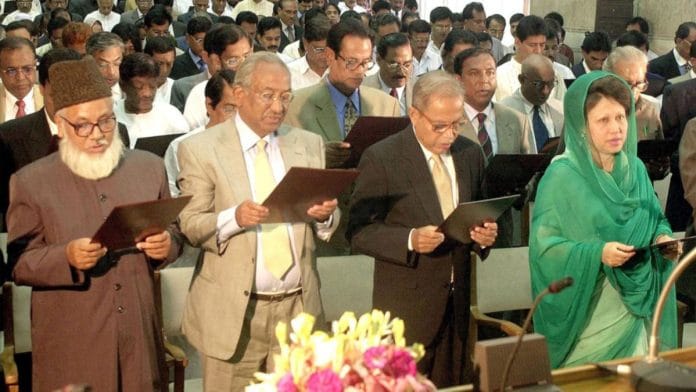



New Delhi: When former Bangladesh PM Sheikh Hasina was ousted in 2024, Bangladesh Nationalist Party (BNP) leader Khaleda Zia—from a hospital bed in a TV address—called it “the end of tyranny”. It was her first public statement in six years, and also her last.
Begum Zia, as she was known and who was Bangladesh’s first female prime minister, died Tuesday at 80 at a hospital in Dhaka. Her death ends a chapter that shaped Bangladesh’s politics for more than three decades, defined by a power duel between two women whose personal histories defined a nation for years.
For much of Bangladesh’s history, power oscillated between Khaleda Zia and Sheikh Hasina, the daughter of Sheikh Mujibur Rahman, the country’s founding father. Their rivalry was dynastic, ideological and deeply personal. Between them, they dominated every national election from 1991 onward, alternately governing and dismantling each other’s legacies.
For Khaleda, even her birthday became a political conflict. It was debated on TV and in courts for years. She insisted she was born on 15 August, a date that is marked as Bangladesh’s national mourning day, marking the assassination of Sheikh Mujibur Rahman and much of his family in 1975. Awami League accused her of deliberately politicising the date to provoke her rival.
Government documents, school records and passports listed several different dates, ranging from 9 August 1945 to 5 September 1945 to 5 August 1946.
In 2016, a case was filed accusing her of falsifying her birth date to “tarnish the legacy” of Sheikh Mujib; she was acquitted in 2024.
Yet, Begum Zia held a distinction unmatched in Bangladeshi politics: She had never lost an election from any constituency she contested. In the general elections of 1991, 1996 and 2001, she was elected from five different parliamentary seats; in 2008, even though her party lost the elections, she herself won all three constituencies she contested.
Also read: Rival ‘begum’ freed from jail after Hasina’s flight — who is Bangladesh ex-PM Khaleda Zia
Wife in the background to world leader
Born Khaleda Khanam Putul in the Dinajpur district of what was then undivided India, her family moved to Pakistan after 1947, and she later married a Pakistani army officer, Zia-ur Rahman.
During Bangladesh’s 1971 war of independence, Zia emerged as a key military commander, while Khaleda and her children lived in hiding. At one point, she was arrested by Pakistani forces and held until the end of the war.
According to the 2013 book, Dynasties and Female Political Leaders in Asia: Gender, Power and Pedigree, authored/edited by Claudia Derichs and Mark R. Thompson, Khaleda’s husband, then a commander in the independence movement, had asked her to join him in a demilitarised zone but she had already surrendered. This strained their relationship, and he refused to see her after the war.
It was Sheikh Mujibur Rahman who intervened to reconcile the couple in a period during which Khaleda and Hasina, then young women bound by shared trauma, were even friends.
During her husband’s presidency, she remained largely in the background, playing only a ceremonial role at official events. As is the case with Bangladesh’s dynastic politics, after his assassination in 1981, she entered politics as a custodian of his party’s legacy. As the BNP chairperson, she became the main challenger to military rule under General Hussain Muhammad Ershad. In those years, she and Sheikh Hasina again briefly stood on the same side, leading protests to restore democracy. She earned the moniker of ‘The Uncompromising Leader’ who stood up to the military general.
In 1991, she became Bangladesh’s first female prime minister. She lost in 1996 amid protests and a disputed election, returned in 2001 through a coalition that included Islamist parties like Jamaat, and then lost again in 2008 as allegations of corruption mounted.
Yet she knew what her role meant. When in 1993, she went to address the United Nations General Assembly, BNP was eager to emphasise her place in history: The first elected woman leader from a Muslim-majority country to address the United Nations General Assembly. In a New York Times interview, she herself seemed unmoved by the distinction.
“Hmmm,” she replied, when asked about it. She was more inclined to stress that women’s public participation in Bangladesh was no longer exceptional.
“We allow and encourage women to participate in all fields of national life,” Khaleda Zia said, seated in a cream silk sari. “In the villages, women work in the fields. In towns, they work outside the home. They are active in culture and politics, in offices and government departments, and as doctors and teachers.”
Ironically, in January 2015, when Khaleda Zia was effectively under siege, her office sealed off by police trucks packed with sand to stop her from leading anti-government protests, it was Prime Minister Sheikh Hasina who arrived to offer condolences—only to be stopped at the locked gates—at the death of her younger son, Arafat.
Tarique’s return on 25 August is significant ahead of Bangladesh’s polls on 12 February. Rahman, often referred to as ‘The Dark Prince’ has lived in London since 2008, after leaving Bangladesh following 17 months in detention under a military-backed caretaker government led by Fakhruddin Ahmed. He had multiple charges against him, including a plot to assassinate Sheikh Hasina and maintained that those were all politically motivated. Under the Yunus administration, he was acquitted of all 84 cases. Once election dates were announced, Rehman announced his return. Between 2008 and late 2025, Rahman led the BNP from exile in London. He is now a frontrunner in the 2026 elections.
Khaleda’s foreign policy
In foreign affairs, Khaleda largely followed a familiar pattern: Warmer ties with Pakistan and a cooler relationship with India.
It was during her rule in July 2002, when President Pervez Musharraf of Pakistan, during a state visit to Dhaka, issued an apology for abuses committed by Pakistani forces during Bangladesh’s 1971 war of independence. It was the first such apology by a Pakistani leader and was widely hailed in Dhaka as a diplomatic success for her government. With China, she adopted a “Look East” policy.
She was defeated by Hasina in 2008. The defeat proved permanent as her rival returned to office and stayed for the next 15 years, steadily consolidating power. For Khaleda, corruption cases multiplied, and in 2018, she was even sentenced to prison on charges of embezzling from orphanage funds.
Even during her political eclipse, Khaleda remained engaged in diplomacy. In October 2012, she travelled to India to meet President Pranab Mukherjee, Prime Minister Manmohan Singh and senior officials, including the foreign minister and national security adviser. The visit was widely noted, given the Bangladesh Nationalist Party’s reputation for cooler toward India than the ruling Awami League.
Khaleda then told Indian leaders that her party sought a relationship based on mutual benefit, including cooperation against extremism.
‘One family rule’
Meanwhile, her health deteriorated sharply. She suffered from arthritis, diabetes and advanced liver disease, and after contracting Covid-19 in 2021, doctors urged that she seek treatment abroad. The courts denied repeated requests. “She can bring any doctor she wants,” Bangladesh’s then foreign minister A. K. Abdul Momen said. “She cannot leave the country.”
Even so, her symbolic power endured. After Sheikh Hasina was toppled in 2024 following mass protests and fled the country, Khaleda was freed from house arrest, and several cases against her were dropped. Despite her condition, her party nominated her for three parliamentary seats ahead of elections scheduled for February 2026.
“If Bangladesh succumbs to the rule of one family, it would be a major step backward for the region,” Khaleda Zia wrote in a 2013 Washington Post op-ed where she criticised Hasina for having Muhamad Yunus, freshly awarded the Nobel Prize, removed from his post as managing director of Grameen Bank.
Now, as the country stares at another uncertain electoral cycle, Khaleda’s legacy is being reinterpreted once more. Attention has shifted to her son, Tarique Rahman, who is positioning himself for the long run, and if he succeeds, Bangladesh will once again see “the rule of one family”.
(Edited bu Viny Mishra)
Also read: Sheikh Hasina to Tarique Rahman—tradition of political asylum is more than diplomatic courtesy