



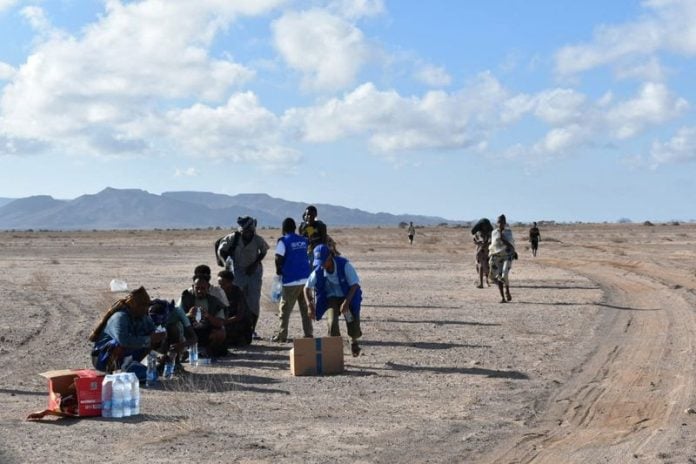
NAIROBI, Oct 11 (Reuters) – At least 139 migrants, including at least 15 children, have died and around 84 are missing after a boat carrying more than 300 people capsized while sailing from Djibouti to Yemen, the United Nations’ International Organization for Migration said on Sunday.
The boat, carrying 305 people, capsized near Guhere, north of Obock — a port town in Djibouti — during the night of October 8-9, the IOM said, citing survivor accounts.
Around 82 people survived the shipwreck, the statement said. A spokesperson for the Ethiopian government did not immediately respond to requests for comment.
Photographs shared by the UN agency showed worn-out sandals and sneakers washed up on the shore.
“Our teams are on the ground alongside local authorities to provide emergency assistance,” said IOM Chief of Mission in Djibouti Alexandre Coissac.
“This tragedy is a stark reminder of the dangers faced by migrants along this migration corridor as they seek economic opportunities,” Coissac said.
Djiboutian authorities are continuing search and rescue operations, the IOM statement said, adding that local authorities are also providing medical care to survivors and arranging burials for the deceased.
The Djibouti government could not be immediately reached for comment.
The migrants were heading to Yemen, with the hope of eventually making it to wealthier Gulf nations, even as Yemeni nationals themselves flee their country, which is experiencing the most serious escalation in fighting between Saudi Arabia-backed government forces and the Iran-backed Houthis since a UN-brokered truce in 2022.
“Despite the violence in Yemen, migrants are still making the perilous journeys hoping to make it to the Gulf countries,” the IOM statement said.
FIGHTING IN ETHIOPIA
Fighting has also broken out in Ethiopia since last month in the biggest escalation of violence since the 2020-2022 Tigray war.
An IOM official told Reuters that the UN agency had documented heavy migrant traffic along the so-called Eastern Route through Djibouti for several years.
“People continue to use the route amid changing conditions in Ethiopia and Yemen, although the volume and direction of movement can shift over time,” the official said.
Ethiopian migrants interviewed as part of the agency’s most recent situation report on Djibouti from September 20 to September 30 said they had left their country due to difficult living conditions, including the impact of drought.
“Some migrants also reported that they were fleeing conflict and forced recruitment by armed forces,” the report said.
Multiple residents of Tigray, where fighting erupted on September 23, have told Reuters that they had seen Tigrayan rebels forcibly recruit young men into the defence forces. The rebels have denied conducting forced recruitment.
The conflict has sparked fears of a return to all-out war with Ethiopia and Eritrea severing relations over alleged Eritrean support for the rebel alliance seeking to overthrow Ethiopia’s government. Eritrea has denied backing the alliance.
SEVERE RISKS
The so-called Eastern Route presents many dangers, including accidents at sea, trafficking and arbitrary arrests once on land. In 2025, more than 900 migrants died or went missing along the route, according to IOM’s Missing Migrants Project, as the number of people undertaking the journey increased by 18%.
IOM has described the crisis sparked by the fighting in Yemen as alarming, with displacement figures surging to 200,000 from 76,000 in mid-September, according to data released by the agency last week.
More than 3,700 people have fled Yemen by sea to Djibouti as of last week, it said.
(Reporting by Nethra Sailesh and Anusha Shah in Bengaluru and Ammu Kannampilly in Nairobi; Editing by Tomasz Janowski, Alexandra Hudson and Susan Fenton)
Disclaimer: This report is auto generated from the Reuters news service. ThePrint holds no responsibility for its content.