





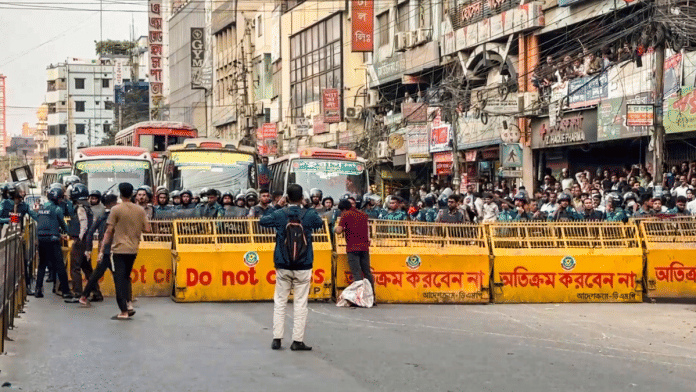



New Delhi: Bangladesh witnessed another round of anti-India protests Thursday, with agitators marching towards India’s mission in Rajshahi, forcing it to shut operations for the day, along with services at two visa centres.
This came a day after Bangladeshi politician and former student leader Hasnat Abdullah told a protest rally in Dhaka, “Once we win and reach Parliament, we will behead Delhi and send it back”.
Hasnat, a member of the National Citizen Party (NCP) which was formed by students who led the July 2024 uprising against the then Sheikh Hasina government, also accused India of harbouring the ousted prime minister, and alleged New Delhi was actively interfering in Bangladesh’s political transition.
Bangladesh has seen a series of protests by different student-led groups over the past few days, targeting Indian missions, with anti-India rhetoric being a key feature at these rallies ahead of the 12 February elections.
A protest on Wednesday, organised by July Oikya (July Unity), demanded the extradition of Sheikh Hasina and other fugitive Awami League leaders they believed were in India.
India summoned Bangladesh High Commissioner Riaz Hamidullah Wednesday and issued a strong demarche over the protests taking place against the Indian missions.
But the protests continued on Thursday too.
A group of agitators, under their July 36 Manch, marched towards the Indian consulate in Rajshahi, with national flags tied around their heads and raising anti-India slogans.
The march was called ‘March to Assistant Indian High Commission, Rajshahi’. It advanced toward the consulate in the Padma Residential Area, before police stopped protesters with barricades roughly 100 yards from the office, local media reported.
But, the demonstrators removed some barricades and staged a sit-in on Pragati Sarani, chanting slogans including “Follow Babar’s path, free the Seven Sisters”, essentially vowing to separate India’s northeast.
“In view of the on-going security situation, we wish to bring to your kind notice that IVAC Rajshahi and Khulna will be closed today (18.12.2025). All applicants who have appointment slots booked for submission today will be given a slot at a later date,” the Indian Visa Application Center (IVAC), Bangladesh, said in a note.
In his speech Wednesday, Hasnat had accused India of “training terrorists”, sheltering what he described as “30,000 Awami League workers,” and sending terrorists back into Bangladesh to “destabilise” the country.
“You shoot us at sight and expect us to salute you?” he asked. “If not with a bullet, we can resist with a stone. In order to have a friendly relationship, you have to respect our borders and our sovereignty.”
He then framed the confrontation as generational. “Through TV and popular media, a narrative has been created that made us believe we will always be dependent on India,” he said. “The younger generation will resist this.”
Invoking history, Hasnat referenced Muhammad bin Qasim, the Arab general who led the conquest of Sindh in the eighth century at the age of 17, and said if he could conquer India at such a young age, it is a lesson for all.
“There is a local and international agenda to stop us from reaching Parliament,” he said. “What happens if I die? People like me will rise from the streets. But once we win and reach Parliament, we will behead Delhi and send it back.”
Also Read: Bangladesh to hold ‘July Charter’ referendum, 1st election since Hasina’s ouster on 12 Feb
Politicising a shootout
The protests followed the shooting of Sharif Osman Hadi, a spokesperson for the Inqilab Mancha, and a prospective independent parliamentary candidate for Dhaka-8, shortly after election dates were announced. Some accounts in Bangladesh alleged the attackers fled to India, though no evidence has been presented publicly.
NCP convenor Nahid Islam described the shooting as symbolic. “With the bullet hitting Osman Hadi, the July Revolution has been attacked,” he said, claiming that the Awami League was operating from exile in New Delhi with New Delhi “backing” to regain influence in Bangladesh’s administration, police, universities and media.
Following a meeting with interim chief Muhammad Yunus, attended by opposition leaders and members of Hadi’s family, Islam warned that without a comprehensive resolution of the Awami League issue, “none of us will be safe”.
The Bangladesh foreign ministry subsequently urged India to prevent suspects linked to the shooting from crossing into Indian territory, and to arrest and extradite them if they already did.
India rejected the accusations. “India has never allowed its territory to be used for activities inimical to the interests of the friendly people of Bangladesh,” the Ministry of External Affairs (MEA) said.
(Edited by Ajeet Tiwari)
Also Read: Bangladesh student leader warns India—’will isolate Seven Sisters, give refuge to separatists’